
Venting a Gothic Revival Cottage Attic

In this weekly Q&A column, retired builder/building inspector Cam Allen answers readers’ home renovation questions. Have a question? Enter it in the form below.
If you are a steady reader of this column you know we are advising a couple on a “build our own home” passive assembly. We are also advising another younger couple on making a number of energy upgrades on a Gothic Revival cottage. Our company IT tech owns this classic home. Like many young couples today, they are blessed with two lovely young ladies, still at the preschool stage. It’s a balancing act between needs and costs so my upgrade
list pays close attention to the reality of a budget. Over this summer and fall at different intervals I will update their progress.
Just a brief description on what is known as a revival style home that was extremely popular in Eastern Canada from the mid 1800s until the 1930s. This basic design was also called the Ontario Gothic cottage or the Farmers cottage. It was promoted in a popular magazine of the era called the Canadian Farmer. They called it the ideal home for a small family in both rural and urban locations. This 1.5 storey design is recognizable by a steeply pitched roof and decorative gables, usually with bargeboard which gave the trademark “gingerbread” appearance. They were also recognized by large porches. At one point the design of the home was so popular the architectural plans were published in this periodical.
The roof design for many of these homes had exposed rafters with the space in between in-filled with wood or brick as a high percentage of these homes, utilizing either timber frame or balloon frame were finished in brick veneer. Some had their rafter tailings framed in later but the actual soffit space is very limited. Inside the home the second floor usually has two bedrooms and some later models had a gable dormer added for the luxury of indoor plumbing
and albeit small, a full bathroom.
I prepared a list of energy upgrades for this couple and it includes attic ventilation, which is not present right now. The previous owner had 16” of blown cellulose installed over the early mineral wool base that was laid in between the ceiling joists. With no functioning soffit vents they installed this insulation over the entire attic floor, tight to the roof decking.
Attic ventilation is simply a must for all homes with an attic space. The buildup of heat has a negative effect on the longevity of the roof coverings, this one is shingled. The other benefit is lowering energy costs by allowing built up heat to exhaust the home. It is a well documented fact that proper ventilation can save up to 15 percent of energy bills annually. The side benefit is this also means your heating and cooling equipment will not run as often, increasing their lifespan. This home has no air barrier and unless it was gutted back to the frame, it never will have so the conditioned air easily rises through the home and gets captured in the attic space. In the summer this captured heat cooks the shingles from the inside. This makes air conditioning less efficient and increases energy costs. In the winter this heat quickly becomes condensation on the cold roof frame causing mould and in advanced cases, wood rot. With a more uniform attic temperature this also allows better insulation performance.
I gave this attic a good look over from a nicely centred hatch and given its age, the wood frame looks quite stable. While there were some ice damming issues last winter, given the pitch of the roof it was not extreme.
Those of us in the sustainable building movement are fully aware of the concept of, “Seal it up tight and ventilate it right” and in new construction that can be achieved. But this is not a new home, there is not a new home budget and even the smallest of upgrades will help. Ridge vents, soffit vents, conventional roof vents, known as “mushroom vents” in the trades, make up over 90 percent of most home attic ventilation. When soffit venting is installed in conjunction with ridge venting it is about as effective a passive ventilation system as possible.

Get the Green Building Project Checklist
Use this handy checklist on your next project to keep track of all the ways you can make your home more energy-efficient and sustainable.
In the case of this home, that’s simply not accessible nor cost reasonable. The only option are gable vents and there are some negative opinions about the ability of cross flow gable venting. However, if gable vents are installed in the right location on the gable and kept clear of vegetation and any wind drive materials they are a good option. They must be installed as close to the peak
of the roof as possible. It is likely that there will be some gable framing in the way so some consideration as to the size of the gable vent is important. In fact, the sizing of the vent is the most critical part of a gable vent installation. The commonly accepted calculations for gable vents are 1 square foot of vent area for every 150 sq feet of attic floor space. Most gable vents range anywhere
from 18×24” to 24”x36”. As an example, a 1200 square foot home would require 8 square feet of total venting. Divided equally and assuming the attic has a clear path from one gable end to the other, each gable vent would be 4 square feet or 576 net square inches of free air flow area. A home like this one with a smaller attic, we are going to aim for vents in the range of 1.5 to 2 square feet of air flow capacity.
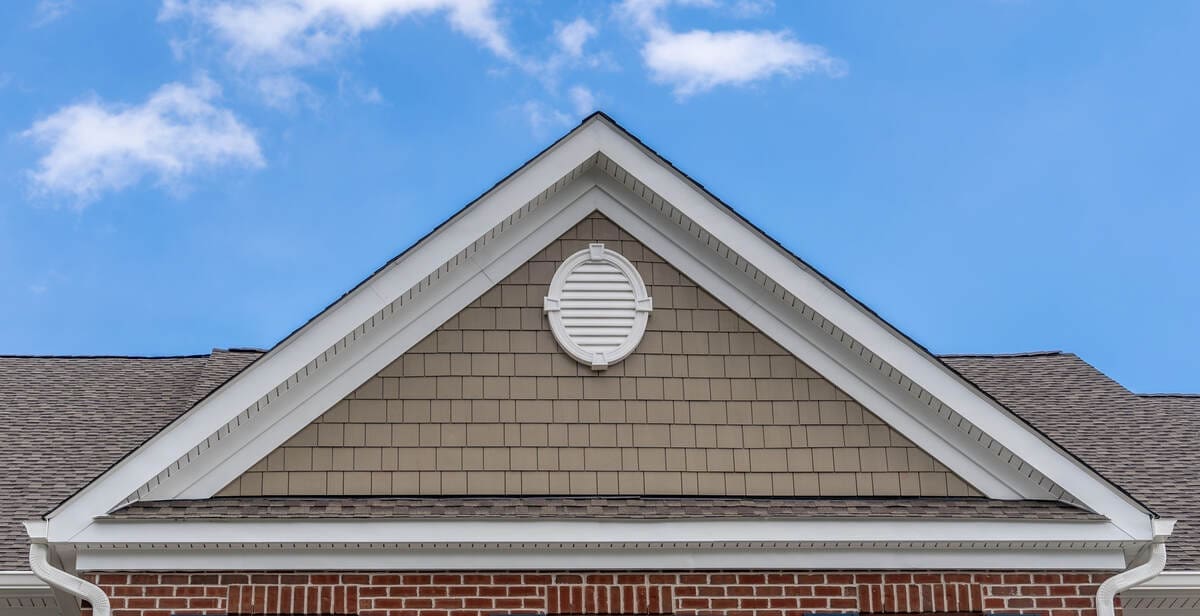
The one nice benefit with gable vents is their ability to improve the overall street appeal of the home. While rectangular vents are very popular, half round and circular vents soften the look of a linear gable with the half round or gothic style adding a touch of grace. Diamond shape, triangular and octagon shape vents add a symmetry to a home with steep, triangular like gables. While most gable vents are white, I have seen coloured models that can complement or add contrast to the street appeal of a home. Attic ventilation is a must and has so many benefits that affect the longevity and operation of a home, which is why this is the first step on the energy savings list for this young couple.
Images from Depositphotos
Have a Home Renovation Question?
Write it down below and we’ll get back to you. All questions get answered – every week, we’ll select one for publication in the column.


