
How Long Does Office Cleaning Take?


Quick Answer
Most offices are cleaned in 30 minutes to 3 hours per visit, and the spread comes from measured area instead of impressions. One cleaner covers roughly 390 m² of general office floor an hour, while washrooms run four times slower because they are timed fixture by fixture. Anyone pricing what is commercial cleaning should start from cleanable area rather than the gross figure on a lease.
A cleaning contract that looks competitive on paper often fails on the clock. Bids priced against gross floor area hand the crew less labour than the building needs, and the shortfall surfaces as skipped baseboards, half-finished washrooms and a quality complaint by the third week. Behind the familiar question of what is commercial cleaning supposed to cost sits a more useful one: how many productive hours were budgeted against the measured space.
The second question has a calculable answer, since published task-time standards convert cleanable area, fixture counts and soil load into labour before a contract is signed. That arithmetic is why well-scoped office cleaning services are priced from a site walk instead of a floor plan, with the schedule built backwards from what the building demands.
Commercial Cleaning Meaning, Measured in Minutes Per Task
A contracted office clean is a stack of timed tasks, each with a published duration. ISSA 612, the industry’s Cleaning Times and Tasks reference, sets standard times for more than 800 tasks in minutes per 1,000 square feet or per unit. Assign those tasks to each space, apply the frequency and the nightly labour falls out of the arithmetic.
Where the Minutes Come From

Get the Green Building Project Checklist
Use this handy checklist on your next project to keep track of all the ways you can make your home more energy-efficient and sustainable.
Coverage rates describe the area one worker services in an hour, and in practice they differ more than fourfold between open floor and washrooms:
General office floor – about 390 m²
Medical and dental rooms – about 204 m²
Washrooms – about 93 m², timed per toilet, sink and dispenser
Open warehouse floor – about 557 m²
Two suites of identical size finish well apart once their fixture counts diverge.
Equipment Changes the Published Rate
Machine choice moves an identical task into a different band. An upright vacuum with a 30 cm path covers about 208 m² in the same hour, while a backpack unit reaches roughly 676 m². A crew arriving with professional-grade equipment works to the faster figure, so the supply list belongs inside the scope of work.
Soil Load Moves the Baseline
Published rates assume light soiling and normal furniture density, however winter in a city like Calgary or Ottawa undoes both. Grit and de-icing residue tracked across entry matting during a freeze-thaw cycle add minutes to every floor task. The schedule holds only where walk-off matting is sized for the traffic it receives.
Commercial Cleaning vs Janitorial Services: Per-Visit and Per-Project Timing
The two labels describe different models, since recurring upkeep is costed per visit against coverage rates, while periodic work such as floor refinishing, carpet extraction, window washing and electrostatic disinfection is costed per occurrence. The distinction is a scheduling one before it is a service one.
How Each Model Is Timed
Set side by side, the two clocks separate cleanly.
| Timing factor | Recurring upkeep | Periodic project work |
| Labour derived from | Coverage rate per space type | Task duration per treated surface |
| Typical visit | 30 minutes to 3 hours | 2 hours for a small suite, up to 5 for 30 workstations |
| Frequency | Nightly, weekly or weekend | Quarterly, semi-annual or annual |
| Overrun risk | Soiling above the light-soil baseline | Equipment choice: a hand sprayer doubles an electric one’s minutes |
An hour missed in the left-hand column repeats every night of the contract.
The Measurement Most Bids Get Wrong
Labour is budgeted against cleanable area, which is always smaller than the gross figure on a lease. A site walk records what the coverage rate will actually be applied to:
- Serviced area only, with mechanical rooms and vacant suites deducted
- Fixture counts per washroom, charged by toilet, sink and dispenser
- Flooring split by type, since carpet and polished hard surfaces carry separate rates
- Entry points and matting runs, where tracked-in grit concentrates
Without a fixture inventory, the washroom line in any quote stays unverifiable.
Contact Time Cannot Be Compressed
Disinfectant labels specify a wet contact period the surface must hold before it is wiped. By contrast, that dwell ignores crew size, so a second worker on a washroom route shortens the wiping without shortening the waiting.
What Are Janitorial Services Doing Between Deep Cleans
Routine upkeep protects the published rate of everything above it. A floor held at the light-soil baseline cleans at its rated speed, while one left for two weeks carries ground-in grit that pushes later visits past their allotted minutes.
What a Skipped Night Costs the Next One
Soil accumulates faster than a rate card assumes. Two or three missed visits in a high-traffic corridor push the area off the light-soil assumption behind its benchmark, so the crew either runs over or leaves work behind.
Inspection Converts Scope Into Evidence
A per-visit inspection is the only record showing whether budgeted labour was spent as planned. A usable note carries five separate entries:
- Tasks completed by area, matched to the contracted frequency
- Washroom fixtures serviced, counted instead of estimated
- Time on site against the benchmark prediction
- Consumables restocked, by dispenser
- Deferrals, with the reason recorded the same night
Where the Schedule Absorbs Seasonal Load
Winter rewrites the arithmetic for several months. Meltwater and de-icing residue extend floor tasks across entry zones and main corridors. More often, providers answer with overnight, weekend and round-the-clock windows instead of a single fixed slot, and a route able to shift its sequence absorbs the extra minutes without reopening the contract.
Calculating Office Cleaning Time From Cleanable Area and Fixture Counts
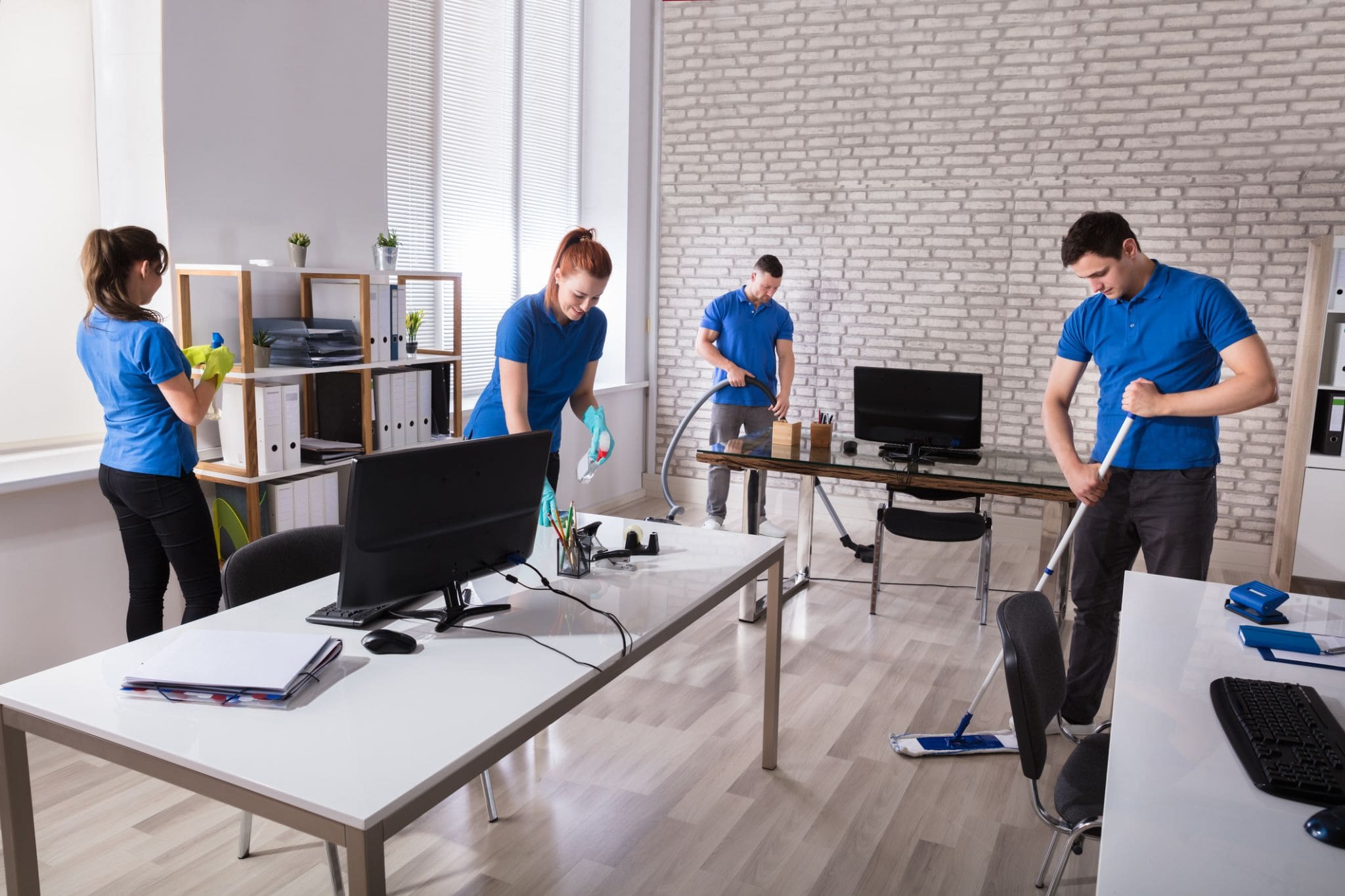
Every hour inside a cleaning contract is traceable. Cleanable area, fixture inventories, flooring types and soiling levels convert into minutes through published task standards.
Facility managers asking what commercial cleaning is going to require each night already hold the inputs, and those figures decide whether the crew finishes the route or leaves part of it.
Images from Depositphotos


