
What Bed Frame Fits a Queen Mattress?
6 Things to Check First


Buying a mattress and a bed frame separately sounds straightforward until they arrive and one of them doesn’t work with the other. A frame that’s too narrow leaves the mattress rocking over the edges. A frame built for a box spring sitting under a foam mattress with no rigid support causes it to sag within months. These are not edge cases. They’re the two most common outcomes when the frame gets treated as an afterthought.
The frame decision is worth working through before the mattress arrives, not after. If you’re still choosing the mattress itself, confirming the frame type first changes which options make sense: a queen mattress on a platform frame has different support requirements than the same size on a slatted frame with a centre rail. Here are six things to check before committing to either piece.
1. Confirming the Interior Dimensions, Not the Label
A queen mattress measures 60 inches wide by 80 inches long – that’s the standard across North America, and it does not vary between brands. What does vary is the interior dimension of the frame meant to hold it. A frame labelled “queen” should have an interior sleeping surface of 60 by 80 inches, but manufacturing tolerances and different design approaches mean the actual fit can land anywhere from snug to noticeably loose.
A gap of up to half an inch on each side is normal and gives you room to fit sheets without wrestling the mattress into a too-tight space. A gap of an inch or more on either side means the mattress will shift when you move in bed, and over time the edges will compress unevenly from hanging unsupported. Before buying, check the product specs for interior width and length, not just the label. If the listing only gives exterior dimensions, that’s worth querying before purchase.
2. Matching the Frame Type to Your Mattress

Get the Green Building Project Checklist
Use this handy checklist on your next project to keep track of all the ways you can make your home more energy-efficient and sustainable.
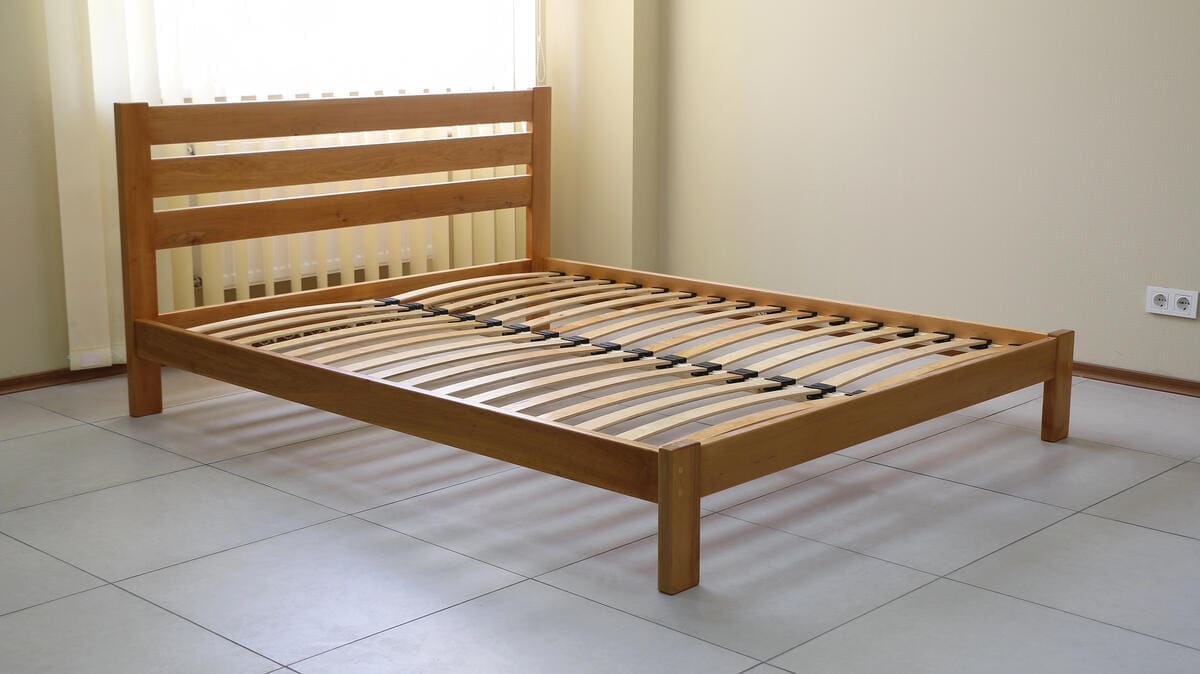
The support structure underneath your mattress matters as much as the mattress itself. Foam, latex and hybrid mattresses need a firm, evenly distributed base: either a solid platform deck or slats spaced no more than three inches apart. Wider gaps let the foam compress downward between the slats, which creates a corrugated surface you’ll feel through the mattress within a few months. Traditional innerspring mattresses tolerate wider slat spacing better because the spring unit distributes the load across the whole surface, but they still benefit from a centre rail on a queen frame.
The table below gives a quick reference for matching frame type to mattress and room context.
Queen Bed Frame Types: Support, Height and Best Use
| Frame type | Height off floor | Slat / support | Best for |
| Platform (low profile) | 6–10 in | Solid or slatted deck | Modern look; no box spring needed |
| Standard with slats | 12–16 in | Slatted; slats ≤3 in apart | Most mattresses; good under-bed storage |
| Storage bed / ottoman | 14–18 in | Solid lift-up base | Small rooms needing extra storage |
| Metal box-spring frame | 7–9 in | Requires box spring | Traditional spring mattresses only |
| Upholstered panel bed | 12–18 in (varies) | Slatted or centre rail | Bedrooms where the frame is a focal point |
| Adjustable base | 12–18 in (motorized) | Solid articulated deck | Foam or latex mattresses; medical need |
3. Checking Whether You Need a Box Spring or Not
Box springs were designed to work with traditional coil mattresses – the two together created a system where the spring unit in the box spring absorbed some of the load and allowed the mattress coils to work through their full range of motion. Most modern mattresses, including foam, latex and hybrid types, are not designed for that kind of articulated base. Placing a foam mattress on a box spring can void the warranty, because the manufacturer specifies a rigid, flat surface rather than a flexible one.
If the frame you’re considering is described as a “metal frame” or “rail frame” with a centre support bar but no deck or slats, it’s built to hold a box spring rather than a mattress directly. Using it without a box spring means the mattress has support only at its perimeter and at one centre point, which is not sufficient for 80 inches of unsupported length. Check the frame’s product description for the phrase “box spring required” or “compatible with platform base” before assuming it suits your mattress type.
4. Measuring the Room for Clearance
A queen frame typically runs 64 to 66 inches wide once the outer frame rails are included, and 84 to 86 inches long. In a room where the bed sits against one wall with access from three sides, you need at least 24 inches of clearance on each walkable side (30 to 36 inches is more comfortable if two people are navigating the room at the same time). Running the numbers before the frame arrives is the step most people skip, and it’s the reason so many bedrooms end up with a bed that feels as though it was dropped in from a crane.
Door swing is the other measurement that matters. A queen frame disassembled into its rails and headboard will fit through most standard 32-inch interior doors, but some upholstered panel beds ship partially assembled with a headboard that won’t clear a narrow hallway. If your bedroom access involves a turn – particularly a 90-degree corner in a corridor under 36 inches wide – get the unboxed dimensions from the retailer before delivery day.
5. Deciding on Frame Height
Frame height, measured from the floor to the top of the sleeping surface, affects the room in two ways: how the bed reads visually and how easy it is to get in and out. A platform frame sitting six to ten inches off the floor keeps the visual weight of the bed low and suits rooms with lower ceilings or a minimal aesthetic. A standard slatted frame at twelve to sixteen inches reads as more traditional and leaves useful under-bed storage clearance – roughly 12 inches of usable height is the threshold at which standard storage bins and flat underbed boxes actually fit.
For most adults, a finished bed height of 24 to 27 inches from floor to top of mattress is comfortable: close to the height of a standard chair seat, which means sitting and standing don’t require much effort. A very low platform frame paired with a thick mattress can still hit that range, while a tall frame with a thinner mattress might fall short of it. Add your mattress height to the frame’s deck height before buying, and you’ll know the finished sleeping height before anything is delivered.
6. Accounting for Headboard Compatibility
Headboards attach to bed frames in one of two ways: they bolt directly to the frame’s headboard brackets, or they are freestanding and simply rest against the wall behind the frame. Frames with headboard brackets use a standard bolt pattern (typically two bolts set 24 inches apart for a queen, at heights of roughly 18 and 25 inches from the floor) but not every headboard is compatible with every frame’s bracket position. If you’re buying a headboard separately, confirm the bracket spacing before assuming they’ll line up.
Upholstered panel beds typically come with the headboard integrated or included as a matched piece, which removes the compatibility question but limits your options if you want to change the headboard later. A frame with standard brackets gives you more flexibility over time: you can swap in a different headboard without replacing the whole base. If the headboard is the visual anchor of the room, it’s worth treating it as a separate decision from the frame rather than defaulting to whatever comes bundled.
Pulling It Together

The frame and mattress need to work as a pair, and that pairing starts with a handful of concrete checks: interior dimensions, slat spacing, box spring requirements, room clearance, finished bed height and headboard attachment. None of those takes more than ten minutes to verify against the product specs, and each one is the kind of detail that causes a return or a poor night’s sleep if it’s skipped. Get the frame right first, and the mattress decision becomes considerably simpler.
Mattress and Frame FAQ
What size bed frame do I need for a queen mattress?
You need a frame with an interior sleeping surface of 60 by 80 inches, which is the standard queen mattress dimension. Allow up to half an inch of clearance on each side for easy sheet fitting. Always check the interior dimension in the product specs, not just the frame label, since exterior measurements include the outer rails and will run larger.
Can I put a queen mattress on a full-size frame?
No. A full-size frame has an interior of 54 by 75 inches, which is six inches narrower and five inches shorter than a queen mattress. The mattress will overhang on all sides and will lack proper support at the edges, causing premature breakdown of the foam or spring perimeter.
Do I need a box spring with a queen bed frame?
It depends on the frame. Platform frames and slatted frames with slats no more than three inches apart do not require a box spring. Foam, latex and hybrid mattresses are designed to go directly on that type of surface. Metal rail frames built to hold a box spring do require one, and using a modern mattress on them without a box spring leaves the mattress without adequate centre support.
How much space should I leave around a queen bed?
Allow at least 24 inches of clear walkway on each side of the bed that needs foot traffic. If two people use the room and both sides of the bed are frequently accessed, 30 to 36 inches per side is more practical. At the foot of the bed, 24 inches minimum keeps the room from feeling blocked, with 36 inches preferred if there’s a dresser or wardrobe opposite.
What is the standard height of a queen bed frame?
Most queen frames place the deck (the surface the mattress rests on) at 7 to 18 inches off the floor depending on the style. Add your mattress thickness to get the finished bed height. A total of 24 to 27 inches from floor to top of mattress is the comfortable sitting range for most adults, roughly equivalent to a standard chair seat height.
Once the frame type, dimensions and support requirements are settled, choosing the right queen mattress becomes a much more focused decision: you’ll know exactly what base you’re working with and can match the mattress construction to it rather than hoping the two are compatible after delivery.
Images from Depositphotos


