
How Thermal Cameras Detect Heat Loss, Air Leaks and Building Problems

In this weekly Q&A column, retired builder/building inspector Cam Allen answers readers’ home renovation questions. Have a question? Enter it in the form below.

Thermal imaging technology is one of the greatest advancements in building energy efficiency. While this technology did not surface in the building environment until the late 90s to early 2000s, the actual technology goes back into the 1800s when infrared radiation was discovered during experiments with sunlight and thermometers. In 1929 the first infrared cameras were built for military use, mainly anti-aircraft detection. By WW2 they had advanced significantly to where they were used to detect enemy troops at night. The US Army used this technology extensively during the Vietnam war. The early models were very bulky. By the late 50s the development of FLIR (forward-looking infrared technology) was developed and over time with modern electronic advancements, these thermal cameras became smaller and more accurate. By the 1980s Thermal Imaging (TI) Cameras became a compact hand held instrument. Firefighters, rescue squads, medical testing (mammograms being one use) and building inspection were all beginning to use this technology.
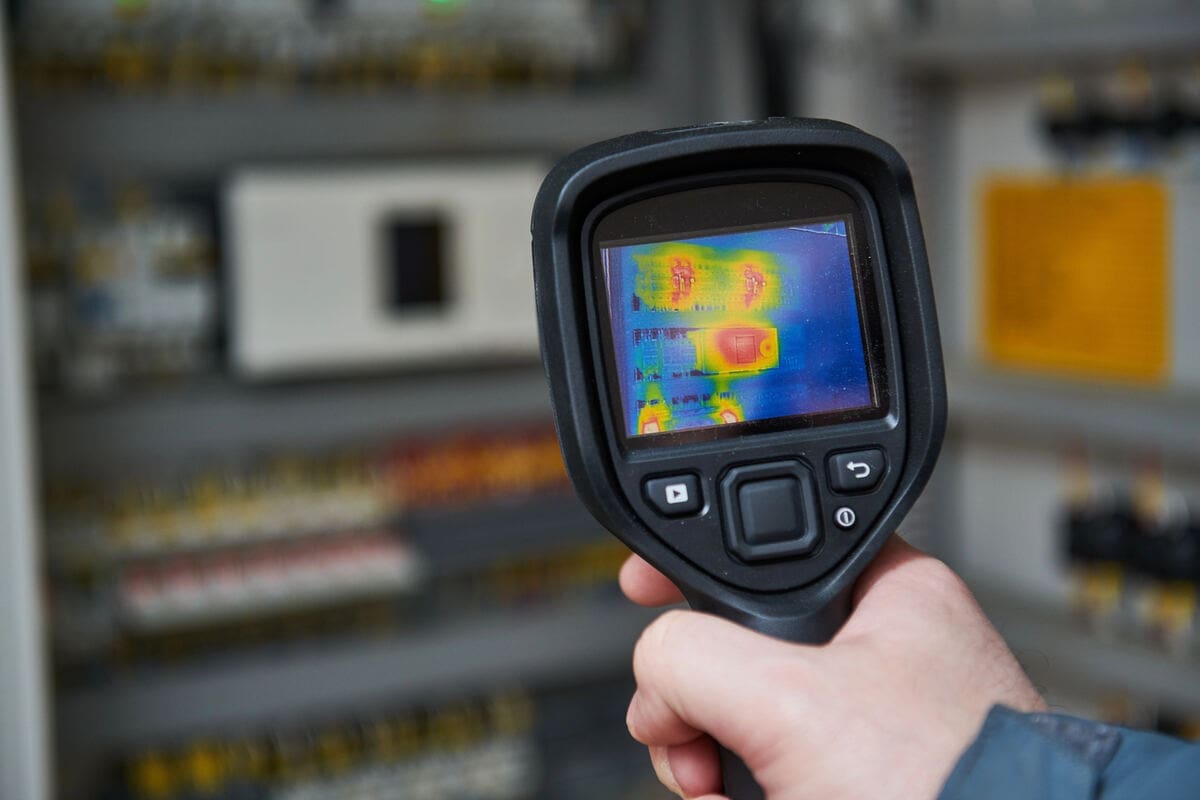
Thermal imaging detects radiation which is emitted by all objects with a temperature above the freezing point. The camera’s sensors measure this energy and assign a temperature to it which is transferred to a colour palette in the screen of the camera. By detecting and measuring the infrared radiation emitted by an object, thermography can create an accurate temperature distribution map or thermogram revealing variations in temperature that are usually invisible to the human eye.
During the period when we were building, inspecting and doing energy assessments, at one point we had three of these cameras and found them irreplaceable for most building investigations. We were not only called to homes with issues, large companies called when they had a motor on a machine acting up. The cameras are able to detect overheating bearings and components. The roofing industry, specifically roofers who worked on rubber membrane flat roofs, found that a skilled TI Tech and a good camera could find leaks in seams and joints not visible to the human eye.
In a home, the list of conditions that a TI camera can detect is extensive. We used them to find air loss in forced air ducting. It’s a well documented fact that metal ducting, not properly fitted and sealed, leaks upwards of 25 percent of the conditioned air in the system. This can translate into considerable heating and cooling energy savings when these leaks are found and corrected. We were often called by electrical contractors for a home electrical panel inspection. The TI camera quickly found any breakers that were defective or wall plugs and light switches that were worn and overheating. It was especially useful in a home with aluminum wiring as this kind of wiring was notorious for overheating at the connections. The simple fact that this technology is not invasive, this helps reduces search and find time to a minimum.
Now, with respect to a home and other than the benefits already noted, a TI camera in the hands of a skilled operator can save hundreds if not thousands of dollars and time finding water invasion, air leaks and insulation gaps which helps improve energy efficiency and prevent long-term structural damage. Companies that do energy evaluation often offer this service within a blower door test and report. Some TI operators offer basic energy loss evaluations to help the average homeowner find out where their hard-earned dollars are leaking out of the home. We used to do this type of inspection and we did a report with floor plan drawings to show the homeowner where the issues that the camera found were located. A common inspection starts in the basement of the home and the sill plate on top of the foundation are notorious for air
leakage. Next are all the openings around any exterior ducting like your dryer vent or side wall vents from a modern gas furnace or boiler. Windows were all checked in the basement. Often the client had some concern with water invasion and with a finished basement a good TI camera can reduce the area to be exposed where water invasion may be an issue. One thing I will note here, TI cameras have limitations and if you have a finished basement that
is drywalled on wood studs attached to a concrete or block basement the TI tech is limited in his or her evaluation as unless the dampness or water has stained the wood or drywall it will considerably limit the cameras effectiveness and ability to accurately locate the leak. In a case like this if the homeowner has cleaned up some water invasion, an experienced TI camera operator can sometimes arrive at a parameter of where the camera shows minute temperature changes.
Where TI cameras are really effective is around windows and doors and any area in the exterior walls of a home where insulation is missing or not properly installed. This investigative process can take time and all of our cameras were fitted with a digital option where we took an actual picture of any major area so the homeowner could follow up with a professional trade to repair or
reinsulate the defective area.

Get the Green Building Project Checklist
Use this handy checklist on your next project to keep track of all the ways you can make your home more energy-efficient and sustainable.
The recent earthquakes in Venezuela were a heartbreaking disaster and it appears the scope of loss of human life is far from over. The search and rescue teams from around the world that responded to this would all have very accurate thermal imaging cameras. The heat from a human body offers a wide thermal image for the rescue teams to help locate anyone trapped under the
rubble. Rescue helicopters are often equipped with this technology.
TI technology has saved thousands of lives since its invention. We always recommend an energy evaluation including a blower door test as the first step to upgrading a home. If the company you are considering also offers a thermal imaging inspection I would strongly recommend adding this to your overall home review. My only recommendation is if you elect to do this, make sure the TI Tech is FLIR certified. I have seen numerous cases where home inspectors simply buy the TI camera, take a quick 2 or 3 hour online course and hang out the shingle stating they are qualified for thermal imaging work. It will save you both in time and money as you upgrade your home, improving its energy efficiency.
Images from Depositphotos
Have a Home Renovation Question?
Write it down below and we’ll get back to you. All questions get answered – every week, we’ll select one for publication in the column.


