SPONSORED CONTENT
What Can You Power with a Solar Generator at Home?
Brought to you by Bluetti

Published: Jan. 18, 2025
Power outages have the unnerving ability to time their arrival at the most inopportune moments. The soufflé quietly collapses as you stumble around, looking for a flashlight or the promises of the power returning lose their credibility as the freezer contents slowly blend with newfound fluidity.
Around this time, one might be thinking about getting a generator to avoid future power outages, and then the inevitable question arises regarding what size generator is required to run the fridge and freezer.
Once the fridge and freezer are taken care of, other appliances can be added. Here, we will be discussing generator sizing. Just how much generator you need to keep the fridge and freezer happily running and what other appliances can be added for what amount of power.
How to Find the Power Requirements for your Refrigerator and Freezer
Usually, the appliance’s power consumption (in watts or kilowatts) is given on a label on the back of the unit. However, the unit’s energy consumption is more useful, and you can easily calculate it by multiplying the number of hours the unit runs by the power rating. This will give you a figure in kWh, but remember that refrigerators and freezers do not run 24 hours a day, so you will need to estimate how many hours the unit runs in a day.
Finding the correct-sized gas generator to run your fridge and freezer is easy because the gas generator will provide sufficient power as long as there is enough gas to keep it running; however, with a solar generator, the amount of time that the batteries can provide enough power to keep your food cool or frozen is of fundamental importance.
Get the Green Building Project Checklist
Use this handy checklist on your next project to keep track of all the ways you can make your home more energy-efficient and sustainable.
Let’s consider a simplistic but typical example to see how long a solar generator like the Bluetti AC200P will keep your fridge/freezer running. You can replace the numbers given with those applicable to your specific circumstances.
This model can provide 2000W of power and also handle a 4800W surge, so switching on your unit is no problem for this solar generator.
For this exercise, I’m going to ignore the effect of opening the fridge/ freezer door, so please bear that in mind. Frequent opening of the doors will reduce the run-time the solar generator will supply.
To establish the maximum run time of the fridge, the following formula is used:
Fridge run time = Battery capacity divided by the fridge Amp-hours.
The average domestic fridge/freezer combination uses 25-75 Ah per day, so let’s be generous and give it 100 Ah daily.
The Bluetti solar generator is rated as 2000Wh, which will provide 166Ah. So, by dividing the battery capacity by the fridge’s daily consumption, we get 166Ah/100Ah, which gives us an answer of 1.66 days.
But there is one element of this equation that you also need to consider: the fridge/freezer doesn’t run all the time. Perhaps you are good at restricting the time the fridge door remains open, and at night, the fridge will only run part of the time. For our calculation and to keep things simple, let’s say that the fridge runs 50 percent of the time. Then, the actual run time of the solar generator is three days, but be cautious as the inverter required to change the DC voltage to AC will also consume some power, so to be safe, you can rely on the solar generator to keep your food cold or frozen for at least two days minimum.
How Long Will a Solar Generator Power Various Other Appliances?
CPAP machines use between 60 to 90 watts of power when the humidifier is not in use, and a 100Ah lithium battery typically powers them for three periods of 8 hours before recharging. However, when the humidifier is used, the consumption does increase substantially.
As a comparative guide, consider the following length of time a battery will power these appliances:
CPAP machine – 24 hours
TV (43 inch) – 9 hours
Microwave – 1 hour 15 minutes
Coffee maker – 1 hour
How to Power a Well Pump Using a Solar Generator
As most industrial and larger domestic well pumps run on AC power, you need an inverter to convert the batteries’ DC voltage to AC. The inverter must also be big enough to handle the well pump’s starting surge.
As a rough guide, using an inverter that can operate at least twice the pump’s power rating is better.
For example, a 2 HP well pump operating with 240V and 10 amps will run at 2400 Wh, requiring four 12v 100 Ah lithium batteries to pump 75 litres per minute. This amount of battery power required is substantially reduced by introducing a holding or pressurized tank, allowing the well pump to operate for a fraction of the time.
Common Domestic Appliances and Their Power Requirements
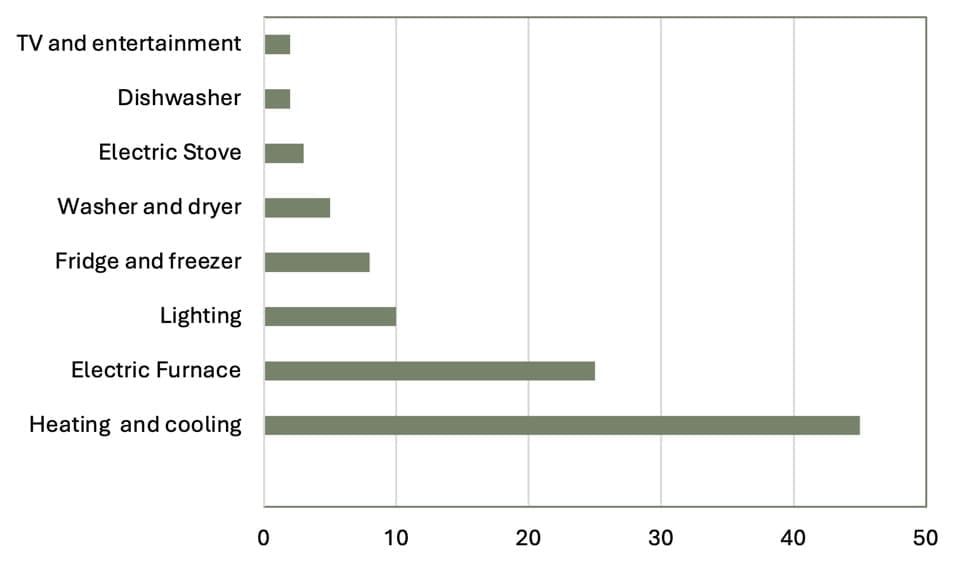
A typical household power consumption for common appliances shows the dominance of heating and cooling requirements for Canadian climatic conditions.
Percent of Total Usage
Heat pumps and Air Conditioners
Factors like the type of building and its insulation characteristics, internal and external temperatures and the heat pump’s size significantly influence the power requirements. Consequently, the range of power utilization is broad, and for guidance, HSPF (Heating Seasonal Performance Factor) and SEER (Seasonal Energy Efficiency Ratio) ratings indicate the unit’s efficiency for heating and cooling, respectively.
Heat pumps and air conditioners draw a lot of power. Air conditioner units and minisplits may only consume 5 to 10 kWh per day but large whole home heat pump systems could take upwards of 50 to 100 kWh a day.
Electric Stove
As a general guide, using an electric stove will consume about 1kWh, but this depends on the heat settings used in the cooking process.
Electric room heater
Electric space heaters consume on average between 500 and 1,500 watts depending on the size and setting. Keeping the heater on for a day will consume around 12kWh.
Electric Furnace
The power consumption of an electric furnace depends on several factors, including:
- Furnace size
- Home insulation
- Climate and weather
- Usage patterns
The typical power consumption of an electric furnace ranges between 10 kW to 50 kW per day.
Electric Fans
Electric fans are relatively low-energy consumers. Smaller fans operating at moderate speeds use 20 watts, while larger fans require up to 100 watts of power. Ceiling fans are generally more efficient than box-type fans.
Indicative Power Requirements for Domestic Appliances
| Lower Range (W) | Upper Range (W) | |
|---|---|---|
| Ceiling Fan | 20 | 100 |
| Heat Pump 2-ton | 1,000 | 1,700 |
| Air Conditioner | 3,000 | 3,500 |
| Electric Stove | 1,000 | 5,000 |
| Room Electric Heater | 500 | 2,000 |
| Electric Furnace | 10,000 | 50,000 |
Average Home Power Consumption
A typical Canadian home of 2,500 square feet uses between 11,000 – 12,000 kWh annually, while a smaller house of around 1,000 sq feet consumes between 6,000 and 10,000 kWh.
A solar generator system that can produce between 6kW and 10kW of power is required to provide sufficient power to run the larger house.
Solar generators are preferred for keeping homes powered up during power failures because they operate silently, do not produce dangerous fumes, and do not pose fire hazards. To give an idea of what size backup solution you would need for your household, listed below are various Bluetti models for different home sizing scenarios.
Choosing the Right Home Backup Solution for Your Household Size?
Small Households
You could look for something in the range of 2kWh capacity. The Bluetti AC200L + B300K Home Battery Backup works well for this situation as it provides 2,400 W output, surging to 3,600 W in Power Lifting Mode, keeping essential appliances like fridges and space heaters running. It’s able to power a 200 W fridge for up to 8.5 hours. Adding on the B300K battery backup provides additional power so you can run devices like your computer or TV. It charges from 0-80% in 45 minutes.
Medium-sized Households
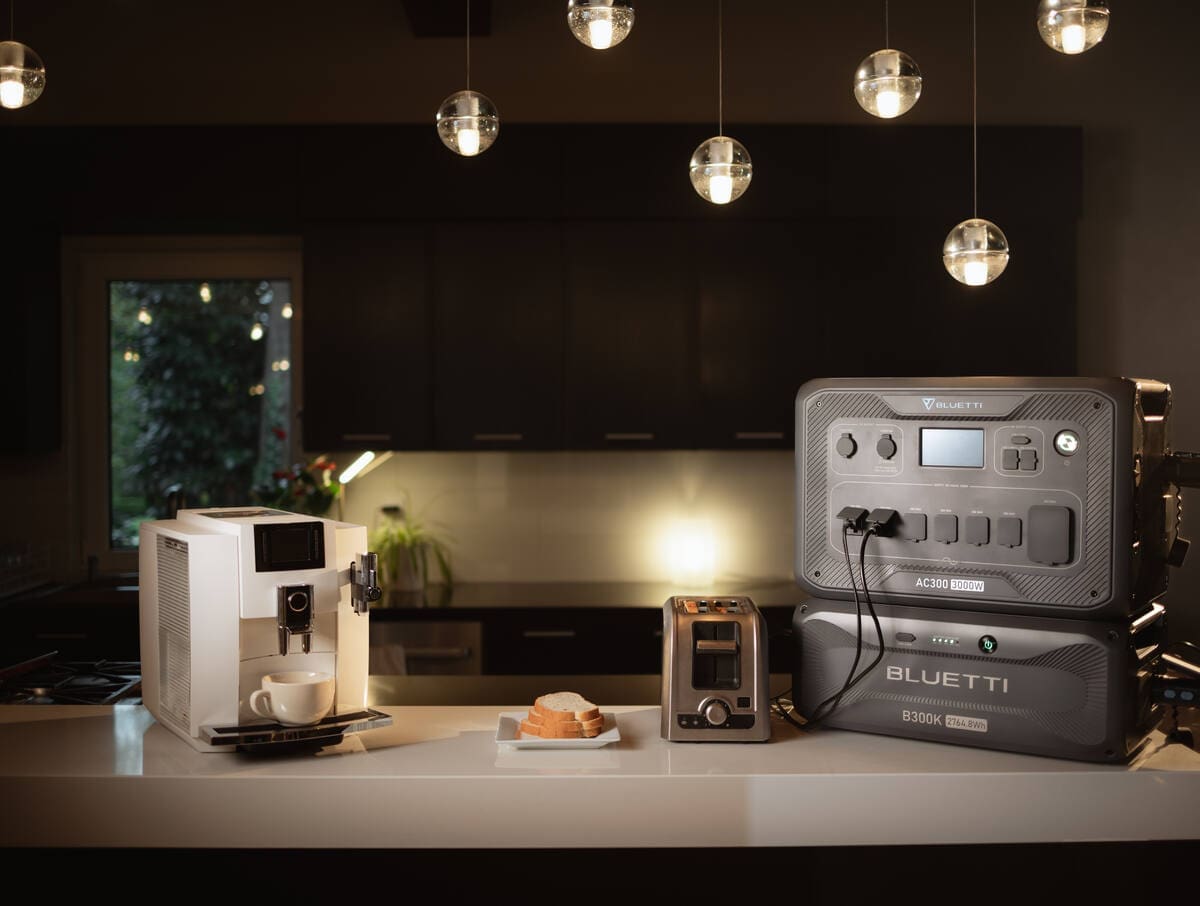
To keep the lights on during a power outage, the Bluetti AC300 + B300K is a good choice for this size household. This combination gives you 3,000 W of power and 2,764.8 Wh of capacity, enough to power an 8,100 BTU air conditioner for approximately one hour.
Large Households
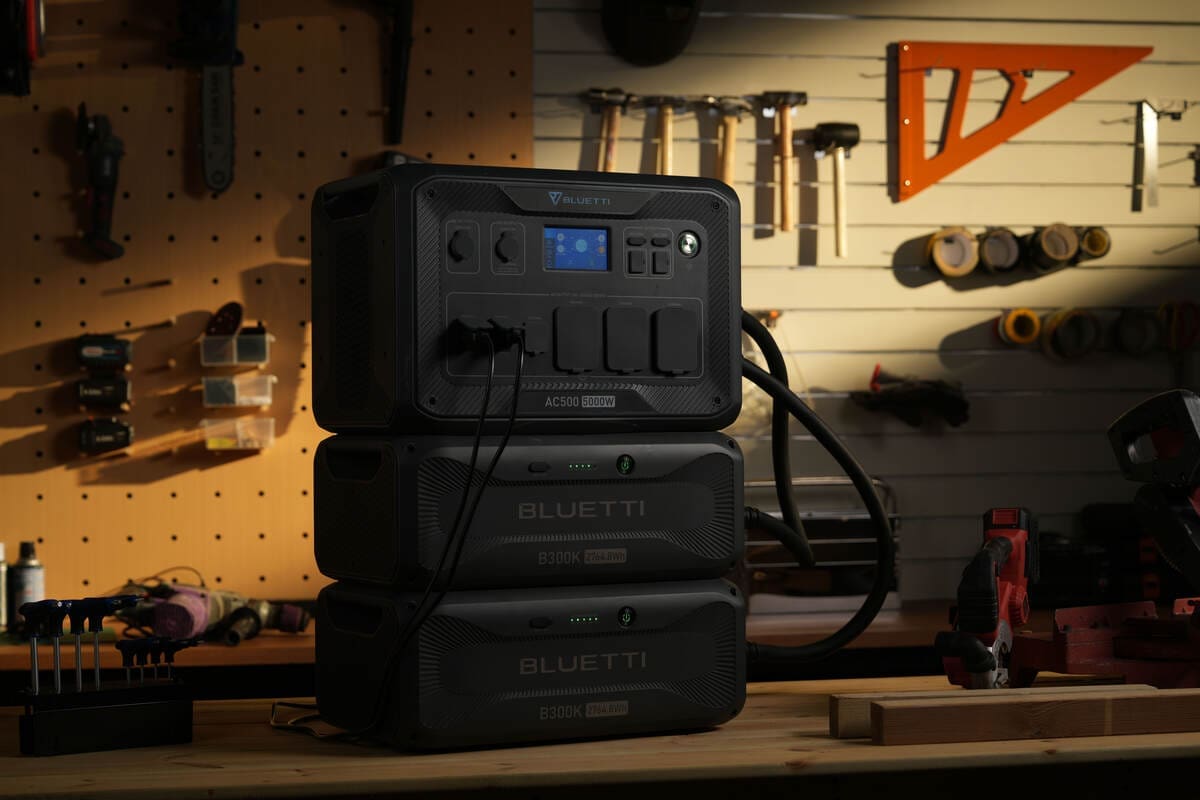
With a larger home comes greater power requirements. The Bluetti AC500 + 2*B300K provides just that. With 5,000 W running power and 10,000 W surge, this system can handle most household appliances, like water heaters and space heaters so you’ll still have comforts like hot water and heating during an outage.
Bluetti is offering an extra 5 percent discount if you use the following code: Green5off