
President Trump’s plan to impose 25 percent tariffs on imports from Canada has sparked significant concern in Canada, though it would also have an impact on American businesses, including construction since Canada is a major supplier of building materials like softwood lumber, steel and aluminum to the U.S.
The potential tariffs threaten to disrupt established supply chains, increase costs and create economic challenges for businesses on both sides of the border. Here we assess the impact the proposed tariffs would have on the construction industries in both countries.
Check out our Buy Canadian: Building Supplies Guide to find Canadian alternatives to American products that are subject to the 25 percent counter-tariff
In this article:
Recap of the Latest Tariff News (Feb. 6, 2025)
Trump Announces 30-Day Pause on Tariffs for Canada and Mexico
President Donald Trump has temporarily paused the imposition of 25 percent tariffs on Canada and Mexico, announcing a 30-day grace period following high-stakes negotiations with leaders from both nations.

Get the Green Building Project Checklist
Use this handy checklist on your next project to keep track of all the ways you can make your home more energy-efficient and sustainable.
This move comes amid growing concerns over escalating trade tensions, with Trump citing commitments from Canadian Prime Minister Justin Trudeau and Mexican President Claudia Sheinbaum to address fentanyl trafficking and border security as key factors behind the decision.
While this pause may signal a shift in Trump’s aggressive trade policies, it has left analysts speculating whether the tariffs will be shelved altogether.
The president’s tone suggests a potential climbdown, though the situation remains fluid. Economists caution that while the delay offers temporary relief, the threat of tariffs continues to loom large, leaving both trade partners and global markets on edge.
As Trump eyes further negotiations, including with China, the 30-day pause introduces a sense of cautious optimism. However, only time will tell if this marks a lasting reprieve or just a temporary concession.
Canada Agrees to Pause Retaliatory Tariffs in Return
In response, Canada agreed to suspend its proposed tariffs on U.S. goods after reaching a temporary agreement with President Trump. The suspension aims to provide time for negotiations and avoid immediate economic strain on industries reliant on cross-border trade.
However, if the dispute is not resolved, the proposed tariffs could have significant consequences for both the Canadian and American construction industries as well as both countries’ economies in general.
Potential Impact of Canadian Tariffs on US Goods on Canada’s Construction Industry
Canada’s proposed retaliatory tariffs on U.S. goods, initially set to take effect on Feb. 4 before the 30-day pause was agreed upon, target a wide array of products crucial to the Canadian construction and manufacturing sectors.
The list includes raw materials and construction essentials such as structural timber, plywood, particleboard, fibreboard, shingles, posts, beams and engineered wood products. Other materials include plastic wall, floor and ceiling coverings, as well as fixtures like doors, windows and blinds, along with lighting components and large storage tanks. Find the full list of Canada’s proposed tariffs here.
These tariffs, proposed in response to the U.S. administration’s 25 percent levy on Canadian goods, could have significant ripple effects throughout Canada’s construction industry.
For projects heavily reliant on U.S. imports, the increased costs of raw materials and components would delay timelines and raise overall project expenses. These measures could exacerbate existing challenges in the industry, such as the ongoing housing crisis and infrastructure backlogs. This uncertainty could deter Canadian construction firms from investing in large-scale projects, as developers may delay or cancel plans due to rising material costs and shrinking profit margins.
Furthermore, the potential tariffs could encourage a shift towards sourcing materials domestically or from alternative international suppliers. While this might reduce reliance on U.S. imports, it could also disrupt established supply chains and increase procurement costs in the short term. For Canadian businesses, these tariffs could strain operations by reducing access to affordable U.S. goods while increasing competition for locally sourced materials.
Potential Impact of US Tariffs: Rising Material Costs and Supply Chain Disruptions

If the U.S. followed through on their threat, their proposed tariffs would cause sharp increases in the cost of exporting materials to the U.S., such as softwood lumber, reducing demand and leaving Canadian suppliers with excess inventory.
In the U.S., tariffs would result in higher material costs, which would inflate project budgets and cause delays or cancellations, particularly for public infrastructure projects. Contractors will struggle to absorb these cost increases, potentially rendering many projects financially unviable.
Tariffs also slow down construction as builders struggle to source products elsewhere and deal with logistical challenges and inferior material quality. If continuing to import from Canada, the tariffs could still lead to delays as the importation process often slows down as a result of them.
The dual impact of rising costs and slowdown in construction will only further exacerbate the housing crisis in the U.S.
Interesting to note is that although President Trump’s proposed tariffs are designed to strengthen the U.S. economy, the result is predicted to be the opposite, with one glaring example being the U.S. housing market. Analysts predict that if Trump were to impose the 25 percent tariffs on Canada, the cost of building a typical home in the U.S. would rise by as much as $29,000.
Competitive Challenges for Canadian and American Firms Due to US Tariffs
The tariffs could make Canadian suppliers less competitive in the U.S. market as their goods become significantly more expensive compared to American-made alternatives. This may force smaller companies out of the U.S. market entirely, reducing cross-border collaborations and revenue streams. While firms could shift trade to other countries or focus more on the local market, it is unlikely to offset the broader financial strain caused by the trade policy.
With diminished demand from U.S. markets, Canadian suppliers would be left with excess inventory and financial strain. While an initial oversupply could lower material prices in the short term, producers may respond by cutting back on production, potentially driving up costs in the long run.
To adapt, Canadian businesses might look to diversify their markets, targeting Europe or Asia to reduce reliance on U.S. demand.
Meanwhile, U.S. contractors may prioritize local suppliers or import from other countries to offset tariff-related costs. The first of those options could boost local industries, though they could have a problem scaling to meet the large demand of materials. Both strategies would require time and investment, leaving firms vulnerable to economic strain and operational challenges in the short term.
U.S. tariffs on Canadian softwood lumber have led to mill closures and job losses in Canada as well as a consequent increase in construction costs in the U.S. “During Trump’s first term, tariffs on Canadian softwood lumber led to a surge in costs for homebuilders. Back in 2018, the NAHB estimated that the tariffs added nearly $9,000 to the cost of constructing a single-family home,” as reported in HousingWire. “The impact on lumber prices was dramatic, with costs rising close to 80 percent year over year, in part due to the taxes.”
The Impact of Tariffs on the Canadian Dollar and The Consequent Effect on Canadian Construction
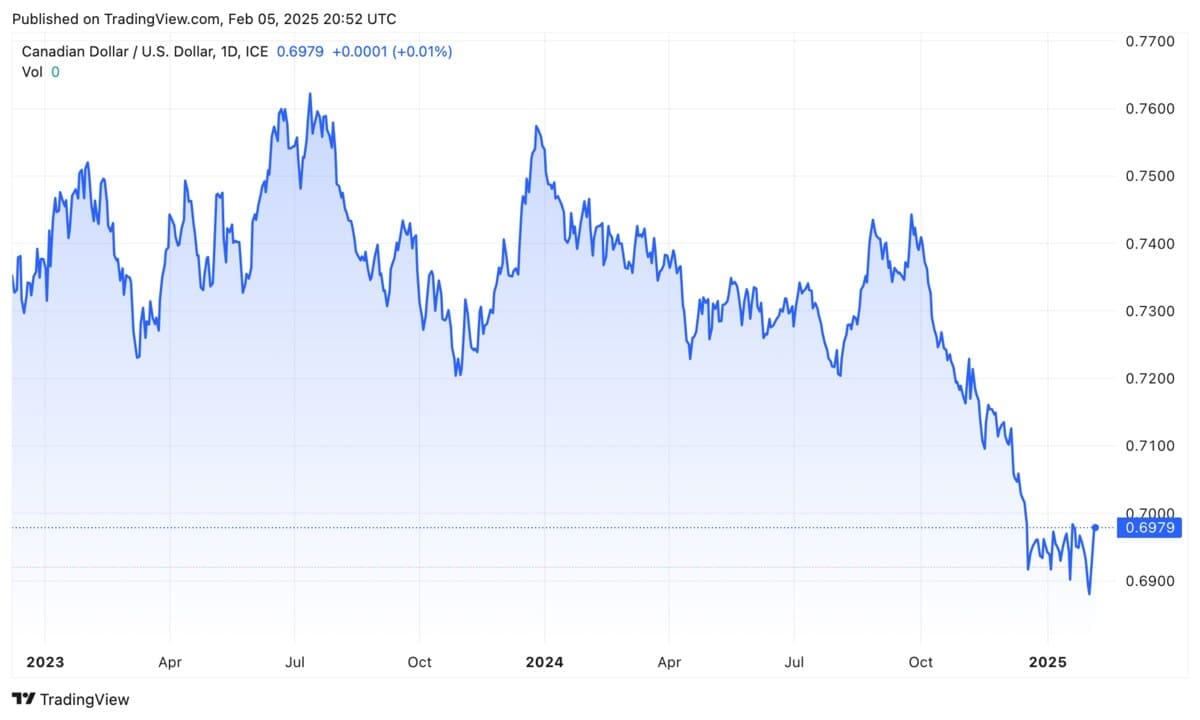
The threat of tariffs from the United States has caused significant volatility in the currency markets since October, with the Canadian dollar (CAD) experiencing a sharp depreciation against the U.S. dollar (USD), hitting a low of $0.68 after the U.S. tariffs were announced last weekend before raising a notch to $0.69 after the deal to temporarily halt tariffs was reached.
Analysts suggest that the USD/CAD exchange rate could climb to 1.50 in the short term if tensions escalate. This weakening of the CAD makes U.S. imports more expensive, further exacerbating challenges for Canadian industries that rely on American materials.
For the construction industry, a depreciated CAD translates into higher costs for imported U.S. goods such as timber and steel. This could significantly inflate project budgets, delay timelines and strain already tight margins, particularly in housing and infrastructure construction. Smaller firms may struggle to absorb these costs, leading to potential project cancellations or slowdowns.
The expected volatility in the CAD also creates uncertainty for long-term planning and investment. Developers and contractors may hesitate to commit to large-scale projects, given the fluctuating costs of materials and labour. This volatility and uncertainty is expected to continue as long as the threat of tariffs loom.
Despite the massive upheaval of the past week, there’s a good chance that all this talk of tariffs may not amount to anything other than hot air, as many are expecting this 30-day pause to continue indefinitely after President Trump has acknowledged the potential pain the tariffs would cause to his country’s economy. Given Trump’s transactional nature it’s likely he could be satisfied with his win regarding improved border security (however small it was) as a trophy to show to his people and will be content to let the issue rest.
Images from Depositphotos