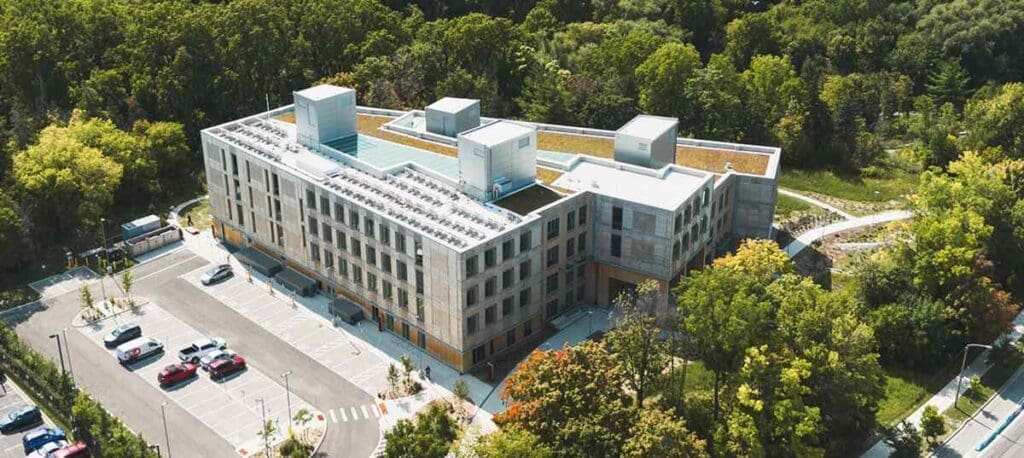

The City of Toronto is implementing new embodied carbon caps and cash incentives of up to $5,300 per apartment for builders who limit the amount of embodied carbon within new constructions. With the rising concern about the embodied carbon that building materials such as aluminum, steel, glass and concrete contribute to a building’s overall carbon footprint, this new building policy seeks to reduce the embodied carbon of new building projects in the city.
Examining Carbon-Heavy Building Materials in Toronto
For many years, the carbon footprint of a building was viewed as an energy efficiency issue. People were mainly concerned about how much energy a building uses for heating, cooling and lighting. However, over recent years there has been a shift towards evaluating the overall carbon footprint for these building materials, versus evaluating just the operational carbon emissions of a building.
Embodied carbon, which is the carbon emissions from building materials’ whole lifecycle (i.e. extracting raw materials, manufacturing, transportation, construction, maintenance and disposal) can represent up to 50 percent of a building’s lifetime emissions, according to KPMG.
According to a research group led by the University of Toronto, concrete foundations and parking garages account for as much as 80 percent of the carbon expended by any given project over the course of its lifetime.
“That’s a really big powerful number in terms of how we are going to tackle climate change and how are we going to address emissions from buildings,” says Shayna Stott, a senior City of Toronto planner.
Cash Incentives for a Reduction in Carbon-Heavy Building Materials
Get the Green Building Project Checklist
Use this handy checklist on your next project to keep track of all the ways you can make your home more energy-efficient and sustainable.

The City of Toronto is now aiming to tackle the amount of embodied carbon in buildings. For those builders who voluntarily limit the amount of embodied carbon in their building projects, there are cash incentives of up to $5,300 per apartment, depending on the size of the apartment.
This move will be a part of the Toronto Green Standard Version 4, and applies to a variety of building types. Toronto City Council already voted to eliminate parking minimums for new condominiums and rental buildings, a choice that will result in less concrete consumption and smaller garages.
Toronto is now implementing new embodied carbon caps of 250 kgCO2e/m2 and 350 kgCO2e/m2, which take aim at a variety of carbon-heavy building materials. These levels are ideal as they are still within reach of current approaches, but extreme enough to generate substantial savings.
It’s expected that more intensive carbon caps will be applied to all city projects as time goes on. Using cash incentives and carbon caps is just half of the equation, however. The other half of the equation is using building techniques and materials that use less carbon to begin with.
Dialing back on the unnecessary use of massive amounts of concrete is one way to help achieve this goal. What material that is set to replace concrete in many ways is mass timber.
Mass timber features a very low level of embodied carbon, and is therefore being viewed as a great alternative to run-of-the-mill building materials. In Toronto a sustainable apartment complex was recently built with mass timber as the main building element.