Solar Energy in Canada
Discover Your PV Potential in This Ranking of Provinces and Cities

Published:
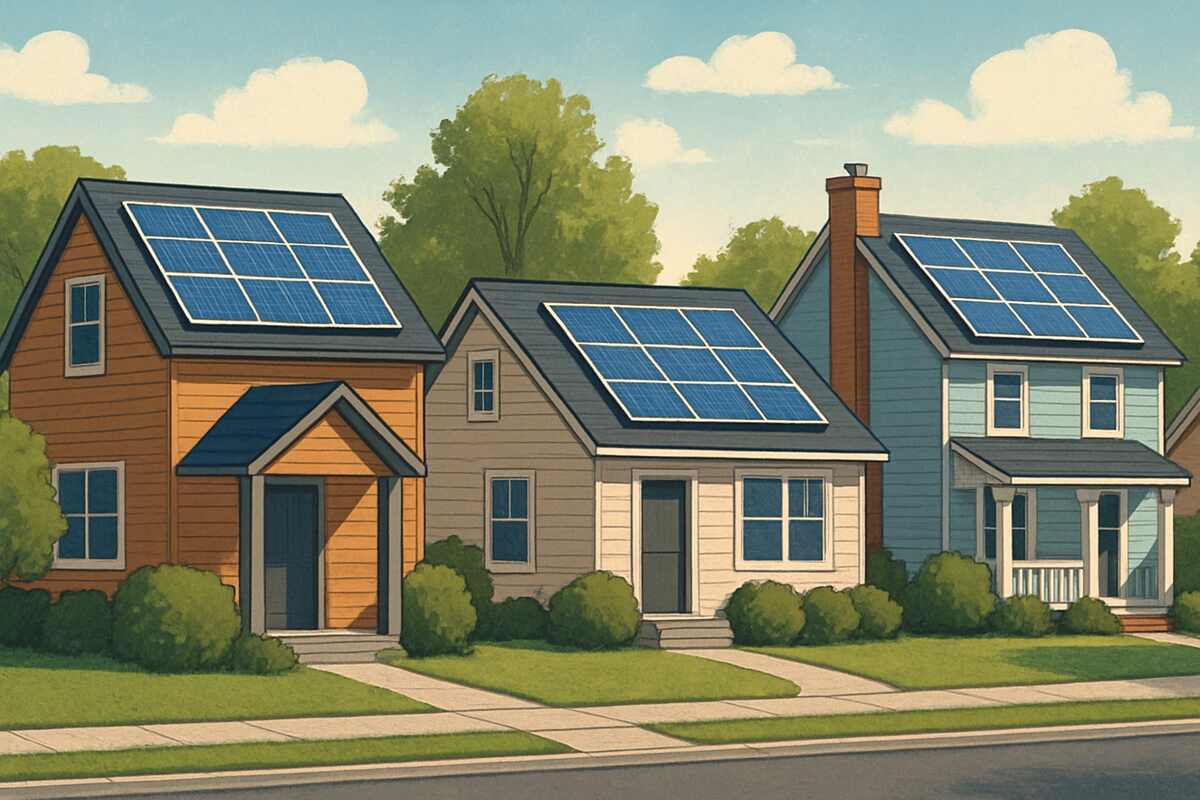
Despite Canada’s harsh climatic conditions, it is blessed with ample sun. Natural Resources Canada estimates that rooftop solar alone can provide 76 percent of Canada’s building energy needs. Yet, as of 2024, solar energy contributes only 1.7 percent to the country’s total primary energy mix. That leaves a lot of room for growth as more and more Canadians are looking to add solar to their roofs.
If you’re thinking of switching to solar (or if you’re just curious about it), you may be wondering whether you happen to live in one of Canada’s solar energy hotspots. In a country as big as Canada, it’s inevitable that the sun shines more on some regions than others. This guide will show you the difference in solar potential (aka photovoltaic potential) from one part of the country to another, ranking individual provinces, regions and cities.
Get a Quote from a Solar Installer Near You
Solar Potential in Canada: A Province by Province Assessment
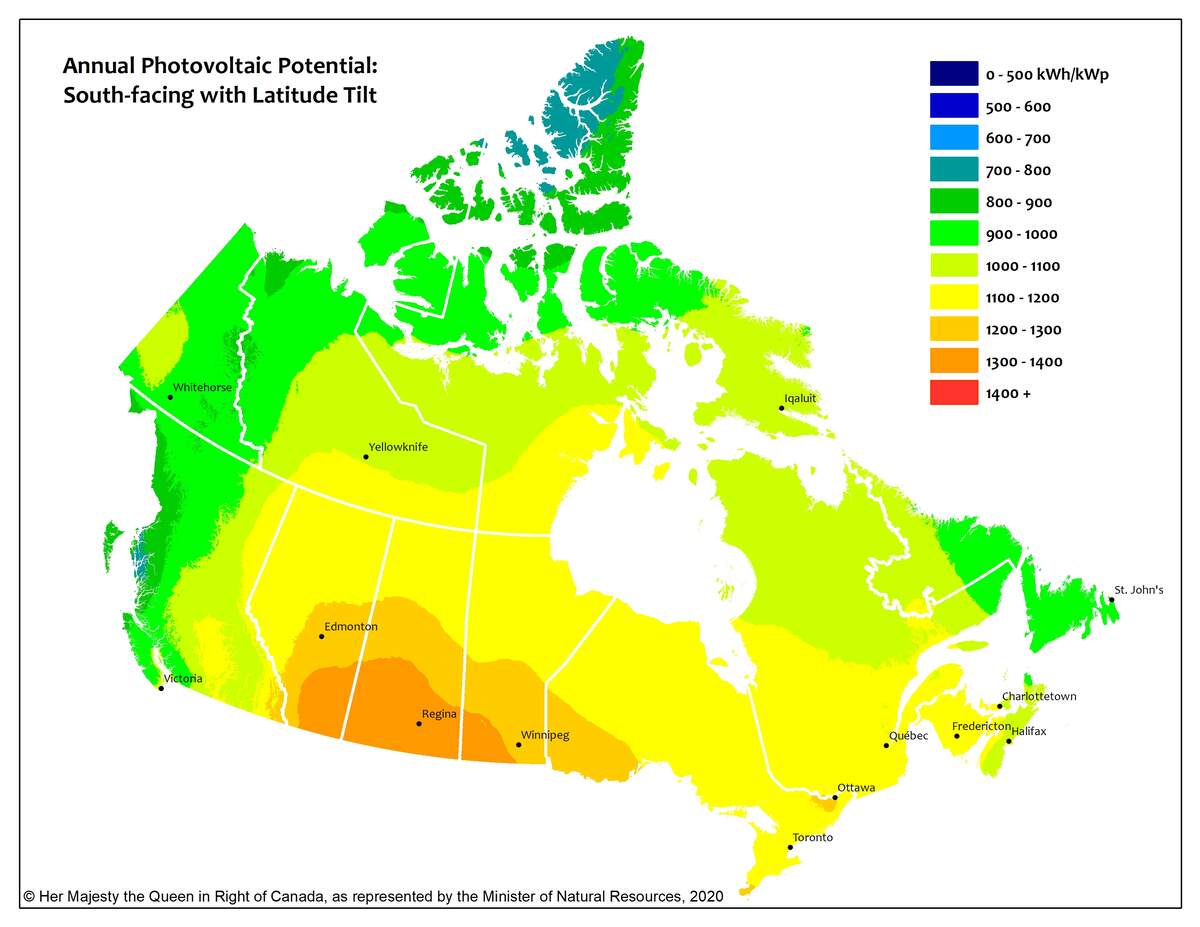
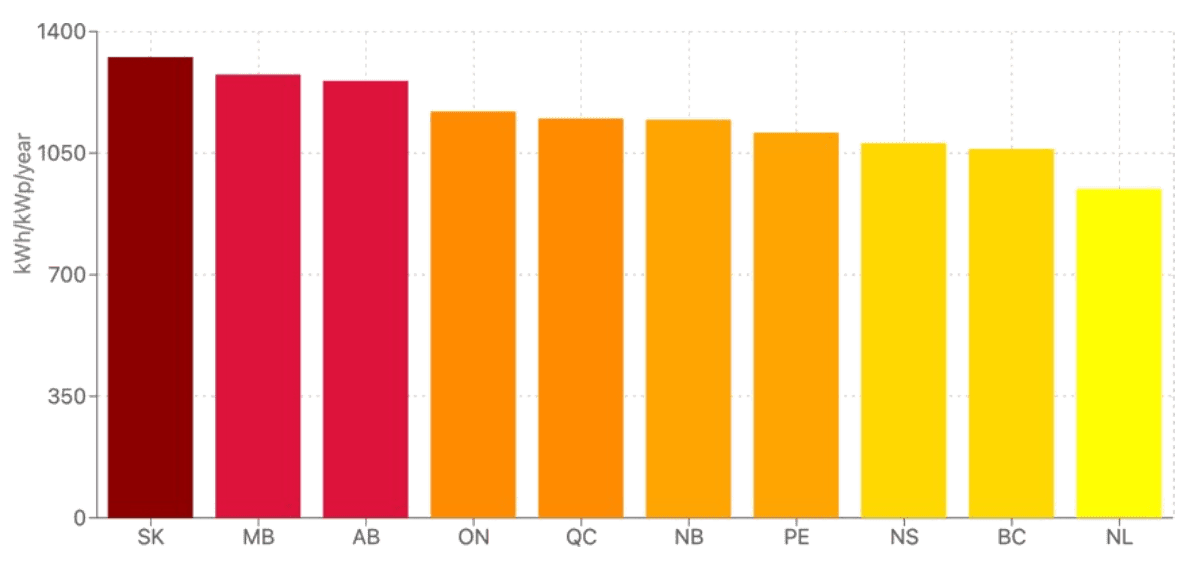
On average, Canada has a solar potential of about 1,152 kWh/kWp/year, for every kilowatt of solar panels installed. This measure is calculated using the average solar insolation, which is a measure of the amount of sunlight that falls on a surface over a certain period. It’s a useful way to estimate how much electricity your solar panels will generate. Take a look at the table below to see how much solar potential your province has.

Get the Green Building Project Checklist
Use this handy checklist on your next project to keep track of all the ways you can make your home more energy-efficient and sustainable.
Average Solar Potential Per Year (By Province)
Key Takeaways
- The Prairies are the region with the highest photovoltaic potential in the country.
- British Columbia, one of Canada’s most densely populated provinces, has relatively low solar insolation due to frequent cloud cover, especially along the coast.
- Newfoundland and Labrador has the lowest solar potential in Canada due to long, cloudy winters and its northern latitude.
Now, let’s look more deeply into the benefits of installing solar in each province. Here are the provinces, ranked from highest solar potential to lowest along with the capital cities’ month-by-month photovoltaic potential.
1. Saskatchewan
Average solar potential of province = 1,326 kWh/kWp
Setting up solar in Saskatchewan is a no-brainer. This province enjoys ample sun and clear skies, making it perfect for solar PV systems. Despite this, Saskatchewan’s current energy mix is heavily dependent on fossil fuels and has not fully tapped into its vast availability of solar. The provincial government is planning heavy expansion of solar and offers a home energy efficiency rebate and tax credits to offset initial investment.
Regina (Solar potential = 1294 kWh/kWp/year)
| Month | Solar Potential (kWh/kWp/year) |
| January | 95 |
| February | 108 |
| March | 127 |
| April | 123 |
| May | 113 |
| June | 108 |
| July | 117 |
| August | 121 |
| September | 111 |
| October | 110 |
| November | 83 |
| December | 79 |
2. Manitoba
Average solar potential of province = 1,276 kWh/kWp
Manitoba closely follows Saskatchewan in solar potential. It has the third cleanest grid in Canada, generating most of its energy through hydroelectricity. Harnessing its vast solar resources would help diversify its energy mix, reduce dependence on hydro and support remote areas with off-grid solar. Manitoba offers a provincial rebate up to $5,000 per home, tax credits and interest-free loan.
Winnipeg (Solar potential = 1,210 kWh/kWp/year)
| Month | Solar Potential (kWh/kWp/year) |
| January | 86 |
| February | 102 |
| March | 130 |
| April | 122 |
| May | 114 |
| June | 104 |
| July | 113 |
| August | 112 |
| September | 99 |
| October | 87 |
| November | 69 |
| December | 71 |
3. Alberta
Average solar potential of province = 1,258 kWh/kWp/year
Alberta is among Canada’s sunniest provinces but continues to rely on oil, natural gas and coal. Alberta offers a whole range of attractive incentives for solar, more than any other province. Better still, Alberta has a deregulated energy market that allows homeowners to sell excess energy at a premium rate and buy energy from the grid at a lower rate. You can learn more about this seasonal rate switching program here. In Alberta, seniors can also access a low-interest loan for energy-efficiency upgrades.
Edmonton (Solar potential = 1,181 kWh/kWp/year)
| Month | Solar Potential (kWh/kWp/year) |
| January | 76 |
| February | 95 |
| March | 124 |
| April | 119 |
| May | 108 |
| June | 103 |
| July | 109 |
| August | 109 |
| September | 102 |
| October | 100 |
| November | 74 |
| December | 63 |
4. Quebec
Average solar potential of province = 1,150 kWh/kWp/year
Despite cold winters and cloud cover, Quebec has promising solar potential. Its electricity grid is the cleanest with hydroelectricity generating almost all its energy needs. Solar adoption is very low in this province since electricity is so cheap, making solar not an attractive option. However, the province will be launching incentives in 2026 that could cover 40 percent of the initial costs of solar panels.
Quebec City (Solar potential = 1,080 kWh/kWp/year)
| Month | Solar Potential (kWh/kWp/year) |
| January | 80 |
| February | 96 |
| March | 122 |
| April | 104 |
| May | 100 |
| June | 93 |
| July | 98 |
| August | 101 |
| September | 87 |
| October | 75 |
| November | 58 |
| December | 65 |
5. Ontario
Solar potential of province = 1,170 kWh/kWp/year
Nuclear dominates energy generation, providing about half of the province’s electricity, supported by hydro, natural gas and wind. Ontario offers a provincial loan under the PACE program with a 20-year repayment period. There are municipality-specific incentives and rebates in cities like Guelph, Ottawa. Indigenous communities can benefit from a First Nations Conservation Program offering free energy efficiency upgrades.
Toronto (Solar potential = 1,096 kWh/kWp/year)
| Month | Solar Potential (kWh/kWp/year) |
| January | 70 |
| February | 85 |
| March | 107 |
| April | 104 |
| May | 107 |
| June | 105 |
| July | 111 |
| August | 109 |
| September | 98 |
| October | 89 |
| November | 57 |
| December | 55 |
6. New Brunswick
Annual average solar potential of province = 1,146 kWh/kWp
New Brunswick has cloudy and snowy winters but has promising solar potential. The province is 38 percent carbon intensive and would benefit from greater solar integration. New Brunswick incentivizes home energy efficiency retrofits by offering tax credits and through its other programs.
Fredericton (Annual average solar potential of 1,094 kWh/kWp)
| Month | Solar Potential (kWh/kWp/year) |
| January | 84 |
| February | 93 |
| March | 114 |
| April | 97 |
| May | 98 |
| June | 94 |
| July | 100 |
| August | 103 |
| September | 97 |
| October | 85 |
| November | 62 |
| December | 67 |
7. Prince Edward Island
Annual average solar potential of province = 1,109 kWh/kWp
PEI’s maritime climate creates cloudy, stormy conditions, making it vulnerable to power outages. Solar is a great option for energy security and resilience of homeowners. The province is heavily dependent on New Brunswick for imported energy through undersea cables. Within the province it generates wind energy to meet 25 percent of its energy needs. It offers a solar rebate that can cover up to 40 percent of the upfront installation cost of solar panels.
Charlottetown (Annual average solar potential of 1,046 kWh/kWp)
| Month | Solar Potential (kWh/kWp/year) |
| January | 84 |
| February | 93 |
| March | 114 |
| April | 97 |
| May | 98 |
| June | 94 |
| July | 100 |
| August | 103 |
| September | 97 |
| October | 85 |
| November | 62 |
| December | 67 |
8. Nova Scotia
Annual average solar potential of province = 1,079 kWh/kWp
Nova Scotia offers modest but consistent solar potential. Almost half of its energy needs are met by fossil fuels, with the remaining from wind, hydro and imported energy from Newfoundland and Labrador. The SolarHomes rebate program covers up to 25 percent of initial costs, and there are other low-interest loan options.
Halifax (Annual average solar potential of 1,016 kWh/kWp)
| Month | Solar Potential (kWh/kWp/year) |
| January | 69 |
| February | 81 |
| March | 102 |
| April | 86 |
| May | 93 |
| June | 93 |
| July | 97 |
| August | 100 |
| September | 96 |
| October | 84 |
| November | 58 |
| December | 56 |
9. British Columbia
Annual average solar potential of province = 1,062 kWh/kWp
While solar isn’t the strongest here compared to other provinces, it is still viable. BC has a very low-carbon grid as it uses hydroelectric power, but solar can enable diversity and back-up energy resilience. BC offers rebates up to $5,000, tax exemptions and low-interest loans.
Victoria (Annual average solar potential of 1,018 kWh/kWp)
| Month | Solar Potential (kWh/kWp/year) |
| January | 45 |
| February | 58 |
| March | 91 |
| April | 98 |
| May | 102 |
| June | 101 |
| July | 112 |
| August | 115 |
| September | 117 |
| October | 87 |
| November | 49 |
| December | 41 |
10. Newfoundland and Labrador
Annual average solar potential of province = 947 kWh/kWp
This province ranks the lowest in average PV potential due to frequent overcast weather and coastal fog. It benefits from abundant hydroelectric power, but solar may still be viable in off-grid areas or summer cabins. The province offers several incentives for energy efficiency upgrades, including solar.
St. John’s (Annual average solar potential of 884 kWh/kWp)
| Month | Solar Potential (kWh/kWp/year) |
| January | 54 |
| February | 68 |
| March | 90 |
| April | 81 |
| May | 85 |
| June | 85 |
| July | 94 |
| August | 92 |
| September | 83 |
| October | 66 |
| November | 45 |
| December | 41 |
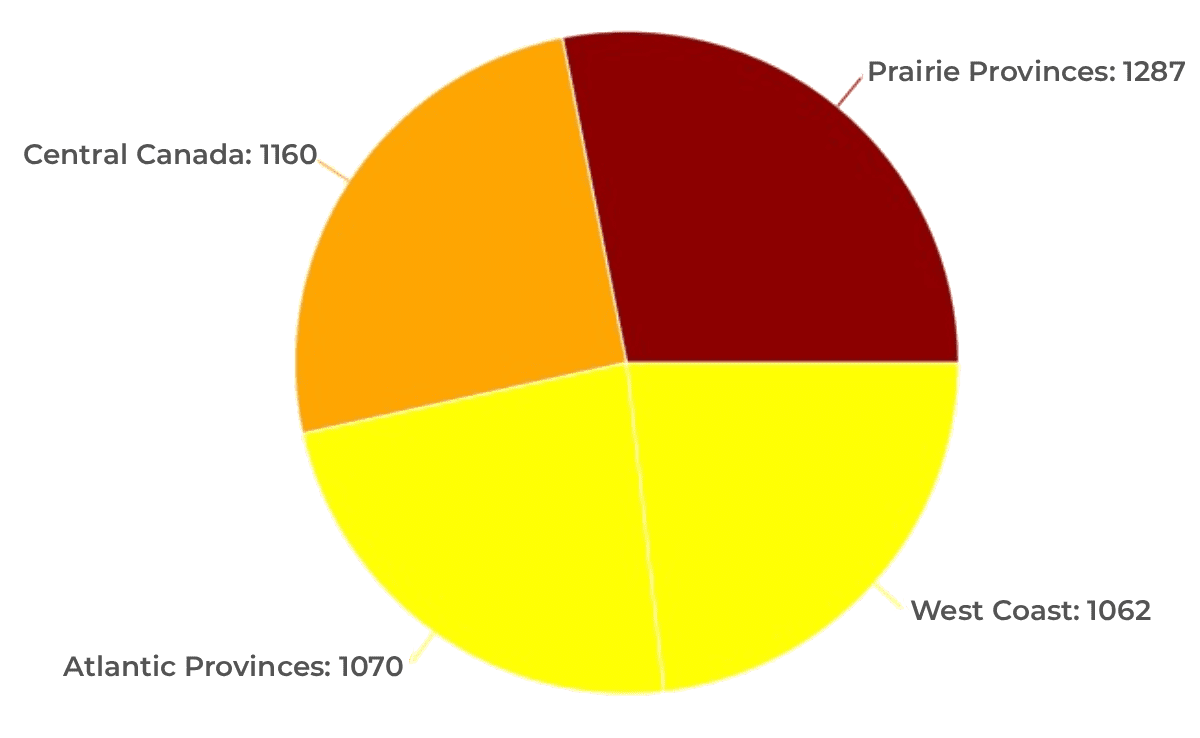
Solar Potential in Canada (By Region)
A Closer Look at the Solar Potential of Canadian Cities
Want to know specifics about the solar potential Canadian cities? Have a look at these charts. In the first, we look at the solar potential of the most populated cities in the country and in the second we have a look at the cities with the highest solar potential in the country.
Solar Potential of 30 Largest Cities in Canada
| City | Province | Average solar potential (kWh/kWp/year) |
|---|---|---|
| Toronto | Ontario | 1096 |
| Montréal | Québec | 1129 |
| Calgary | Alberta | 1228 |
| Ottawa | Ontario | 1140 |
| Edmonton | Alberta | 1181 |
| Winnipeg | Manitoba | 1210 |
| Mississauga | Ontario | 1092 |
| Vancouver | British Columbia | 938 |
| Brampton | Ontario | 1088 |
| Hamilton | Ontario | 1085 |
| Surrey | British Columbia | 928 |
| Québec | Québec | 1080 |
| Halifax | Nova Scotia | 1016 |
| Laval | Québec | 1133 |
| London | Ontario | 1084 |
| Markham | Ontario | 1095 |
| Vaughan | Ontario | 1091 |
| Gatineau | Québec | 1139 |
| Saskatoon | Saskatchewan | 1283 |
| Kitchener | Ontario | 1104 |
| Longueuil | Québec | 1131 |
| Burnaby | British Columbia | 922 |
| Windsor | Ontario | 1143 |
| Regina | Saskatchewan | 1294 |
| Oakville | Ontario | 1233 |
| Richmond | British Columbia | 957 |
| Richmond Hill | Ontario | 1092 |
| Burlington | Ontario | 1087 |
| Oshawa | Ontario | 1101 |
| Sherbrooke | Québec | 1088 |
Top 50 Cities in Canada With the Highest Solar Potential
| City | Province | Average solar potential (kWh/kWp/year) |
|---|---|---|
| Estevan | Saskatchewan | 1,383 |
| Weyburn | Saskatchewan | 1,376 |
| Medicine Hat | Alberta | 1,368 |
| Moose Jaw | Saskatchewan | 1,364 |
| Regina | Saskatchewan | 1,360 |
| Swift Current | Saskatchewan | 1,355 |
| Brooks | Alberta | 1,352 |
| Saskatoon | Saskatchewan | 1,349 |
| Martensville | Saskatchewan | 1,343 |
| Brandon | Manitoba | 1,342 |
| Warman | Saskatchewan | 1,341 |
| Lethbridge | Alberta | 1,330 |
| Melville | Saskatchewan | 1,326 |
| Morden | Manitoba | 1,314 |
| Winkler | Manitoba | 1,309 |
| Dauphin | Manitoba | 1,302 |
| Chestermere | Alberta | 1,302 |
| Portage la Prairie | Manitoba | 1,301 |
| Calgary | Alberta | 1,291 |
| Airdrie | Alberta | 1,287 |
| Lloydminster (Part) | Alberta | 1,279 |
| Steinbach | Manitoba | 1,275 |
| Winnipeg | Manitoba | 1,272 |
| Selkirk | Manitoba | 1,267 |
| Camrose | Alberta | 1,267 |
| Red Deer | Alberta | 1,265 |
| Lacombe | Alberta | 1,264 |
| Thunder Bay | Ontario | 1,227 |
| Windsor | Ontario | 1,211 |
| Gatineau | Quebec | 1,200 |
| Ottawa | Ontario | 1,200 |
| Terrebonne | Quebec | 1,196 |
| Laval | Quebec | 1,194 |
| Repentigny | Quebec | 1,194 |
| Blainville | Quebec | 1,194 |
| Kingston | Ontario | 1,194 |
| Mirabel | Quebec | 1,193 |
| Longueuil | Quebec | 1,191 |
| Montréal | Quebec | 1,190 |
| Saint-Jérôme | Quebec | 1,184 |
| Saint-Jean-sur-Richelieu | Quebec | 1,180 |
| Flin Flon | Manitoba | 1,179 |
| Greater Sudbury | Ontario | 1,171 |
| Miramichi | New Brunswick | 1,170 |
| Oshawa | Ontario | 1,167 |
| Bathurst | New Brunswick | 1,165 |
| Toronto | Ontario | 1,163 |
| Markham | Ontario | 1,162 |
| Thompson | Manitoba | 1,160 |
| Mississauga | Ontario | 1,159 |
Key Takeaways
- Most of the top 10 cities are from Saskatchewan, with the most populated cities, Saskatoon and Regina, following closely behind.
- Alberta and Manitoba come next, with Medicine Hat and Brandon showing the best potential for solar in each province, respectively.
- The two most populated provinces, Ontario and Quebec have promising solar potential too. Thunder Bay and Windsor lead in Ontario, while Gatineau and Terrebonne have the highest potential in Quebec.
- The third most populous province, British Columbia, does not secure a place in the Top 50 cities list.
Don’t be disheartened if you belong to provinces or cities that didn’t make cut. You can still benefit from putting solar on your rooftop. Provinces are working very hard to achieve Canada’s 2050 net-zero target and are heavily incentivizing energy efficiency upgrades, especially solar. Take a look at our Solar Incentive Finder to find an incentive that’s right for you. This is your chance to capitalize on these incentives and enjoy longer term savings!
What Should You Keep in Mind Before Going Solar?
Now that you know the solar potential in your province/city, you should match your home energy needs to the solar potential. If the average solar potential in your city is 1,100 kWh/kWp/year, see how many kWp of solar panels you would need to meet your home energy needs. An average household in Canada consumes about 11,135 kWh. This means that with a 6-kW solar photovoltaic system, you can realistically meet half of your household energy needs using solar under the right conditions.
Right sizing your solar system is important not only to save on upfront costs, but to ensure that you have enough solar energy to meet your own needs, and to export excess back to the grid. This will help you achieve your payback faster.
No more reason to wait, just go solar!
Sources and methodologies
- The annual average solar potential figures were calculated using the ‘Photovoltaic Potential and Solar Resource Maps of Canada – Municipality database’ Natural Resources Canada. The Canadian average and provincial averages are calculated by averaging the annual average solar potential of 3,423 municipalities in the 10 provinces.
- The Top 50 cities list was arrived at by filtering all municipalities recognized as ‘Cities’ by Statistics Canada and arriving at the top 10 cities with the most solar potential in each province. Quebec does not recognize any municipalities as cities. Therefore, the top 10 municipalities recognized as ‘ville’ were chosen. Nova Scotia does not recognize any ‘cities’, and instead the 20 most populous ‘Regional Municipalities’ and ‘Towns’ were chosen.
- The top 50 cities for solar in Canada fall within 3 provinces: Saskatchewan, Alberta and Manitoba. To give a full picture of all provinces, the top 10 cities in each province with the highest solar potential are featured in the list. For provinces with more than 10 cities, the 20 most populated cities were chosen and among them, the top 10 cities with the highest solar potential are featured.
- Information on provincial energy profiles were sourced from Canada Energy Regulator.
Get a Quote from a Solar Installer Near You
The following information helps us to find the best local professional to complete your project. You will be contacted by email shortly after submitting the form.