An awning that’s not at the right pitch isn’t just an eyesore – it’s a problem waiting to happen. From water pooling and fabric sagging to poor drainage and wind resistance, a misaligned awning can shorten its lifespan and leave you with costly repairs. Whether it’s protecting your patio or shading your storefront, getting the angle right is the key to keeping your awning functional, durable and looking great. Here’s why pitch matters and how to fix it before the next downpour ruins your day.
Setting the Pitch
A horizontal awning has a zero-degree pitch. If you start lowering the edge further away from the wall, you will increase the pitch angle until the awning rests parallel to the wall, at which point it will have a pitch of 90 degrees. The ideal awning pitch lies between the two extremes, and here is what you need to know to get the best possible position for your awning.
First, there is a minimum setting to ensure proper rainwater runoff. The magic figure is 14 degrees. This does not mean the awning must be set at 14 degrees, but rather that the pitch should be 14 degrees or greater to achieve correct rainfall runoff.
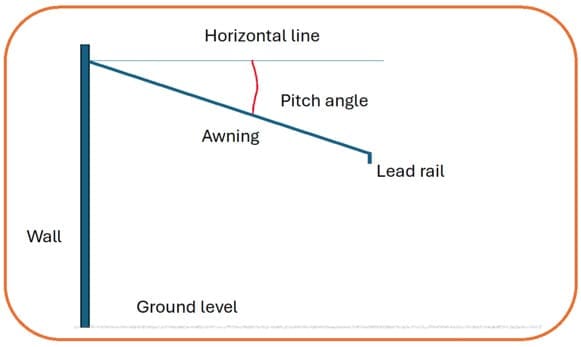
Having a pitch of 14 degrees does not guarantee that rain will not pool on the awning. If the awning fabric is stretched water will collect on it, and if a significant amount does collect, it may cause the awning to collapse.
While getting the rainwater to run off the awning is certainly important, there are some other factors to consider when deciding on the most appropriate pitch for your awning.
What’s a Good Pitch for an Awning?

Get the Green Building Project Checklist
Use this handy checklist on your next project to keep track of all the ways you can make your home more energy-efficient and sustainable.
Now that we know the minimum pitch, the other factors we have to consider are:
- The height where the awning is attached to the wall
- The area the awning will cover
- The height of the awning’s outside edge (lead rail)
The pitch significantly influences all of these measurements. So, let’s start on the outside edge (lead rail), as it needs to be high enough for people to walk underneath it without bumping their heads. To be safe, 6’8” (2.02m) would be the minimum height, but awnings frequently have a border (sometimes a valance) on the outside edge, so don’t forget to consider that as well.
As a helpful guide, for every metre the awning extends from the wall, its height will be reduced by 25 cm. An alternative method is the 3/12 formula, which indicates that for every 12 feet of projection, the height should be reduced by 3 feet.
Fixing Height for Awning With 14° Pitch and a Lead Rail Height of 6’8″
| Projection (feet) | Fixing height at wall (feet) | Projection (m) | Fixing height at wall (m) |
|---|---|---|---|
| 6 | 7’10” | 2 | 2.52 |
| 7 | 8’1″ | 2.25 | 2.58 |
| 8 | 8’3″ | 2.5 | 2.65 |
| 9 | 8’7″ | 2.75 | 2.71 |
| 10 | 8’10” | 3 | 2.77 |
| 11 | 9’1″ | 3.25 | 2.83 |
| 12 | 9’4″ | 3.5 | 2.90 |
| 13 | 9’7″ | 3.75 | 2.96 |
| 14 | 9’10” | 4 | 3.02 |
Let’s take the example of an awning that extends four metres from the wall. It must be attached to the wall at a height greater than 3 metres (the imperial equivalent is a thirteen-foot projection that requires a fixing height of almost 10 feet) to allow for easy access under the outside edge or lead rail.
Once you’ve finalized the height and size of the awning, you must consider another factor: the sun’s apparent movement from winter to summer. This will significantly affect the shaded area under your awning, so it’s important to check where the sun will be at the times you’re most likely to use the space under the awning.
You can use a tool like this sun position plotter to check the sun’s position throughout the year to determine the shade that your awning will provides in the different seasons.
How to Adjust the Pitch of an Awning
Most manufacturers of retractable awnings supply comprehensive instructions on how to alter the pitch. This normally involves the release of a securing bolt and the turning clockwise of an adjustment screw to increase the pitch.
When the maximum adjustable pitch is insufficient to protect the area from the sun, a valance connected to the lead rail can be utilized to increase the protected area.
Some awnings have a jack handle system that allows users to extend and retract the awning manually and adjust the pitch.
Fixed awnings don’t allow for a pitch adjustment.
Retractable and Fixed Awnings
Fixed awnings have the advantage when price is the deciding factor, but as is the case in so many instances, the initial cost is only one of the many considerations that should be considered.
The average life span of the fabric on a fixed awning is around three years because it is permanently exposed to UV radiation, snow, rain and perhaps hail and ice from time to time. As a result of being permanently exposed, the fabric is prone to fading and becoming unattractive.
Along with the relatively rapid deterioration of the fabric, exposure to extreme weather conditions like heavy winds may cause severe damage to the framework. While the awning may do a great job in summer in reducing the amount of sunshine entering the house, its permanent nature blocks the winter rays from entering the house, causing you to use more heating than you otherwise would need.
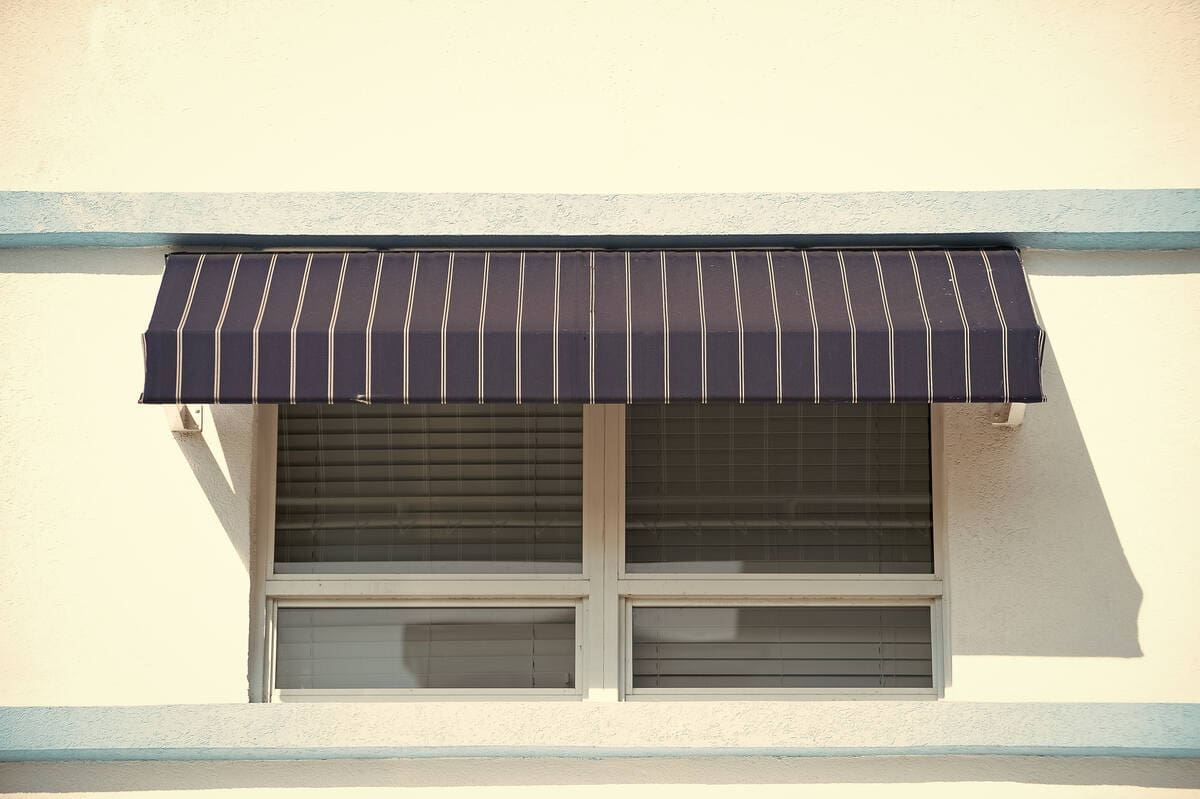
Fixed awnings also reduce the amount of light entering the home, which may be appreciated during summer but not in winter, when artificial lighting could be required to compensate for the loss.
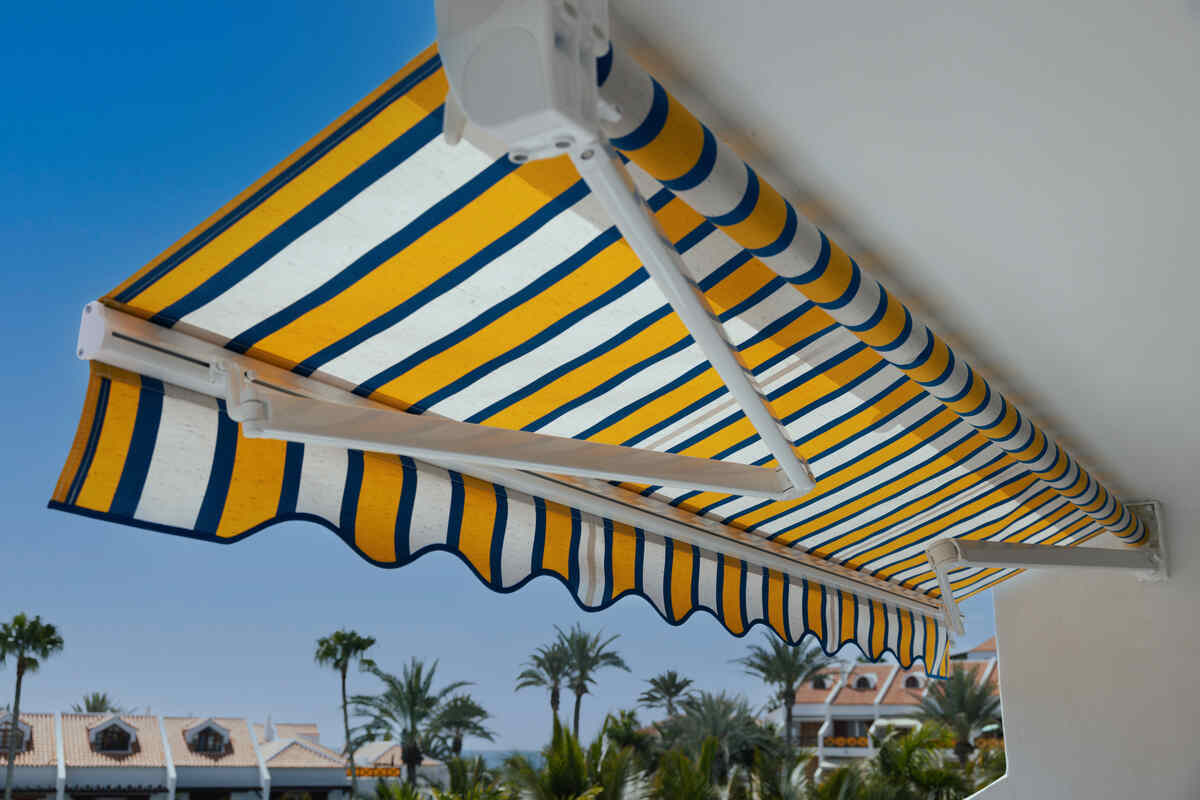
Retractable awnings provide a versatile option with the valuable advantage of being able to be closed, thereby protecting the fabric from UV radiation and harsh weather conditions.
More sophisticated awnings can automatically retract the awning when wind and rain receptors indicate the necessity to do so. In addition, by retracting the awning in winter, natural lighting is improved together with allowing passive heating.
Setting your awning at the correct pitch will prolong its life expectancy and attractiveness. While retractable awnings have the advantage of being closed during adverse weather conditions, fixed awnings need care and maintenance to ensure that rainwater does not pool on the roof, which could cause severe damage.
Images from Depositphotos