

Circular saws and miter saws are two of the most popular power tools, and they perform a significant role in most woodworking projects. The main difference between the two saws is that circular saws are moved over the workpiece, whereas miter saws tend to have the workpiece brought to them.
Here we will go through the right tool for different DIY projects and highlight the key differences between the saws.
Different tools serve different purposes, and it is critical to make the best choice and get the right saw for most of your woodworking activities.
Let’s have a look at the details of the two different saws and their typical applications.
Circular Saws
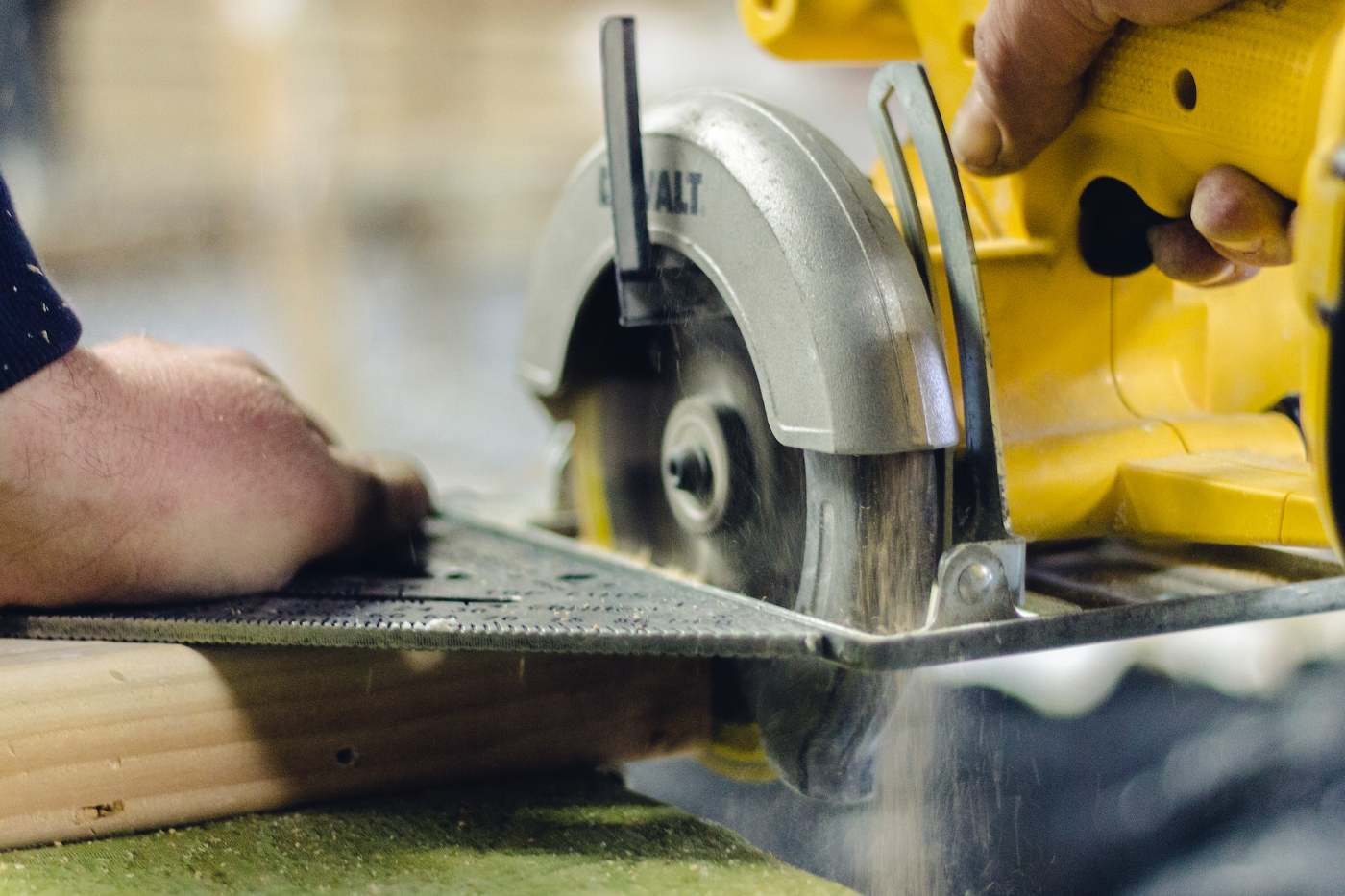
Among DIY enthusiasts, circular saws are second only to power drills in popularity. Circular saws are one of the most versatile tools for cutting wood, especially boards and doors. They can do almost every cut that a miter saw can do and then a whole lot more.
Circular saws have no limit to the size and length they can cut. They are light enough to move around, can be set up in seconds on the construction site, and only require a power source.

Get the Green Building Project Checklist
Use this handy checklist on your next project to keep track of all the ways you can make your home more energy-efficient and sustainable.
Cordless versions of circular saws offer an even greater level of convenience than the traditional cable versions. Advances in battery technology have provided sufficient power for battery-powered circular saws to dominate building sites.
The most popular range of blades found in circular saws begins at a seven-inch diameter circular blade and moves up to nine, ten, and twelve-inch blades. This allows for timber two inches thick to be cut by the smaller models, while the ten-inch blade will get to a three-inch depth of cut.
An excellent example of a lightweight circular saw is the DeWalt DWE 575SB, which comes with a 7-1/4 inch blade that can cut timber up to 2-1/2 inches thick. It also has bevel settings at 22.5 and 45 degrees. Its light weight makes it easy to get to the job site, and the ease of use makes it a versatile tool to handle a variety of cuts.
Circular Saw Blades
Combination blades with tungsten carbide teeth are the most common blade found in circular saws. They are almost always the blade sold together with the saw. They offer good performance both in ripping and crosscutting, but like everything, performance is compromised for the sake of versatility.
A combination blade will cut in different directions. It will do rip cuts, but not as well as an actual ripping blade, and similarly, the combination blade will perform cross cuts, but the result will not be as smooth as a true cross-cut blade.
The correct blade in the circular saw is less critical than having the right blade in a miter saw. A miter saw requires a cross-cut blade, and the cut’s smoothness mainly depends on the number of teeth on the blade. However, a miter saw that has a “flip over” facility will require a combination blade if it will be used for ripping.
Versatility always comes at a price. Circular saws sacrifice accuracy for versatility, as anyone who has tried to cut an eight-by-four board freehand will acknowledge. We may well have followed the line as closely as possible, but the cut is always a little disappointing.
Circular Saws with Tracks
Making perfect straight cuts was not easy until track saws arrived and brought a new straight edge to circular saws cutting up boards. Track saws have raised the level of accuracy of circular saws making straight cuts so that they can compete with panel saws, but at a fraction of the price.
The significant advantage of having a circular saw matched with a track system is that it provides the circular saw with a guide to ensure that the cuts are perfectly straight when cutting up large sheets and manufactured boards. They also play a positive role in avoiding tear out when cutting plywood sheets.
There is another advantage of the track system, too, in that very few rough-sawn lengths of timber are absolutely straight. The width across the board will vary by a small amount, and there may well be a slight curve along the length.
Laying the track down on one of the sides and cutting the length ensures that one side is now perfectly straight, and the piece can then be fed through a table saw for accurate and consistent sizing. I don’t know of an easier or faster method of getting total conformity in a length of timber with a DIY tool.
Miter Saws
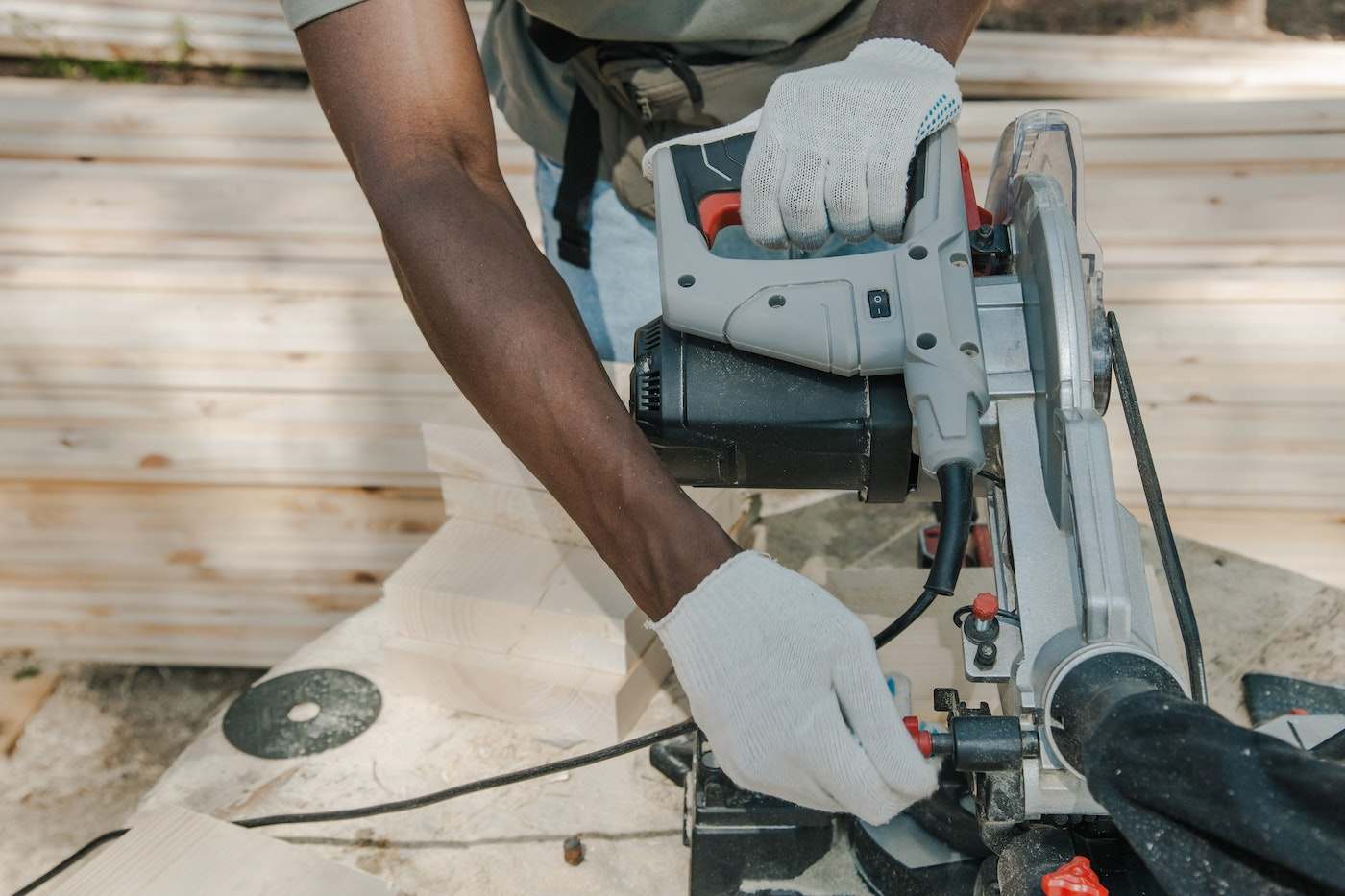
Miter saws, on the other hand, have limitations. They have a relatively small cutting width ability and can’t rip long lengths of timber. They also require a stand to support them.
So, what makes them so popular?
Miter saws are accurate, predictable and can cut precise angles. It takes a fair amount of skill to cut a steady ninety-degree angle across a twelve-inch board with a circular saw. A correctly set up miter saw will do straight cuts perfectly every time so long as the board is accurately presented.
With a miter saw, we need to bring the piece of wood to the saw and locate and hold it securely and accurately in position for the saw to perform its work and create accurate cuts.
There are different types of miter saws, ranging from the simple cut-off—sometimes called a chop saw—to the saw with a slide attachment, to the more sophisticated pivot arm-type saws.
The cut-off saw can do all the tricky compound cuts, but the width of the material is limited to less than the blade’s diameter. Hence the length of cut is limited by the blade size unless you turn the workpiece around and cut from the other side.
Miter saws with a slide can cut wider widths because the motor and blade assembly can slide on the bars, which extends the capability of the saw to cut wider widths.
The downside of miter saws with slides is that they take up more room in the workshop to accommodate the length of the slides.
Pivot arm miter saws provide the same advantage that miter saws with slides deliver, but they are far more space efficient. Sadly, they are also more expensive.
All of these miter saws can do bevel cuts as well as miter cuts. In addition, they can do compound cuts, meaning they can do both cuts simultaneously.
Table saws can also produce precise cuts with the aid of a fence guide. Most table saws can do a bevel and miter cut simultaneously, but I would only use the table saw in preference to the miter saw if the workpiece was too big for the miter saw to handle.
The Advantages of Using a Miter Saw
Anyone who has tried to cut crown moulding by hand will understand the frustration of getting not only the miters but the bevels to fit snugly together. A miter saw, correctly set up, will be your best friend cutting corners perfectly if you arrange the stops correctly.
A miter saw is an excellent tool for making angle cuts and is your best option for cutting various angles effortlessly and accurately.
Where accurate measurements are critical, such as when cutting picture frames, the miter saw will cut different angles easily, safely and quickly. Door frames also require accurate and precision cross-cutting to ensure a good fit.
A typical example of a site miter saw is the DeWalt DWS 780, which has a maximum cutting width of just over twelve inches. It has a 12-inch blade (305 mm) and makes bevel cuts up to 49 degrees to the left and right. It has a miter facility of up to 50 degrees to the left and 60 degrees to the right.
Another useful feature is the ‘grooving stop’ that allows for the accurate cutting of grooves and rebates.
The blade guard that automatically covers the blade when not on the workpiece makes working with this saw much safer.
Other Versions of Miter Saws
The “flip over” miter saw is a popular tool on the construction site because it opens up the ability of the miter saw to do ripping and long cuts. The conventional arrangement of the miter saw on top of the table can be remodeled by turning the table over, and the miter saw is converted into a small table saw.
As a table saw, long cuts are possible and different cuts, like bevel cuts, can be made because the angle of the blade can be altered from 90 to 45-degrees. These cuts are usually possible on one side only, however, because of the motor’s position under the table.
The radial arm saw was immensely popular some years ago but seemed to have lost ground to the modern miter saw.
A radial arm saw was the first stationery saw I bought many years ago, and it had a range of different uses. It could make accurate crosscuts or almost any angled cut and had an advantage over a miter saw in that it could also rip long lengths of timber. It could also cut rebates, dovetails and grooves even at different angles.
The disadvantage of the radial arm saw, however, is that it needs to be carefully set up, and the table has to be levelled to ensure high-quality performance.
Differences Between a Miter Saw and a Circular Saw at a Glance
| Miter Saw | Circular Saw |
| Stationary with workpiece brought to the machine. Can be moved to site but is heavier than a circular saw. Accurate and precision crosscuts. Can cut accurate bevel, miter and compound cuts easily, quickly and repetitively. Best miter saws have laser guidance lines. Not able to rip cut and limited cross-cut width. More expensive option. | Machine moves to the workpiece. Lightweight and easy to carry. The accuracy of cuts is determined by the operator. Limited ability to make accurate cuts. No laser facility. Guidelines are stamped on the base plate. No limitation on length of rip or cross-cut. Cheaper than a miter saw. |
The Different Materials Circular and Miter Saws Can Handle
The electric motor fitted to both circular and miter saws results in a powerful tool that can handle various materials and consequently opens up the ability to undertake different projects.
Both saws can be used for aluminum work, provided the correct blade is fitted to the saw. With the right blade fitted, laminates and plastics can also easily work with these saws.
Conclusion
If I were starting out doing DIY projects, I would say that both a circular and a miter saw would be essential. And then, what about a flip saw? Would that suffice? Cutting up an eight-by-four board on a table saw is difficult, especially given the size of flip saw tables, and the distance between the fence guide and blade is relatively small. You do indeed get extensions to help, but the small tables are restrictive.
The best combination is a circular saw with a track saw attachment and a separate miter saw. This will allow you to do long straight-line rip cuts using the circular saw as a hand-held tool and the versatility of a miter saw for different types of cross-cuts at specific angles.
Compound miter saws make it easy to complete fairly complex joinery in a fraction of the time it would take to make the cuts by hand. While you may be able to cut an accurate single bevel with a circular saw, you will need a little bit of luck because the circular saw provides less accuracy and is more at home making rough cuts.
The type of saw you choose will play a significant role in your enjoyment of your woodworking. Power saws provide a high-speed solution to the rather tedious and tiring alternative of cutting with a hand saw.
Different types of saws perform better at different kinds of cuts, and as you move towards a more specialized tool, you will have to sacrifice a little versatility.
So, consider your different options carefully and get the best saw for your specific needs. If I can provide you with one suggestion, no matter what saw you choose, it is to get the most powerful saw your budget will allow. I’ve never heard a woodworker complain about a tool being too powerful.
F.A.Q.s
What is the function of the laser tool on a miter saw?
The laser provides a line across the worksurface that the blade will follow when the cut commences. Some miter lasers provide a double line, while others have only a single line. It is important to remember the side of the line that the cut will be made in instances where there’s only a single line.
How can a dovetail groove be cut using a miter saw?
Dovetail grooves are easy to cut on a sliding or pivot miter saw by setting the bevel at the desired angle and fixing the depth of cut to less than the thickness of the workpiece.
You will need to cut one side of the dovetail and then turn the workpiece around to cut the other side. Once both sides of the dovetail have been cut, you will need to make repetitive cuts to remove the wood from inside the groove.
What are the dangers of working with power saws?
While safety features have come a long way in recent years, miter and circular saws present real and serious risks. Saw blades don’t distinguish between wood and your fingers, and there are very few woodworkers who don’t have a couple of scars from a vicious kickback or a careless finger getting in the way of the blade. Make sure the blade guards are always in place when operating these machines.
Not only is there a danger of severe cuts, but there’s also the health risk of sawdust.
Be mindful when operating these machines and take all safety instructions seriously. They are there for your benefit.
Feature image: cottonbro studio; Image 1: George Pastushok; Image 2: Ron Lach