
Building Canada Strong with Mass Timber
Case Study of the TRCA Headquarters Examining the Use of Mass Timber in Mid-Rise Construction

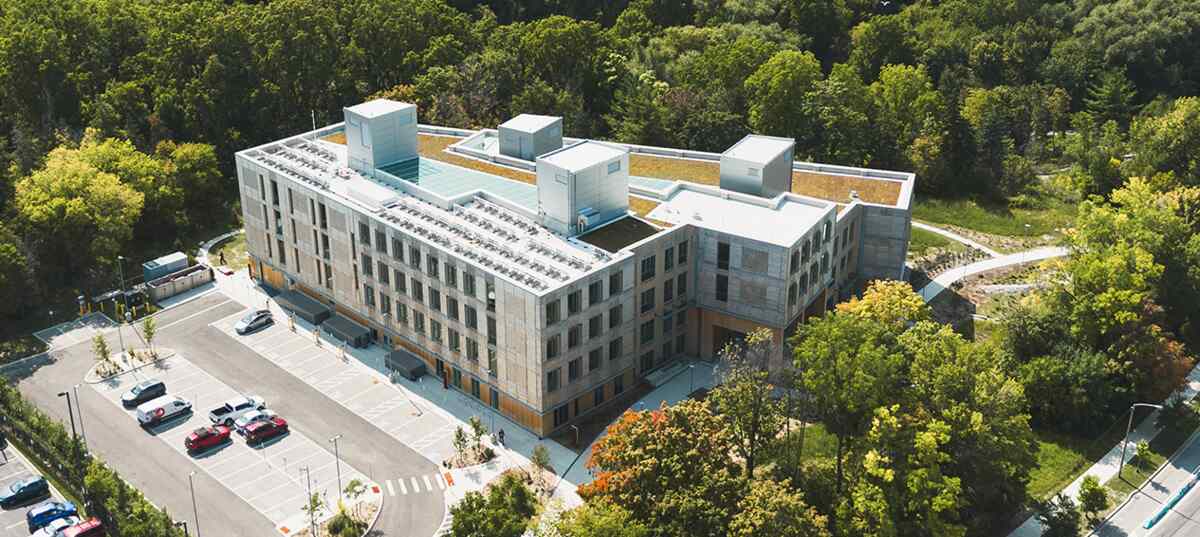
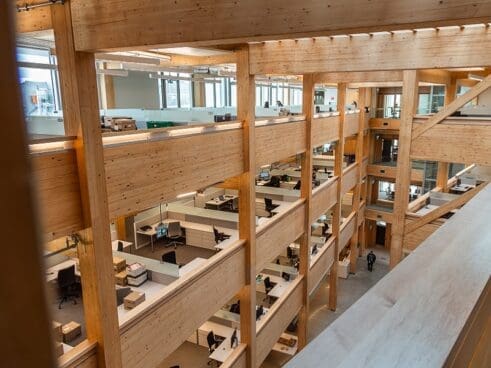
Imagine living or working in a space that is comfortable when it’s scorching hot outside and feels warm and cozy when winter temperatures dip below zero. This building would feel breathable and feel closer to nature. Sunlight would filter through the spaces, reflecting softly and creating an atmosphere that feels open and welcoming. The new headquarters of the Toronto and Region Conservation Authority (TRCA) at 5 Shoreham Drive is a demonstration of this. It’s a 4-storey, 87,000 square foot mass timber (MT) building constructed using wood through-and-through for external and internal structure and finishes.
What is Mass Timber?
Mass timber is manufactured by bonding together multiple sheets of wood to form strong load-bearing structural elements. The most common types of MT include Cross-Laminated Timber (CLT), Glued Laminated Timber (GLT or Glulam), Nail-Laminated Timber (NLT), Dowel-Laminated Timber (DLT), and Structural Composite Lumber, to name a few. Mass timber types differ based on the way they are bonded together, such as using glue, nails or dowels and the direction in which they are stuck together (eg. criss-cross like in CLT or the same direction like in glulam). Each type of mass timber serves a different structural purpose in a building.
The TRCA headquarters has taken a wood-first approach and has integrated timber into structures that do not typically use the material. TRCA runs several initiatives to advance conservation efforts and create awareness among the public on the importance and ways of protecting the natural resources that Ontario is blessed with.
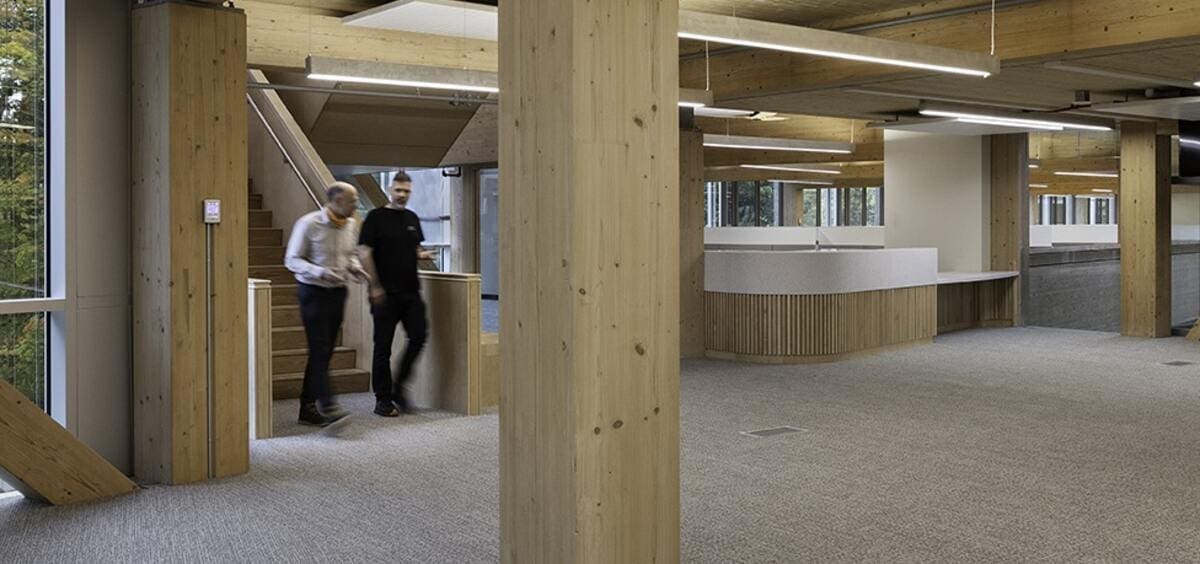
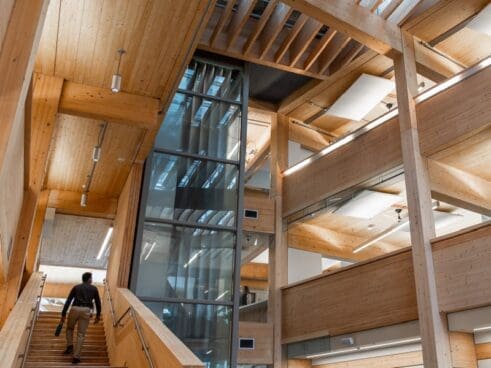
As part of this mandate, TRCA built its energy efficient, net-zero headquarters as a symbol of environmental stewardship. Opening directly into the Black Creek ravine, the building brings the forest inside with exposed mass timber, creating a connection to the natural landscape. It is constructed using a glulam post-and-beam frame and exposed timber bracing, CLT floors and envelope and nano-CLT in the interiors. It also has fully timber-based stair and elevator cores.
The National Building Code of Canada now allows mass timber construction up to 12 storeys, and the Ford Government in Ontario recently amended the Ontario Building Code, allowing encapsulated mass timber construction up to 18 storeys. British Columbia has also amended its building code to allow up to 18 storeys.
Get the Green Building Project Checklist
Use this handy checklist on your next project to keep track of all the ways you can make your home more energy-efficient and sustainable.
Carbon Emissions of Mass Timber
Mass timber buildings have significantly lower carbon emissions across their lifecycle. Substituting carbon-intensive materials like concrete and steel can reduce upfront embodied carbon by 40 to 70 percent in structural systems. Cement and steel production involves high-temperature manufacturing processes that use kilns and blast furnaces, respectively. These are highly energy intensive and, for the most part, require fossil fuels.
Manufacturing emissions of mass timber are lower due to less energy-intensive production processes like drying, pressing and laminating, which mostly use electricity. But what makes timber even better is its biogenic carbon storage. Trees naturally absorb and store carbon from the atmosphere when they grow and this sequestered carbon remains locked-in for the entire life of the building. Natural Resources Canada reports that MT products store approximately 1 tonne of of CO₂e per cubic metre of wood. When biogenic carbon storage is accounted for in a whole building Life Cycle Analysis (LCA), it brings down the embodied carbon of MT to zero or even negative.
However, a World Resources Institute report on mass timber warns that using it does not immediately make a building devoid of carbon emissions. The report notes that logging processes often leave out wood wastes such as roots or small branches that are burned or left to decompose without purpose. Furthermore, the growing demand for mass timber would burden forests around the world and require excessive resources to grow and manage fast-growing plantations. These carbon costs are not accounted for in LCA calculations.
Timber, however, remains the better option compared to conventional materials like cement and steel, especially if it is responsibly sourced. Certifications from the Forest Stewardship Council (FSC) or from North American standards like the Sustainable Forestry Initiative (SFI) or the Canadian Standards Association help ensure that you source your timber from sustainably managed forests. Sourcing your timber locally will further cut down transportation related emissions.
The TRCA headquarters is reported to have used Eastern white cedar, spruce, oak, and maple, claimed to be sourced almost entirely locally from Ontario. The Ontario-based supplier, Element5, supplied all the MT used in the building and helped achieve a cost-effective, prefabricated shell to fit the unique design needs of the building.
Wood-based construction earns credits in rating systems like LEED, Canada Green Building Council’s Zero Carbon Building and Living Building Challenge. The TRCA headquarters has secured CAGBC’s Zero Carbon Building Design Certification and is targeting LEED v4.1 Platinum and WELL Building Standard v2 Silver. It also won the Carbon Leadership Forum’s Ontario Embodied Carbon Award for New Construction in 2023.
Inherently Fire-Resistant
The TRCA headquarters has natural wood visible from nearly all points inside the building. The timber is intentionally left exposed and minimally treated. Throughout most of the building, the wood structure is finished with natural, low-impact treatments rather than heavy chemical fire retardants. In specific locations like an enclosed fire escape, the timber has been coated with a clear, fire-protective finish to meet the City’s fire safety requirements.
Mass timber inherently has strong fire resistance properties. Fire resistance tests on different types of mass timber elements met the CSA O86-19 standards for fire resistance of at least 2 hours, making it on par with other non-combustible materials like concrete. While exposed mass timber has been cleared by code, the TRCA headquarters has additionally included Yakisugi charred wood cladding on the exteriors. Yakisugi is a Japanese technique that chars the surface of wood, known to protect it from fire, weather and pests.
Cost Implications
It’s easy to revel in the aesthetic beauty and low-carbon promise of mass timber until the proforma stares back at you with some $$$. TRCA’s headquarters is a four-storey building of 87,000 square feet, completed at an approximate cost of $65 million. The per square foot cost is approximately ~$747, which includes the timber and other sustainability features like solar panels, solar chimneys an open-loop geothermal system, etc. Conventional commercial buildings in Toronto would cost approximately $250-400 per sq ft.
However, mass timber doesn’t necessarily demand a premium cost. Comparative studies have shown that mass timber assemblies are cost-competitive or only slightly more expensive than conventional concrete assemblies. A 2025 study in British Columbia showed that the structural cost for a mass timber tower was $485/sq. ft. vs $477/sq. ft. for a concrete tower, almost at par when all structural components are compared.
Another study by CreateTO that assessed the feasibility of delivering affordable rental housing using mass timber showed that the cost for a 10-storey Toronto Green Standard Tier 3 mass timber building was $472/sq. ft. vs $518/sq. ft. for the concrete option. A 12-storey version showed that the costs were nearly equal, with mass timber costing ~$450/sq. ft. vs concrete costing $447/sq. ft. Therefore, MT is not inherently expensive and depends on the design and structural considerations of a building. Mass timber can help address Canada’s housing crisis in a low-carbon way, especially through hybrid structures that can include a combination of mass timber, steel and concrete.
Over time, mass timber’s material properties can help offset upfront cost premiums by stabilizing indoor temperatures and reducing HVAC load. A study by the Canadian Wood Council reported that mass timber elements like CLT have significantly lower thermal conductivity than concrete or steel, which reduces the rate of heat transfer through the building envelope. In Canada’s extreme climates, this thermal inertia helps reduce indoor temperature swings. While mass timber is not a substitute for insulation, a well-designed envelope with insulation can reduce peak heating and cooling demand, contributing to long-term operational savings.
Furthermore, mass timber’s prefabrication and precise off‑site manufacturing enable faster on-site assembly and significantly reduces on‑site labour costs and time. It shortens construction timelines by up to 25 percent and lowers overall construction costs.
Additional savings come through CLT’s lower weight, at least 30 percent less than concrete. A lightweight structure requires a smaller foundation, reducing the need for heavy equipment and lowering material costs. Exposed timber also reduces interior finishing costs. Therefore, while a comparison between mass timber and conventional materials would not be apples-to-apples due to the varied design and structural needs of each material, mass timber could work out to be cost-effective with the right value-engineering.
The Demand-Supply Gap
The TRCA headquarters is referred to as “one of the most sustainable and innovative” mid-rise buildings in North America, and mass timber has an important role to play in that. While this is one of the newest mass timber structures in Canada, it’s not the first. The Greater Toronto Area alone has more than 25 completed projects and across Canada there are 600+ completed mass timber structures and 150+ under construction or being planned. The mass timber industry in North America is expected to grow at a CAGR of 19.4 percent by 2031. However, so far Canada has only 19 manufacturing facilities, mainly in British Columbia and Ontario. To meet the demand, the industry continues to import mass timber from European suppliers.
The Transitions Accelerator, in association with the Forest Products Association of Canada and the Canadian Wood Council, released a Mass Timber Roadmap that notes Canada’s significant potential in advancing its mass timber manufacturing and supply chain to meet local demand. It recommends public-private partnerships, enabling government policies, standardization of mass timber products to support prefabrication and skill development across the supply chain. The roadmap details a potential for the MT market to grow up to $1.2 billion by 2030 and $2.4 billion by 2035.
Natural Resources Canada’s (NRCan) GCWood program was launched in 2017 and offers non-repayable funding of up to $5 million to support mass timber projects in the country. In 2026, the program will offer renewed funding for multi-unit residential buildings that use locally manufactured wood and demonstrate cost-effectiveness, quick construction and replicability. The Investments in Forest Industry Transformation (IFIT) program also supports advancements of innovative building materials, including MT, through capital investments. Through the GCWood and IFIT programs, the federal government is supporting multi-unit residential projects across provinces and investments in forest protection. NRCan supported the TRCA headquarters with a contribution of $2 million through the GCWood program.
Canada is blessed with an abundance of forest resources that can support its growing demand for mass timber in the construction industry while helping to address the housing crisis, create job opportunities and accelerated achievement of its net-zero targets. With stronger policy support and private sector investments, Canada can not only achieve self-reliance, but also emerge as North America’s leading supplier of mass timber.
However, overconsumption of resources without sustainability planning can topple any progress made. Mass timber is not the holy grail replacement for concrete and steel, but a strong alternative material alongside other efficient, low-carbon materials that can support the construction industry’s transition towards greater sustainability.
WATCH || Introduction to the TRCA head office
Images from Depositphotos