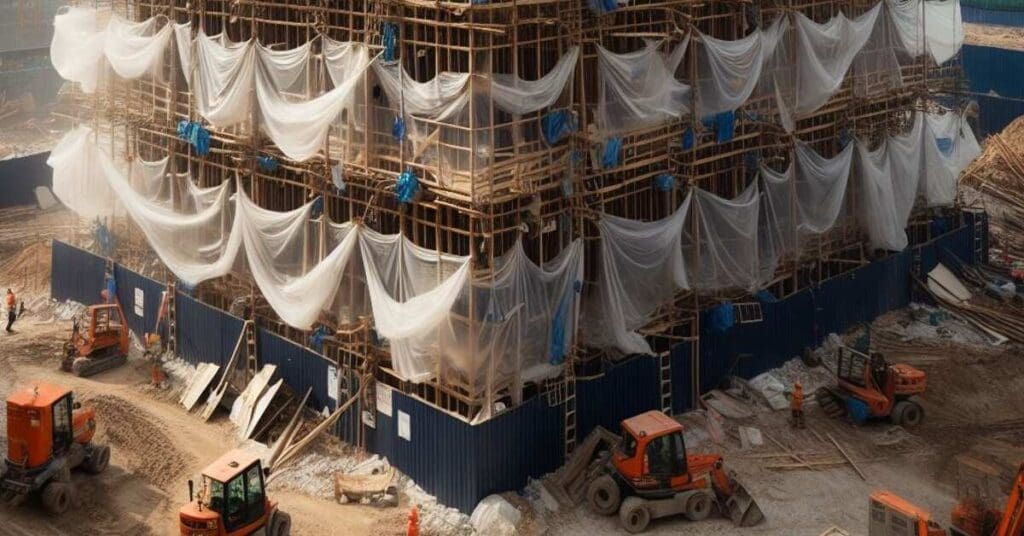
The construction industry is one of the biggest waste producers in Canada and the world, so it’s not surprising that the zero waste movement has taken an interest in this industry. Its ultimate goal is to minimize waste and create a circular economy in which reusing, recycling and repurposing will become the norm.
Such an economy will create resource efficiency and pave the way towards sustainability, which is key to saving our planet. To read more about the principles of a circular economy as applied to green construction, check out Elastochem Adds 200 Eco-Friendly Electric Forklifts to the Fleet.
What Is Zero Waste?
Before we discuss how the zero waste movement can help architecture become more sustainable, we should understand what it is exactly.
The economy we live in today is largely linear and wasteful—we buy, consume and then discard. These discarded materials and products end up in landfills, where they decompose for decades, if not centuries.
But the economy that the zero waste movement promotes—the circular economy—is quite different. Ideally, no products would ever end up in landfills once it was implemented.
Instead, we’d repair the broken ones, find new uses for those that can’t be fixed and recycle as a last resort. That way, we would significantly reduce the need for raw materials, as well as the amount of waste choking up our planet.
How Architecture Can Implement Zero Waste Principles
Get the Green Building Project Checklist
Use this handy checklist on your next project to keep track of all the ways you can make your home more energy-efficient and sustainable.
To build sustainable buildings with minimal negative impact on the environment, architects need to keep zero waste principles in mind. Those can be thought of as four Rs—rethink, reduce, reuse and recycle. So, let’s see how each one can be applied to various construction projects to make them more environmentally friendly.
Rethink
Incorporating zero waste into your buildings starts from the design stage. So before you make any concrete plans, consider how to make your project sustainable.
Are there any innovative solutions and new materials you can use? Perhaps you could invest in more sustainable practices during the construction process itself. Ultimately, what matters is to take your time, research the topic and make informed decisions about your project.
Reuse
In the context of sustainability and construction, reusing can mean two things. Usually, it refers to finding and repurposing various materials instead of using raw ones.
Check any soon-to-be-demolished buildings in your area and see if you can save any materials for your project. For instance, old structural steel parts, solid wood, partitions, glass and finishings can find new life in your building.
But reusing doesn’t refer only to materials. You can repurpose entire buildings—with a few adjustments, a factory can turn into an office building and a hotel into a dwelling.
That’s much better than having a building demolished and constructing a new one in its place. After all, each demolition comes with a lot of waste that ends up in landfills.
And nowadays, architects are well aware of a single building’s potential multifunctionality. That’s why, during the design stage, they often try to create more flexible buildings that might eventually be reused. Keep that in mind as you design your own buildings—you’ll greatly contribute to the zero waste movement that way.
Reduce
The idea of reducing is also a complex one, as it may refer to a number of things. For instance, you may reduce the use of a certain material, and by extension waste creation, simply by consciously resizing the building.
But you may achieve the same or even better results by designing lightweight systems that don’t need as many raw materials and resources to build.
Reducing may also refer to decreasing the carbon footprint associated with a material by using materials produced closer to your construction site.
If you do that, your materials won’t need to travel far to reach you, in which case less gas will be required for their transportation. Plus, excessive packaging to protect the materials won’t be necessary either, which goes along perfectly with zero waste principles.
But your attempts to reduce waste shouldn’t be limited just to the construction process. Think about the materials you’re using and their entire lifecycle.
How long do they last, and how well do they age? What will happen to them after they are no longer useful? Choose your materials carefully, and waste will be much less of a problem.
Recycle
When materials outlive their usefulness, they often end up in a landfill. That isn’t the only option, though. Instead of discarding them entirely, we can create new products from them, either with different or similar characteristics.
But to do that, it’s important to keep the future in mind and use as many recyclable materials in construction as possible. Wood, concrete, glass, paper, gypsum and masonry belong to that category.
Other materials, such as certain insulation materials, plastics, lead and asbestos don’t and should be avoided because they are often harmful both to the environment and people.
In Conclusion
Sustainable architecture requires some careful thinking and planning ahead, but in the end, it’s certainly worth the trouble. After all, a large portion of all waste comes from the construction industry, so minimizing it would do wonders for our planet.
And if anything can help us achieve this goal, it’s the zero waste movement and its four Rs. For more on this topic in relation to Canada, visit More C&D Waste Solutions Coming to Calgary.
Feature image: Jilbert Ebrahimi; Image 1: Jimmy Chan