SPONSORED CONTENT
How Long Does it Take to Charge a Solar Generator?
Brought to you by Bluetti

Published: February 13, 2025
I’m tempted to suggest that the most accurate way to find out how long it takes to charge a solar generator is to add 10 to 20 percent to the manufacturers’ advertised time to get to the actual value. Now, I’m not suggesting that the manufacturers or suppliers are misleading you. It’s just that they will calculate their particular timing under ideal conditions, and ideal conditions are few and far between.
A couple of clouds, a coat of dust on the panels, a little shade and the seasonal position of the sun will affect the recharge time, so err on adding a little extra time and you won’t be disappointed. Among the more significant factors that influence charging time are:
- The type of battery is important because lithium-ion batteries charge faster than traditional lead-acid batteries.
- Atmospheric conditions and altitude influence the amount of sunlight on the solar panel and, consequently, the charge rate.
- The size of the batteries and the area of the solar panels also dictate the charge rate.
Don’t be tempted to leave your solar panels connected to your battery without using a charge controller. Your batteries will suffer if you continue charging them when fully charged.
You can calculate the approximate time it will take to charge your solar generator by using the formula:
Capacity in watt hours divided by the maximum solar input equals solar charging hours.
So, a 1500Wh capacity battery charged by solar panels producing 800W would be fully charged in just over 1.8 hours. (1500/800=1.875 hours)

Get the Green Building Project Checklist
Use this handy checklist on your next project to keep track of all the ways you can make your home more energy-efficient and sustainable.
However, if your solar panels only produce 200 watts, your solar generator will take seven and a half hours to charge. This is where the advertised charging time becomes a little optimistic, as you would need to regularly alter the position of the solar panels to maintain an efficient charging rate. Do also bear in mind that the very best solar panels seldom exceed 25 percent efficiency.
A further limitation on charging speed is that many smaller generators limit the amount of power coming in from the solar panels, and in some cases, particularly with smaller generators, this limitation can be as low as 60 watts.
Here are some approximate charging times for a portable 500 Wh generator connected to solar panels with the following charging power:
- Solar panels producing 50 watts = 12 to 24 hours to full charge
- Solar panels producing 100 watts = 6 to 12 hours to full charge
- Solar panels producing 200 watts = 3 to 6 hours to full charge
The following chart looks at different sized solar generator systems.
Approximate Recharging Times for Solar Generators
| Generator capacity | Time to charge to 100% | Solar panel capacity |
|---|---|---|
| 250 Wh | 3 hours | 110W panel |
| 1 kWh | 3-6 hours | 220W panel |
| 1.2 kWh | 4-8 hours | 160W panel |
| 2 kWh | 5-13 hours | 160W panel |
The chart provides approximate recharging times for generators of different sizes using an array of solar panels. However, a number of other factors influence the time taken to recharge batteries.
Battery capacity and solar panel efficiency are two of the main determinants of the recharging time, while the intensity of the sunlight and the daytime length also strongly influence it.
As a result, you will need to consider the time of year when estimating the recharging time – it will be longer in winter because of the lower intensity of sunlight and there’s also less sunlight due to the shorter days. However, you gain a slight advantage because solar panels are more efficient at colder temperatures.
The other variable you have little control over is your location’s climatic conditions. As a general guide, here are some approximate charging times for a 1kWh generator using a 220 W solar panel in the following cities across Canada.
| City | Approximate recharge time |
|---|---|
| Calgary | 5 hours |
| Toronto | 5 hours 45 minutes |
| Yellowknife | 6 hours 15 minutes |
| Halifax | 6 hours 15 minutes |
| Vancouver | 6 hours 30 minutes |
Annual Photovoltaic Potential in Canada
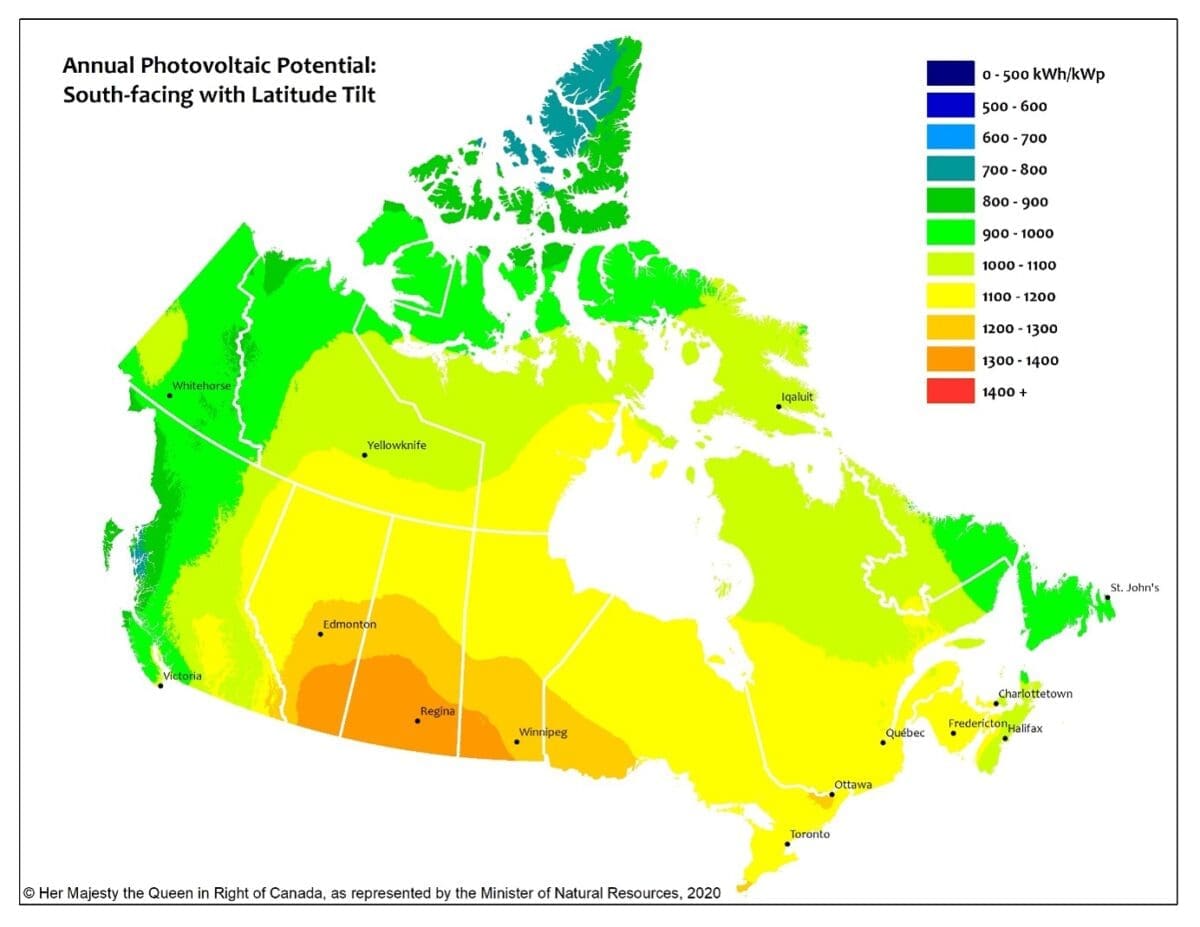
Living in areas that enjoy high levels of sunshine and clear skies makes solar power much more efficient. The above photovoltaic potential map offers a visual representation of this effect.
In Canada, Saskatchewan has the best overall conditions for utilizing solar power, followed by Alberta, the southern parts of Manitoba, Quebec, Ontario, New Brunswick, Prince Edward Island, Nunavut, Nova Scotia, Northwest Territories, British Columbia, Newfoundland and Labrador and Yukon.
Variances in summer and winter daylight hours also significantly affect charge rates, as the shorter sunlight hours experienced during winter prolong the charging time.
Charging a Solar Generator: An Example

Solar generators have alternative charging facilities using conventional AC domestic power and DC power from a car outlet. These are useful alternatives when the weather is not conducive to solar charging.
For example, the Bluetti Elite 200 v2 solar generator stores 2073 Wh and provides 2,600 watts of power. This generator can be recharged using the AC adapter in 1.1 hours to get to an 80 percent charge. Alternatively, the car outlet will do the same job but will take 4.2 hours to charge the battery fully. If you use the dual adapter, the recharge time will be reduced to 1 hour for an 80 percent charge. If the weather improves, you can get fully charged in 2.4 hours using only the clean energy of the sun.
Bluetti is offering an extra 5 percent discount if you use the following code: Green5off