Canada’s commitment to achieving net-zero greenhouse gas emissions by 2050 demands a massive scaling of electricity supply to meet the growing demand required to reach the emission reduction target. In this report we focus on the impact of increased electrification as it pertains to residential use.
Carrot and Stick: Incentives and Taxes Enabling the Transition to Electrification
Since 85 percent of residential greenhouse gas emissions in Canada comes from space and water heating, transitioning from fossil-fuel-powered furnaces to the much more efficient electric heat pumps is the most important key to unlocking the door of decarbonization for homes.
The uptake of heat pumps had been given a boost with the introduction of the Canada Greener Homes Grant in 2021. Given its popularity, it ran out of funding only two and a half years later. However, with the introduction of the Oil to Heat Pump Affordability program in 2023, heat pumps got another boost. The Canadian government has further enhanced the scheme in October of last year to make the transition from oil to electric-powered heating more affordable.
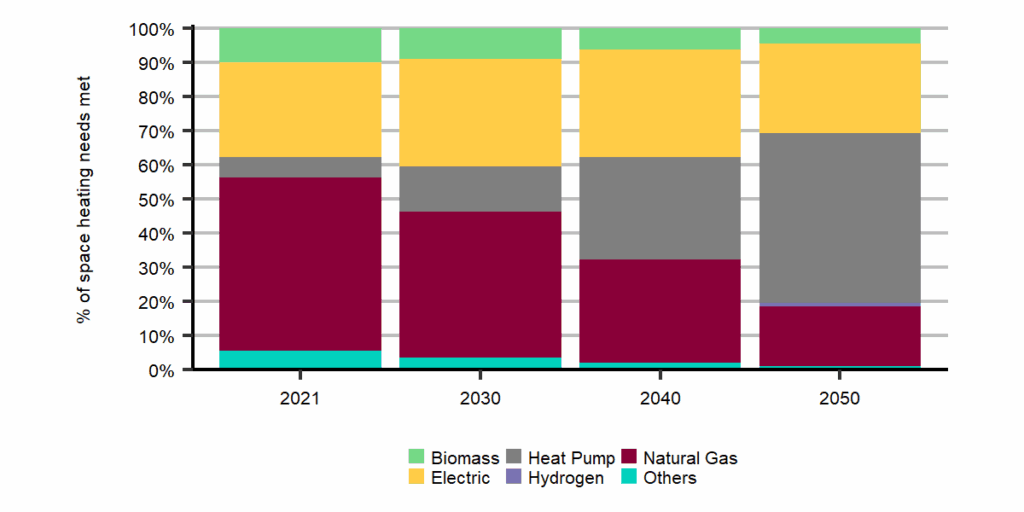
Residential Space Heating by Technology, Global Net-zero Scenario
Along with these incentives the government has also introduced additional taxes to further strengthen the move to cleaner energy.

Get the Green Building Project Checklist
Use this handy checklist on your next project to keep track of all the ways you can make your home more energy-efficient and sustainable.
Since the introduction of the carbon tax in 2018, when the Greenhouse Gas Pollution Pricing Act was enacted, Canada has introduced measures to conform with the Paris Agreement, which requires greenhouse gas emissions in 2030 to be 30 percent less than those produced in 2005.
The initial tax of C$20 per ton of CO2 was more than doubled the following year to C$50 per ton, and subsequently, government announcements confirmed that the tax would increase by C$15 annually from 2023, with a final target of C$170 per ton in 2030.
According to figures released by the Oxford Institute for Energy Studies, the cost implications of the carbon tax for natural gas producers are compelling them to review innovative technologies and diversify into energy sources like electricity and hydrogen.
Important Issues that Affect the Choice of Energy Source
Most domestic energy consumers choose from the following heating systems:
Electric baseboard heaters – An easy to install, low maintenance option that is favoured in a lot of homes where only individual rooms need heating. They are costly to operate as electricity is more expensive than gas. They are inefficient at heating large rooms.
Natural gas furnaces – Given the abundance of natural gas in Canada, these furnaces are currently a cost effective option. Since gas is generally delivered via pipeline, it’s not usually an option for remote communities. The emission of carbon dioxide associated with this energy source is significantly affected by the escalating amount of carbon tax.
Oil furnaces – Popular in regions where where there are no natural gas pipelines. It’s an option that works for off-grid homes. Prices can be higher than natural gas and electricity. High CO2 emissions.
Electric furnaces – They are cheaper to install than oil or gas furnaces, require no exterior ducting and have reliability that lasts thirty years. The heating time for electric furnaces is longer that gas furnaces. They are more suited for homes where electricity costs are lower.
Heat pumps – A more advanced and environmentally friendly option with superior efficiency levels (300 to 400 percent compared to a conventional gas furnace’s efficiency levels of 80 to 90 percent). They are also the most cost-efficient long-term solution to support the transition to electricity’s dominance as a power source.
In certain jurisdictions, new building regulations are being created that either outright ban fossil-based heating in new buildings or impose more stringent energy efficiency standards. In Montreal, for example, by 2025 it will be illegal to install fossil fuel-powered space and water heating systems in new residential, institutional and commercial buildings that are under three storeys. Additionally, in Quebec replacing furnaces with fossil fuel-powered systems is illegal.
Heating water accounts for about 20 percent of energy consumption in Canada, second only to space heating which consumes 64 percent, according to CBEEDAC’s report on Domestic Water Heating and Water Heater Energy Consumption in Canada.
Gas companies will be quick to highlight the efficiency of their products and compare the relative costs of electricity and gas. Fossil fuels are cheaper; however, while that may be true today, future trends seem to favour the cleaner electrical choice. The concept of a net zero emission country by 2050 is not possible while gas is still utilized as a common source of domestic heating.
Grid Capacity and Future Demand
Both the International Energy Agency and the Canadian Climate Institute have raised the alarm about the amount of increased capacity required for Canada to achieve its goal of net-zero status by 2050.
To accommodate the additional burden of charging electric vehicles and home heating systems the size of the grid would have to at least double, according to a study completed in 2022.
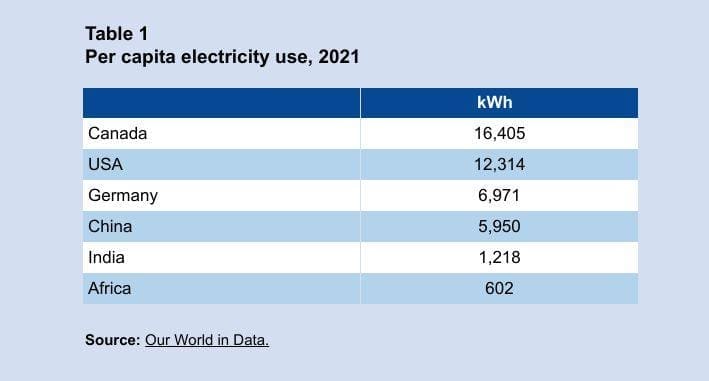
Canada Leads the World in Electricity Use per Capita
Electricity for Heating Systems
Part of the solution is to replace old-fashioned and energy-hungry baseboard heaters with modern heat pumps. While this would reduce the overall electricity demand in certain provinces such as Quebec and Newfoundland and Labrador, a move from fossil fuel energy to heat pumps in Toronto would double the city’s electrical demand as a result of the estimated 650,000 gas furnaces utilized in the area which would have to be replaced with heat pumps.
Electricity for Electric Vehicles
The increase in EVs also affects power demands. The Federal Government hopes to replace internal combustion engine vehicles by 2035, according to the Economist Intellegence Unit
A study conducted by the Fraser Institute highlights the effect of having all passenger vehicles become net zero by 2035. The additional strain EV transportation puts on the grid has a varying impact in different provinces. Quebec, for example, would only require a further 4.6 percent supply, while Ontario would need an additional 26 percent supply.
There is some difficulty, however, in making precise predictions as the load demands for charging EVs do not correspond with high load times for domestic use. A further element to consider is that EVs may be able to provide support during high load times by feeding back into the grid using the stored energy in their batteries.
The Projected Contribution of Electricity to the Energy Requirements
The demand for electricity worldwide will inevitably increase as the Paris Agreement supports the transfer of energy sources from natural gas to electricity. Canada’s share of electricity in energy consumption was 24 percent in 2020 and is projected to climb to 59 percent in 2050, according to Enerdata. Conversely, Canada’s share of fossil fuel consumption is expected to drop from 76 percent in 2020 to 17 percent in 2050.
Canada is fortunate in that more than two-thirds of its electricity generation is sourced from renewable sources like hydro and thermal, while solar and wind power also provide additional power. In 2022, over 80 percent of energy production stemmed from non-GHG-emitting sources.
How to Effectively Reduce Harmful Domestic Emissions
Each province has dissimilar targets to reach zero emission levels successfully. In provinces like Ontario, British Columbia and Quebec, where electricity generation is almost totally sourced from non-fossil-fuel sources, the transition from gas-heating furnaces to heat pumps will comfortably achieve the goal of zero emissions.
However, in provinces such as Saskatchewan and Alberta where electricity power is generated from burning fossil fuels, it makes little sense to replace gas furnaces with electrically powered heat pumps when the utilities’ that generate electricity will emit greenhouse gases.
So, in these provinces individual homeowners will need to install alternative power sources like solar or wind turbines. In these cases, a hybrid model would be the most logical system to employ where gas is only utilized when the green energy sources are unable to meet the demand.
In either situation, the limited availability of electricity would suggest domestic users switch from energy-sapping baseboard heaters to more efficient heat pump systems. Though heat pumps alone are not the sole answer to increased energy efficiency – maintaining an airtight building envelope and the quality of the building’s insulation is also critical to ensure a comfortable environment.
Some Long-Term Projections
The most significant consequence of striving for a zero-emission status by 2050 is that Canada’s electricity supply will have to increase by a factor of between 1.6 to 2.1. In addition to this substantial growth in generation capacity, power generation will also need to shift towards energy sources that do not emit greenhouse gases like solar and wind. By 2050, the generation of power from fossil fuels will have to be limited to less than one percent of the total power generated.
Residential End-use Energy Demand (Petajoules)
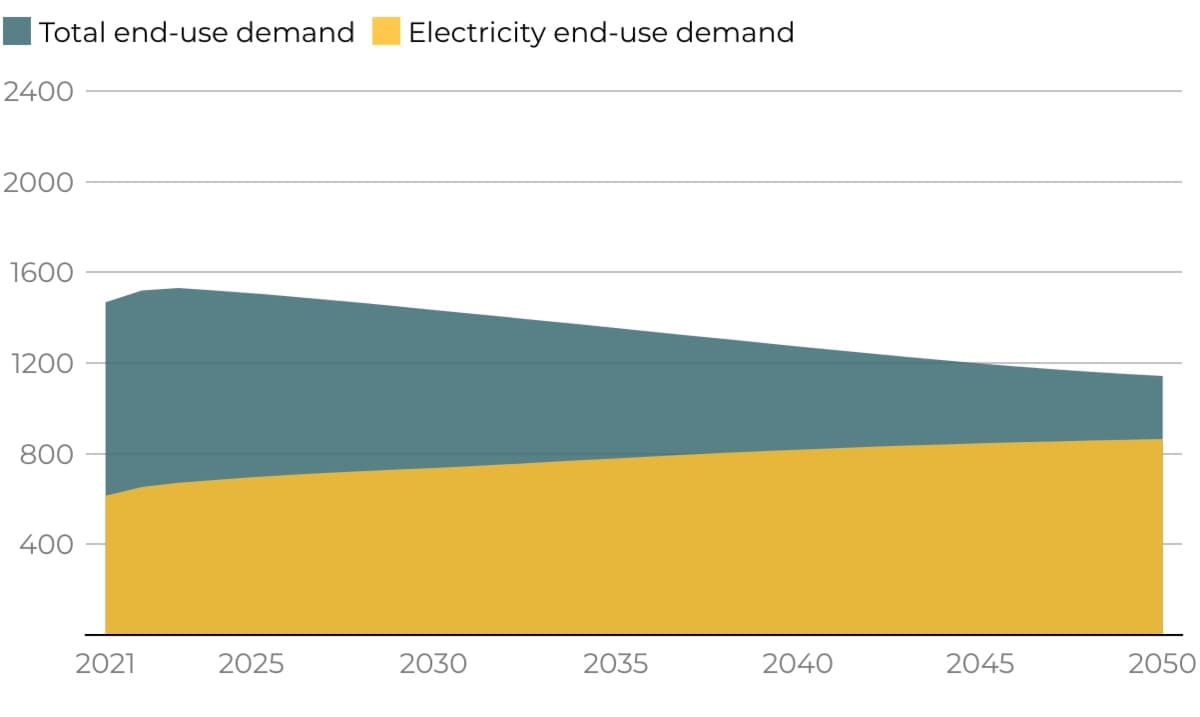
Canada Energy Regulator’s scenario for energy supply in 2050 indicates that wind power will have to increase ninefold, supported by a steady increase in rooftop solar installations.
The installation of more efficient heating equipment (e.g. heat pumps replacing baseboard heaters) and buildings becoming more energy efficient with improved insulation, will reduce electricity consumption and the cost of electricity by 2050, according to the CER.
Gas suppliers are naturally confronting the move to replace gas furnaces with electrical systems, but whatever efforts they make to lobby policymakers will have limited impact as the country has already charted its course towards net-zero greenhouse gas emissions.
Federal, provincial and municipal governments across the country are changing their policies and building codes at a time when electrification technologies are improving and costs are coming down.
The challenges to making the switch to electricity rely on the additional cost that the homeowner would have to bear and the questionable ability of the electricity supply being able to meet demand. Incentives to increase adoption of solar and heat pumps as well as carbon taxation will play major roles in this regard.
When the energy demand forecast is considered, it would seem that the most practical scenario would be to support the move to zero emissions by using fossil fuels when peak demand cannot be met by the available electricity supply.