
A toilet needs to be easy to maintain, hygienic and simple to operate. We all tend to minimize interaction with our own waste, and frankly, I don’t recall a conversation in which a friend proudly regaled us with the new features of his toilet.
Nevertheless, an efficient waste disposal system can reduce impact on the environment. Today we’re going to compare two options for those wanting to dispose of their human waste in a more sustainable way: composting toilets and incinerating toilets. We’ll review both systems’ essentials and weigh their respective benefits to help you make an informed choice.
Essential Elements of a Composting Toilet
Composting toilets function with millions of microbes and bacteria happily breaking down human waste in a rich oxygen environment. The efficient high-carbon system is free of any unpleasant odours, and the completed process results in a rich humus.
For composting toilets to operate efficiently, sufficient amounts of carbon-rich material, such as sawdust or leaf litter, must be added to prevent unpleasant odours.
Modern composting toilets separate liquid and solid waste, promoting more rapid evaporation. Traditionally, composting toilets scored maximum points on the environmental scale using no water or power, but introducing a small fan or heater to the unit does improve the evaporation rate. This is important as water makes up almost 90 percent of human waste.
You may well ask, so where does the liquid waste go? Some clever modern designs divert liquids from the solid waste in the toilet bowl. Where the toilet has been permanently installed, the liquid waste is diverted to a French drain. Absorbent material like sawdust or coconut fibre is added to the system to assist in drying out the waste.

Get the Green Building Project Checklist
Use this handy checklist on your next project to keep track of all the ways you can make your home more energy-efficient and sustainable.
Fans can also increase the evaporation rate and exhaust air from the bathroom to the outside to ensure the room is odour-free.
Many modern composting toilet designs have a sealed lid, which creates an airtight seal when the toilet is not in use. This ensures that the area is odour-free.
Disposing of waste in a composting toilet seems to attract the most resistance; however, modern designs ensure the process is quick and easy. Various options are available for disposing of the waste depending on your location and the availability of a composting facility.
Where no local composting facilities exist, the content of composting toilets can be added to solid waste disposal facilities, much like other items such as diapers.
Pros and Cons of a Composting Toilet
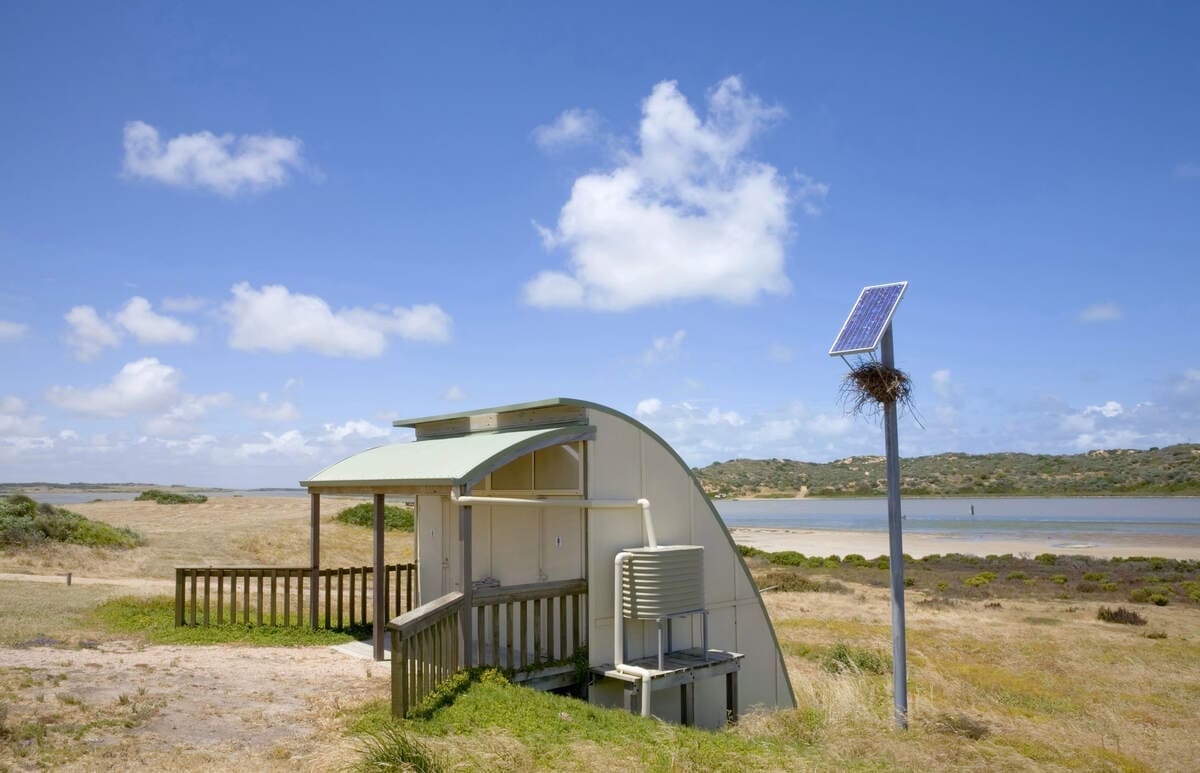
As water availability becomes an increasing concern, the composting toilet’s ability to function without using water is a significant advantage. Composting toilets are not reliant on additional power sources, so they are ideal for remote localities and off-grid operation.
Other advantages include the toilet’s comparatively low cost and maintenance requirements. However, some essential tasks are required to keep the toilet functioning properly.
- Regularly adding carbon-rich materials to maintain the correct balance between carbon and nitrogen.
- Removing the finished compost from the composting chamber on a regular basis to ensure sufficient space for the addition of new compost.
- Ensure that the venting system provides sufficient oxygen for microorganisms to energetically break down the waste and prevent odours.
Modern design has solved the problem of excess liquid storage, and innovative design separates liquid from solid waste to remove the potential of unpleasant odours.
Well-managed compost disposal results in a nutrient-rich material to fertilize gardens and eliminate the need for synthetic fertilizers.
Essential Elements of an Incinerating Toilet
Incinerating toilets use high temperatures to reduce human waste to small amounts of ash. This process significantly reduces the volume of waste and produces biodegradable ash.
Like combustible toilet systems, incinerator toilets don’t need water to function, so they also score well as environmentally friendly systems, even though they require energy to incinerate the waste. There are some incinerator models that do offer a water option to clean the bowl, but the more common variety uses a wastepaper liner.
Incinerator toilets work with electricity, natural or propane gas. They must be vented because the incinerator reaches a temperature of almost 1,400°F (750°C).
Incinerating toilets that rely on electrical power have an element that produces radiant heat. However, this also means that in the event of a power failure, the toilet’s incinerating function will not operate.
The flushing mechanism in an incinerating toilet differs slightly from that of conventional toilets in that the bowl is lined with a wastepaper liner that is flushed away after use.
Incinerating toilets can handle both liquid and solid waste, and more advanced systems have a filter in the vent pipe to remove unpleasant odours.
After using the toilet, waste is deposited into the reservoir located under the incinerator, which reduces the waste to ash during the burn cycle. Safety features ensure the burn cycle is interrupted if the toilet lid is lifted and only starts again when the lid is replaced and the flush button is depressed.
Pros and Cons of an Incinerating Toilet
Incinerating and composting toilets provide an intermediate function in disposing of human waste. Both toilets need their contents physically removed, and this is where the incinerating toilet has the advantage over its composting rival in terms of ease of use.
The volume of waste in the incinerating toilet that needs to be physically removed is minimal compared to that of a composting toilet. In addition, the sterile ash is free of pathogens and can be easily disposed of. However, the contents need to be disposed of more regularly than composting toilets due to the smaller holding capacity.
Incinerating toilets are ideal for areas with no or limited water supply. Reducing human waste to sterile ash promotes a healthier environment and reduces the risk of contaminating the local ecosystems.
Operating an incinerating toilet is simple. Once the paper liner in the toilet bowl has been filled, a trap door is released and the waste is dropped into the incinerating chamber.
There are a few crucial maintenance requirements that need to be followed:
- The ash container needs to be regularly removed and the ash disposed hygienically.
- The elements in electric models or the burners in gas models need to be regularly inspected to ensure that they operate efficiently.
- A qualified technician may need to service the unit from time to time to ensure it operates hygienically and efficiently.
The installation of the incinerating toilet is basic and requires no plumbing. All that is needed is the installation of a vent pipe and an electrical connection for the heating element if the system is electric or the connection to a gas supply if using propane or natural gas.
The initial cost of an incinerating toilet is high, and the system’s running costs depend on the price of electricity or gas to energize it. On average, the unit will use between 1.5 to 2 kilowatt-hours of electricity per cycle, and even when using gas to heat the system, an electrical supply will be required to power the exhaust fan.
Incinerating toilets use a lot more energy than composting toilets since they are burning the waste and they also require the disposable liners, making them the less sustainable option of the two.
Relative Costs of Incinerating vs Composting Toilets
Composting toilets cost between $1,000 and $2,000, but you can save some money by building your own DIY unit. While smaller models are available for as little as $600, you do need to assess the unit’s ability to handle the amount of waste produced.
If you intend to manage the disposal of the composted waste, it may be necessary to add a composter receptacle to complete the composting process. Some insulated versions can be left outside during winter, and the insulation promotes active decomposition by maintaining a high temperature inside the receptacle.

Other products that may be useful are packets of microbe mixtures that accelerate the decomposition process.
The addition of an exhaust fan may help remove any odours and these are available in both DC and AC versions at around $50 to $100.
Incinerating toilets start at around $2,000 and can move up in sophistication to models that cost $5,000, which would include a venting system. An additional expense is the bowl liners. These are single use and can run you 10c or more apiece.
While composting toilets have minimal running costs, incinerating toilets use electricity at 1.5 to 2 kilowatt hours per cycle.
Canadian Permits and Restrictions on Composting and Incinerating Toilets
Local authorities seem to lack a clear policy regarding composting and incinerating toilets. Given the somewhat uncertain rules, it would be best to consult with your local building inspector or council to remove any doubts about the legality of installing a composting or incinerating toilet.
While installing conventional water connections for waterborne sewage may be compulsory for new buildings, there is no restriction on fitting a composting or incinerating toilet.
Building inspectors may insist on the composting or incinerating toilet being approved, but there is some ambiguity about what constitutes an ‘approved’ unit. It may take some convincing to get the support of your local building inspector or council, and having a certificate to show that your unit is certified may be helpful. Popular certificates are the ETL certificate for urine-diverting toilets and the NSF 41 for non-diverting units.
Rural environments seem to be most comfortable with composting toilets because they require no utilities, but as water becomes ever-scarcer, their environmental appeal grows.
The issue of efficient and hygienic disposal of composting material is delicate and sensitive and mainly depends on individual preferences. It is no wonder that official policy remains somewhat unclear.
Composting and incinerating toilets are very popular choices for cabins, rustic homes, RVs and boats. Happily, they have made the unpleasant trip to the outhouse on a cold and wet night a thing of the past and they have done so in a very environmentally friendly way.
Quick Comparison of Incinerating and Composting Toilets
| Composting Toilets | Incinerating Toilets | |
|---|---|---|
| Cost | Cheaper | More expensive |
| Running costs | Almost zero | Electricity and bowl liners |
| Ease of installation | Easy | Easy |
| Venting | Good idea | Essential |
| Maintenance | Low and simple | Low but may require a technician from time to time |
| Disposal of waste | Requires careful attention | Easy |
| Frequency of waste removal | Infrequent | Frequent |
| Transportable | Easy to transport | Not easy to transport |
| Off-grid ability | Great off-grid capability | Needs electric or gas supply |
| Bowl cleaning | Required | Not required because of liner |
| Emptying capacity | Every couple of months | As much as daily |
| Good for the environment | Scores high | Not quite as good |
Read more on this topic in Composting Toilets: Taking Responsibility for Our Own Waste.
Images from Depositphotos