
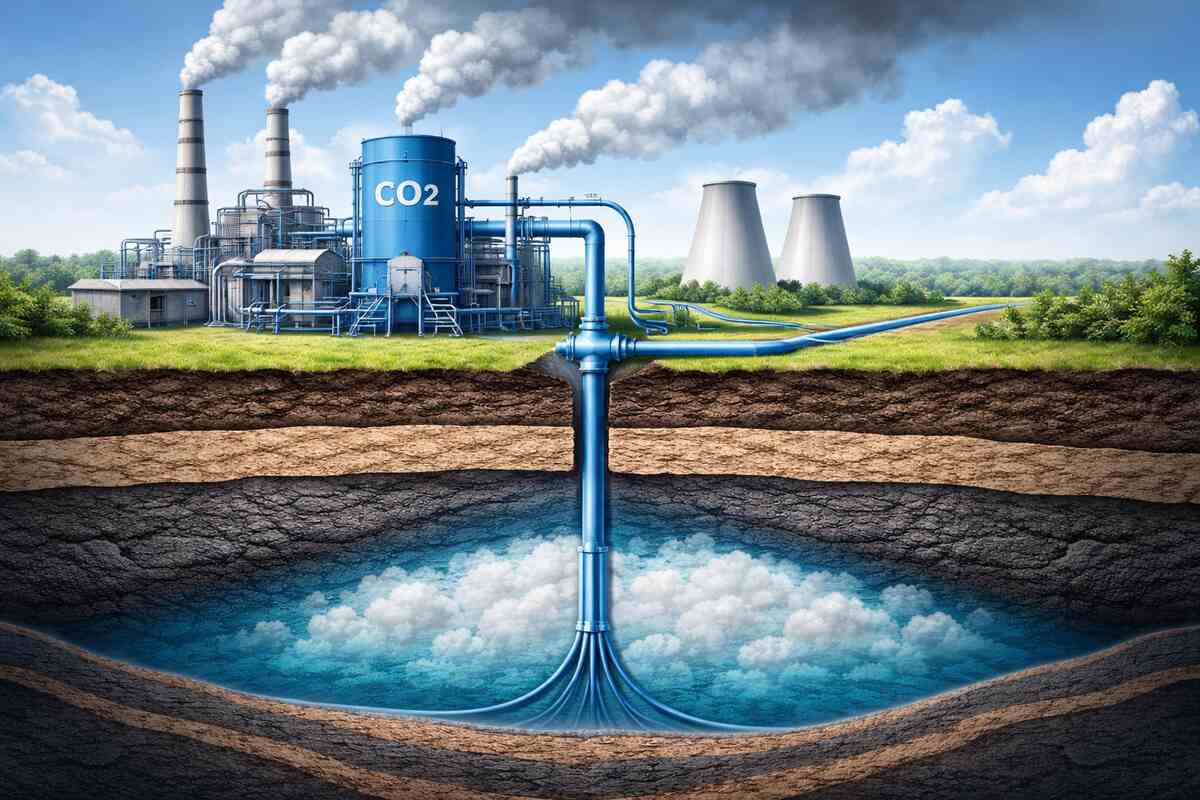
Carbon capture is no longer central to the global decarbonization pathway, according to the latest net-zero analysis from the International Energy Agency.
In its updated Net Zero Emissions by 2050 scenario, the agency places renewables, electrification and energy efficiency firmly at the centre of emissions reduction efforts, while carbon capture, utilization and storage (CCUS) is assigned a limited, supporting role.
Under the IEA’s pathway, solar and wind are expected to deliver nearly three-quarters of global electricity by mid-century, with hydro and nuclear lifting low-carbon generation above 90 percent. CCUS contributes less than 5 percent of total emissions reductions economy-wide, including just 1.2 percent from the power sector.
Cost and Deployment Speed Drive the Shift
The agency cites cost, speed and scalability as the primary reasons for the change. Renewable energy capacity expanded by nearly 800 gigawatts globally in a single year, driven largely by rapid solar deployment in China.
Distributed solar is also reshaping power systems in emerging economies, with Pakistan importing tens of gigawatts of panels outside traditional grid structures in just two years.
Carbon capture has not followed a similar trajectory. Projects are bespoke, tied to specific facilities and emissions streams as well as being exposed to high material and construction costs.
The IEA notes that full CCUS systems in Europe cost between €105 and €280 per tonne of CO₂ captured once transport and storage are included, levels that carbon markets rarely sustain without permanent subsidies.

Get the Green Building Project Checklist
Use this handy checklist on your next project to keep track of all the ways you can make your home more energy-efficient and sustainable.
Canada Remains a Global CCUS Outlier
Despite the IEA’s global shift, Canada continues to expand its carbon capture sector. According to the Global CCS Institute’s Global Status of CCS 2024 report, Canada ranks third worldwide for CCUS projects in development and hosts about 8.8 percent of global capture capacity, despite accounting for just 1.4 percent of global emissions.
Operating facilities in Canada provide roughly 4.4 million tonnes per year of CO₂ capture capacity, with five capture plants, four dedicated storage sites and more than 460 kilometres of CO₂ pipeline infrastructure in service. As of May 2025, Canada had captured approximately 21.6 million tonnes of CO₂ and stored more than 62 million tonnes, according to Natural Resources Canada.
Public Funding Continues to Support Projects
Federal and provincial governments remain active funders. Ottawa committed more than $21 million in 2025 to five Alberta-based carbon capture projects through Natural Resources Canada’s Energy Innovation Program, including transport, storage and capture technologies.
WATCH » Carbon Capture and Storage Projects Receiving Funding
A Narrower Role Going Forward
The IEA stresses that CCUS is not being abandoned, but repositioned. In sectors where electrification is impractical, such as cement, steel and certain chemical processes, carbon capture may still play a role. However, the agency’s latest pathway makes clear that the backbone of net zero will be built on technologies already scaling rapidly, rather than those still struggling to do so.
Images from Depositphotos