
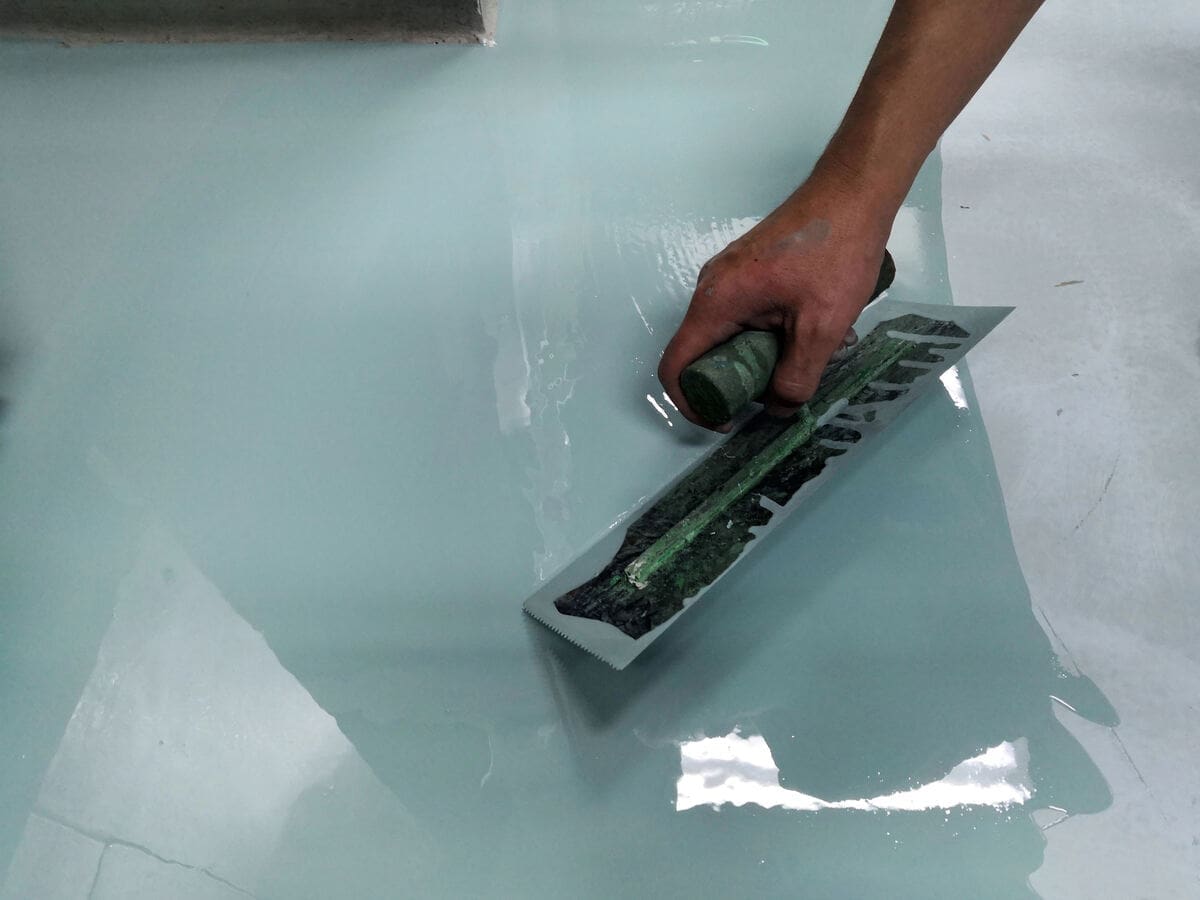
An epoxy bathroom floor ticks almost all the boxes in terms of durability, appearance and moisture resistance. It’s easy to clean and can be made to have a smooth or textured surface, whichever you prefer. Best of all, you can get really creative with epoxy. You can embed materials in it, you can go with a 3D look, marble, terrazzo, checkerboard – there’s no shortage of ideas when working with this material.
A new epoxy floor can revive an old bathroom and give it a warm and welcoming appearance, however it does come with environmental and health concerns. We’ll be exploring how to epoxy your bathroom floor using bio-based resins as an eco-friendlier and healthier alternative.
How to Epoxy Bathroom Floors

There are two rules about working with epoxy, and if you keep to them, the result will be a beautiful floor.
Rule number one is to make sure your preparation work is thorough and complies with the manufacturers’ conditions. Drying times are not merely suggestions. They are provided for a reason, and making sure your preparation time embraces the drying times is going to make your project so much more enjoyable.
Rule number two is to keep things as clean as possible. Dust and dirt have the potential to ruin your hard work, so take extra care and make sure everything is spotless before you apply the epoxy.
There are four stages for making your new epoxy bathroom floor a masterpiece. Always make sure to check the curing times for the different epoxy coatings, and be mindful of the fact that the curing times are dependent on the ambient temperature.

Get the Green Building Project Checklist
Use this handy checklist on your next project to keep track of all the ways you can make your home more energy-efficient and sustainable.
1. Surface Preparation
Surfaces need to be clean and free of any loose material. A rough texture similar to an 80-grit sandpaper will ensure a good bonding profile for the curing compound. Levels should be checked to ensure that there are no bumps that could affect the smoothness of the floor.
A note of caution is that new concrete needs a lengthy period to cure before epoxy primer can be applied. It’s best to do a moisture test to ensure the surface is ready to accept the coating. Normally, thirty days is the minimum period required for the concrete to cure properly.
2. Primer Application
The primer is the bond between the substrate and the epoxy, and the final quality of your floor will depend on the attention you devote to ensuring a perfect bond between the epoxy primer and the floor.
Applying a primer is a recommended step because it seals the surface, requiring less epoxy to coat your floor. Less material means less cost both to you and to the environment. It also improves adhesion, fills in imperfections in the flooring and reduces the chances of bubbling in your epoxy.
A six-inch roller seems to be the right size tool to apply the primer, but do focus on getting a finish that is as uniform as possible. The end result depends on this, so avoid dips and bumps and get the coating as flat as possible.
To save yourself some time, certain epoxy resins are self-priming so you only need to do one application.
3. Applying the Resin
Once you have applied the epoxy primer, you will need to follow the product’s drying time specifications. Normally, manufacturers specify the primer’s minimum and maximum curing times. Make sure to comply with these requirements.
Once the primer has cured, confirm the pot life of the mix before you add the hardener to the resin, and make sure you can use all the product in the time allowed. Once the epoxy coating has been applied, it’s time to take a break and relax while the coat dries before the topcoat is applied. If you are going to add some creative artwork and apply a clear top coat, then this is the time to lay down your masterpiece.
4. Topcoat
Applying the topcoat is the chance to display your artistic flair. Here, you can add colour and texture to create a unique design. A clear final topcoat usually covers creative designs and colours. The choices are almost endless, and my only concern is that the floor will get wet from time to time, and a smooth floor will be slippery, so adding an anti-slip additive to the final topcoat is a good idea.
Rubber granules added to the topcoat mix are an ideal way to create a non-slip surface, but remember to stir the mixture often while applying the topcoat to ensure an even spread of the granules.
Rubber granules are kinder and more comfortable for bare feet, and for this reason, I prefer them to other non-slip materials like grit or sand.
Bio-based Resins as an Alternative
While new epoxy flooring is a great way to revamp a tired bathroom, it does come with some environmental concerns. Epoxy resin is one of the most popular resins in the industry, but epoxy resin made from petrochemical sources is not sustainable and is harmful to the environment both during production and disposal. Furthermore, working with it can cause respiratory and other health problems such as contact dermatitis.
The production of traditional epoxy resins creates greenhouse gases, and the finished product is not biodegradable, but this doesn’t need to stop you as there are several environmentally friendly and sustainable alternatives to traditional epoxy resin. Bio-based epoxy resins are the solution to many of the concerns regarding possible damage to the environment. They are made from renewable plant-based sources so they have a lower carbon footprint than conventional epoxy resins, which are petrochemical based. While the feedstocks are growing they also absorb CO2 unlike using fossil fuels that just release carbon dioxide. Other environmental benefits that bio-based epoxy has over conventional epoxy include: reduced toxicity, more energy-efficient production and better biodegradability.
Consider using one of the following bio-based epoxies as an alternative to harmful petroleum-based ones that damage the environment.
Rosin-based Epoxy Resin
Rosin, which is used in the manufacture of epoxy, is a resin made from pine trees and other plants. The resin is chemically modified to produce bio-based epoxy resin.
Carbohydrate-based Epoxies
Carbohydrate-based epoxies, together with those made from sugar like sorbitol, are great alternatives to their petrochemical competitors. Isosorbide is another natural plant product that can produce epoxy resin. The introduction of isosorbide promotes an epoxy resin with high gloss characteristics and good UV, scratch and impact resistance, making it an excellent choice for bathroom floors.
Lignin-Based Epoxy Resins
Lignin is a by-product of the paper industry and creates an epoxy resin with significant mechanical stability properties. It is used in high-strength applications and reduces CO2 emissions, formaldehyde and other harmful chemicals as compared to conventional epoxy.
Epoxy Resins made from Vegetable Oil
Many vegetables, such as soybeans, linseed and castor oil, can be used to manufacture epoxy resin. These resins offer a great alternative to environmentally damaging petrochemical-sourced resins.
What to Look for When Choosing the Right Epoxy Resin for Your Bathroom
There is a wide range of bio-based epoxies available for bathroom floors. If your local hardware store doesn’t stock it, search online for terms like “bio-based epoxy,” “biobased resin” or “bioepoxy.” Choose one that ticks the following boxes:
- Low-carbon raw material
- Low or zero volatile organic compounds (VOC) emitting properties
- Suitable for DIY projects
- Great water resistance
- Scratch and wear resistant
- Non-slip finish
Remember to carefully plan your work schedule to accommodate all the drying times for each application, and your project will make a smooth transition to a beautiful, environmentally friendly bathroom.
Want some inspiration? Check out our Pinterest collection of epoxy bathroom floor ideas.