Spurred on by government incentives, the number of heat pump units installed has grown substantially in recent years in BC and across Canada. Given their high efficiency and their consequent ability to save you significantly on energy bills, the technology itself is an easy sell. Cost, however, is a whole other matter. And that’s what we’ll be looking at here. We’ve assessed the average costs you’ll expect to pay in BC, based on the most common systems installed in the province: ductless mini splits, multiple head and ducted air source heat pumps. Specifically, we’re looking at the average installation costs that people were quoted by installers.
In most cases, the bigger the unit, the more expensive it will be, so we need to compare the heating or cooling capacity of different-sized heat pumps. For a strange but historical reason, this is measured in tons. It has nothing to do with how heavy the unit is but goes back to the days when a ton of ice was used to cool the house down. Heat pumps are also sized in BTU (British Thermal Units) with 12,000 BTU equalling 1 ton.
Common Types of Heat Pump Systems
The next variable we need to deal with is the type of system that will be fitted. Here are the most common types of systems being installed in BC.
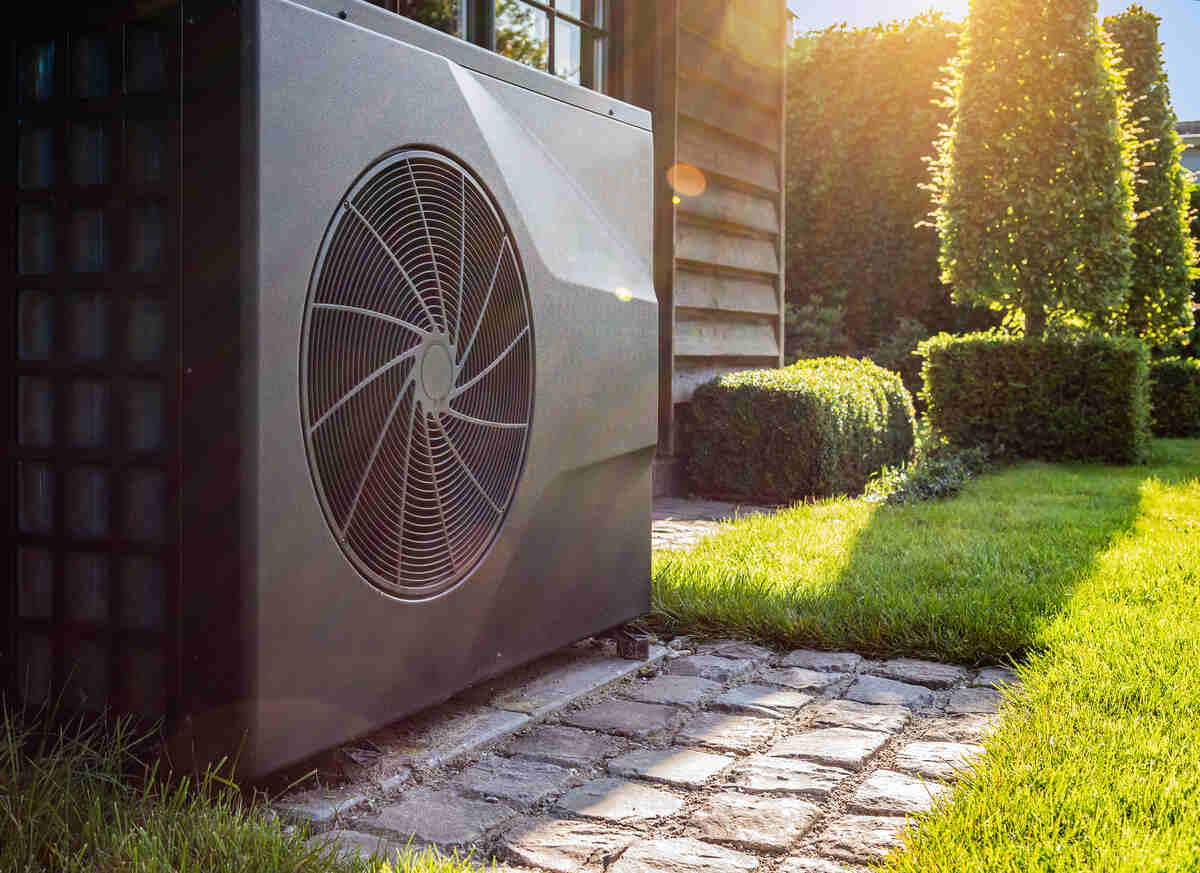
Ducted air source heat pumps – The main power unit is located outside and provides air at the required temperature to the internal system of ducts for distribution throughout the house. By using vents fitted within the ducting, rooms can be included or excluded from the heating and cooling system.
Ductless mini-splits – These systems have an external unit coupled to a head unit installed inside the house. The mini-split configuration is the cheapest installation and a more cost-effective system than the ducted system as it does not require installing ducts. Therefore, it’s great for retrofitting purposes as installation is a lot easier. Mini-splits are particularly for homes that need to just head a particular room (additional mini-splits could be purchased for additional rooms or, alternatively, one could opt for a multi-split).
Ductless multi-splits – Similar to mini-splits, but these are primarily suited for homes with multiple rooms that need heating and air conditioning. These systems have multiple internal units that are coupled to a single external unit.
Heat Pump System Costs

Get the Green Building Project Checklist
Use this handy checklist on your next project to keep track of all the ways you can make your home more energy-efficient and sustainable.
Heat pumps between 1.5 to 5 tons have an average cost of $5,200 to $16,250. Models that are suited for a cold climate cost more due to their ability to perform efficiently at low temperatures. All prices are outlined in the chart below.
If you want to go bigger than a 5-ton unit, I’m afraid you’ll be in for a bit of a shock. A 6-ton unit will cost double the $20,000 price of a 5-ton unit. Moving above a 5-ton production unit will double equipment and associated labour installation costs. However, in most cases you wouldn’t need to go beyond 5-ton as you’d just be installing multiple heat pumps at that point.
Seasonal Efficiency Ratings (SEER) and Heating Seasonal Performance Factor (HSPF) are useful, practical indicators of the heat pump’s efficiency, and you should evaluate which side of the equation is more important for your circumstances. A higher SEER figure means the heat pump is highly efficient for cooling, while a higher HSPF figure indicates an efficient heating system.
Average Heat Pump Prices By Size (Not Including Installation)
| Size in Tons | Average Price for Standard Models | Average Price for Cold Climate Models |
|---|---|---|
| 1.5 tons / 18,000 BTU | $5,200 | $8,750 |
| 2 tons / 24,000 BTU | $5,750 | $9,500 |
| 2.5 tons / 30,000 BTU | $6,250 | $10,500 |
| 3 tons / 36,000 BTU | $6,750 | $13,000 |
| 3.5 tons / 42,000 BTU | $7,500 | $13,500 |
| 4 tons / 48 | $8,500 | $14,000 |
| 5 tons | $10,000 | $16,250 |
Some Associated Costs to Consider
Apart from the direct cost of the system, you may need to consider ancillary costs.
- Insulation and air sealing will greatly improve your heat pump’s overall performance. The additional cost depends on various factors, such as the type of insulation and condition of your home’s envelope, and can run you anywhere between $1,000 and $15,000.
- The additional load on your electrical supply may require upgrading your breaker box and replacing your 100-amp breakers. Budget for between $1,000 and $10,000 for possible upgrades.
- If you’re going to install a system that uses the existing ducting, you may have to allocate some funds to correct any leaks. The costs depend upon the condition of the ducting, so a budget between $1,000 and $5,000 should suffice.
Single-stage, Two-stage and Variable-speed Heat Pumps
The price of the heat pump is also dependent on the type required. And these types are related to their sizing. A single-stage heat pump is the cheapest option and will be sufficient for smaller areas (up to around 1,200 square feet). However, this type of pump has a heat range that switches it on and off, so there will be some temperature variation.
For larger areas, a two-stage or variable-speed heat pump is required. Although more expensive, they do offer a more stable temperature control.
Choose the Correct Size Heat Pump
It’s important to select the correctly sized unit for your particular circumstances. A too-small unit will be overworked, while a too-large unit will be under-utilized. Some manufacturers provide a selection tool so you can make an informed opinion regarding the size you need. But they are just an estimate. You can
You will need to do a Manual J load calculation for a more accurate estimation of the size of heat pump you will need for your home. If your installer doesn’t do a Manual J calculation for you, you could do it yourself using CoolCalc. It’s a relatively easy to use tool for this type of calculation.
Remember to consider the range of temperatures in which your heat pump will be required to operate. Heat pumps that can operate at lower temperatures tend to be more expensive.
Average Prices for Heat Pumps Installed in British Columbia
The following data is based on quotes that heat pump buyers across BC reported on the Heat Pump Quote Comparison Survey. While most heat pump sizes have between 10 and 50 quotes reported, which provides an accurate average cost, some sizes do not have many, which is why the pricing is off in a couple of circumstances.
Heat pumps in the 2 to 3 ton range are the most commonly installed size in Canada. So given the economies of scale, it could reflect the lower pricing at that size than heat pumps that are smaller.
Prices with an asterisk beside them indicate that there were 2 or fewer quotes.
| Size of Heat Pump | Forced-Air Ducted | Mini-split | Multi-split |
| 12,000 BTU / 1 ton | $5,926* | $15,000 | |
| 18,000 BTU / 1.5 ton | $18,926 | $6,334 | $9,000* |
| 24,000 BTU / 2 ton | $18,235 | $17,061 | |
| 30,000 BTU / 2.5 ton | $17,796 | $23,000* | $19,007 |
| 36,000 BTU / 3 ton | $20,019 | $22,715 | |
| 48,000 BTU / 4 ton | $22,693 | $13,875* | $23,653 |
| 60,000 BTU / 5 ton | $27,490* | $23,365* |
These are just average prices to give you a general idea of what you can expect to pay. However, prices vary widely for the supply and installation of the heat pump to reflect the individual circumstances surrounding each installation.
So, the best possible policy is to get quotes from a few reputable HVAC installers (or get several if you have the time). There are plenty of local businesses in BC who specialize in doing heat pump installation so it’s worth asking around. You wouldn’t want to just get one quote and that quote happened to be from a business that didn’t give you a good price. It’s a good idea to check the business’ ratings and reviews online on sites like Google, HomeStars and Yelp. And if you know anyone who has had a heat pump installed local to you, see if they’d vouch for the installer who did the work for them.
Aside from installation, you also need to make an informed opinion about the quality of the unit. Higher-end heat pumps do carry a premium, but this is often offset by extended warranty periods and greater utility bill savings.