A Guide to Alberta Electricity Rates and How to Save on Your Bills
Discover the Different Electric Rates Available and How to Make Use of the Deregulated Market to Save Money


You’re lucky if you live in Alberta, because you can choose how much you pay for electricity. Unlike other provinces, Alberta has a deregulated electricity market, and this means that the Government of Alberta does not control electricity prices and usage. Prices follow demand and supply patterns, allowing competitive pricing. This gives you, the consumer, the ability to choose the provider that gives you the best value for your money!
In this guide, we’ll go into more detail on how electricity rates in Alberta work, current rates and how homeowners can save money today and in the future.
Alberta’s Electricity System
Regulated vs Competitive Rates
There are two ways in which you could be billed for your usage: regulated rates and competitive rates and in both cases, the cost of electricity in Alberta is measured in cents per kilowatt-hour (¢/kWh).
If you don’t choose a utility provider, you’re automatically placed on a regulated plan provided by the Alberta Utilities Commission (AUC) called the ‘Rate of Last Resort’ (RoLR). RoRL are set every two years based on market prices of electricity, global market conditions and local transmission charges, among other factors.

Get the Green Building Project Checklist
Use this handy checklist on your next project to keep track of all the ways you can make your home more energy-efficient and sustainable.
Regulated rates often give you little control over how much you pay because the rate is set. Though the prices are mostly stable during the contract period, it may be higher or lower than the competitive rates where you have better control over your savings.
Competitive rates on the other hand allow you to shop around and sign a contract with a utility company.
Fixed vs Floating Rates
If you choose to opt for competitive retail pricing, you have the option to pick between fixed or floating/variable rates. With a fixed rate, the price you pay is locked in for a specified term. Floating rate, on the other hand, changes monthly based on market conditions. The price can go up or down depending on the market, so you could potentially save money when prices are low, but you also risk paying higher prices when the market is more expensive. Floating rates changes every hour, and what you will eventually pay the end of the month would be based on the average pool price for the pay period.
Locking your price in will give you price certainty and will remain the same despite market fluctuations.
Current Electricity Rates in Alberta
Regulated Rates
If you are on a default RoRL plan, your electricity is sold to you by a retailer who handles the billing and customer service for your electricity. You typically don’t have a choice between retail companies and are often automatically assigned a retailer who manages your electricity use. For example, EPCOR is a retailer in Edmonton and surrounding areas, and if you don’t sign up with a competitive retailer or don’t have enough credit history, you will automatically be put on EPCOR’s RoRL.
Distribution companies are utilities that own and maintain electricity distribution. You can’t choose your distributor, as it is based on which part of the province you live. Your electricity will combine charges from both groups. The energy charge comes from your retailer for the electricity you use, and the delivery charge comes from your local distributor for maintaining the wires and infrastructure that brings the electricity to you.
Alberta Electricity Rate of Last Resort (RoRL) from January 2025 to December 2026
| Retailer | EPCOR | ENMAX | Direct Energy Regulated Services | |
| Distributor | EPCOR Distribution | FortisAlberta Inc. | ENMAX Power Corporation | ATCO Electric |
| RoRL | 12.01 ¢/kWh | 12.01 ¢/kWh | 12.06 ¢/kWh | 12.02 ¢/kWh |
Source: Utilities Consumer Advocate, Government of Alberta
The RoRL varies based on the region you live in. In the City of Calgary, the RoRL is currently 12.06 ¢/kWh, and in Edmonton the RoRL is 12.01 ¢/kWh. This rate is applicable to residential customers as well as small businesses that consume less than 250,000 kWh/year. Small business can also opt for competitive fixed and floating rates just like residential consumers.
Larger businesses often negotiate custom contracts with retailers or procure wholesale electricity at much cheaper-per-unit or discounted prices.
Competitive Rates
These rates vary widely depending on several factors such as:
- Your location
- The period of your contract
- Type of plan – fixed or floating
- Type of electricity – if you want to mix in some green electricity
- Surge protection plan that protects your appliances from sudden electrical surges
- Admin fees and transmission cost charged by each utility
Fixed Electricity Rates in Alberta
The lowest fixed electricity rates provided by utilities in Alberta for a 2-year contract (these would change if you tweak your requirements for the factors mentioned above)
| Retailer | Rates | Admin Fee | Other Fees |
|---|---|---|---|
| PowerBill | 7.890¢ | 8.99 | No |
| Olympus Energy | 8.100¢ | 9.5 | No |
| Peace Power | 8.100¢ | 13.99 | No |
| Utility Simple | 8.100¢ | 9.95 | No |
| Alberta Cooperative Energy (ACE) | 8.300¢ | Not Applicable | 7.88 |
| Encor by EPCOR | 8.630¢ | 9.6 | No |
| ATCO Energy | 8.650¢ | 9.99 | No |
| Alberta Cooperative Energy (ACE) | 8.700¢ | Not Applicable | 7.88 |
| Direct Energy | 8.770¢ | 12.5 | No |
| Encor by EPCOR | 9.080¢ | 9.60 | No |
Floating Electricity Rates in Alberta
The lowest floating electricity rates provided by utilities in Alberta for August 2025
| Retailer | Rate | Admin fees | Other fees |
|---|---|---|---|
| AltaConnect | 3.159¢ | Not Applicable | 15.5 |
| Big Energy | 3.159¢ | 7.99 | 8.99 |
| Bright Fire Energy | 3.159¢ | 9.99 | No |
| Energy For Less | 3.159¢ | 9.95 | 14.88 |
| Link Energy | 3.159¢ | 9.99 | 8.99 |
| SPONSOR Energy | 3.159¢ | 9.99 | No |
| Alberta Cooperative Energy (ACE) | 3.580¢ | Not Applicable | 8.14 |
| Easymax by ENMAX Energy Corporation | 3.730¢ | 10 | No |
| Firefly Utilities | 4.340¢ | 8.45 | No |
| Great Canadian Utilities | 4.340¢ | 8 | No |
The competitive rates are lower than the regulated rates, which happens often, but there is a risk of price increase as well. For example, competitive rates, particularly floating rates, can spike during high-demand periods or extreme weather events.
Unlike other provinces, Alberta does not currently have Time-Of-Use pricing for residential consumers, and this means there is no distinction between peak electricity rates and off-peak electricity rates. However, commercial clients may face demand charges based on peak usage. Some retailers have introduced variable rates based on peak and peak-off times, but this is not standardized yet.
Alberta Electricity Rates Comparison
With dozens of utility providers available in Alberta’s electricity market, competition works in your favour. Below is a quick comparison of the electricity rates being offered by some of the main retailers in Alberta.
| Provider | Fixed Rates (¢/kWh) | Floating Rates (¢/kWh) | Additional Info |
|---|---|---|---|
| ENMAX (Easymax) | 8.99 – 10.49 for 1-5 years | Market rates + 1.99 ¢/kWh transaction fee | Can switch between rates each month and cancel within 1 month notice without charges |
| EPCOR | 8.63 for 2 years | 4.62 as of Sept ’25 | Free energy for a year for 15 lucky draw customers |
| Direct Energy | 8.77 – 10.97 for 1-5 years | Floating available | Two free months of electricity charges if green option is chosen |
| ATCO | 8.65 – 9.99 for 1 to 5 years | Market rates + 1.5 ¢/kWh transaction fee | Up to $200/year rewards for home maintenance |
Comparing electric providers is worthwhile since even a difference of 1¢/kWh can add up to over $100 in annual savings. Most often, providers allow cancelling and switching plans at any time without additional charges or penalties. Therefore, if you see an opportunity to get better pricing elsewhere, you can do so without consequence.
Alberta’s Historical Electricity Rates
Alberta’s electricity rates have fluctuated widely. The table below shows the average regulated rates in the past 5 years. You can see how varied the rates are across retailers and timelines.
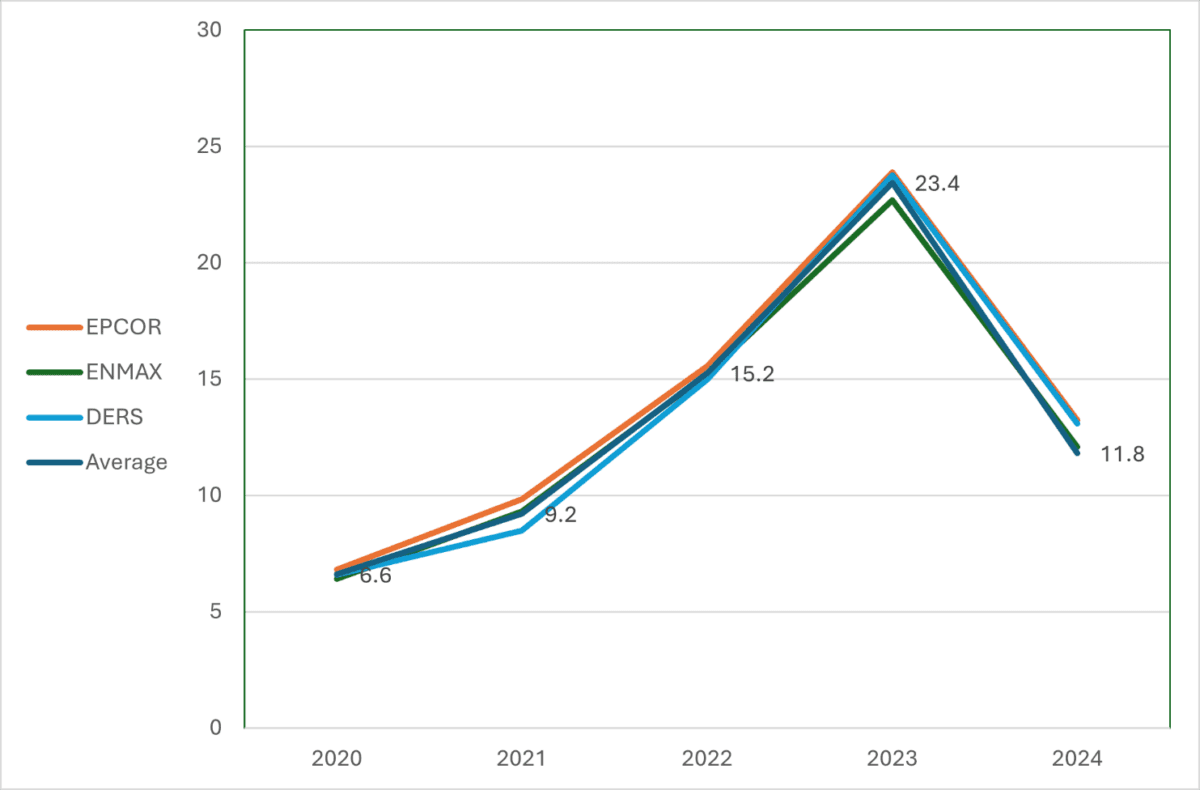
Note that there is a general upward trend in prices (except between 2023 and 2024), as well as uncertainties. To prevent such shocks and not be controlled by the market, a more stable and reliable alternative would be to switch to solar.
Electricity Rates Forecast for Alberta in 2026
Alberta’s electricity rates are expected to be volatile into 2026 and beyond due to natural gas prices, grid demand, coal retirement and renewable energy integration. However, the Government’s move to provide fixed RoRL for 2 years means that Albertans can expect some stability. RoRL is fixed for 2 years until December 31, 2026, and will remain at around 12 ¢/kWh across Alberta’s major retailers during this period.
Competitive rates can vary widely. TC Energy projects wholesale pool electricity rates to be around 4.5 ¢/kWh. This is 8 percent higher than the early 2025 rate. Solution 105 estimates a similar rate at 6 ¢/kWh, which is the retail price including a retailer margin. Adding typical non-energy costs of about 4-5 ¢/kWh for transmission, distribution and additional admin costs of 1-2 ¢/kWh, the total cost for the consumer could be 11-12 ¢/kWh.
Looking farther down the road, know that electricity prices are steadily going up. Wholesale electricity rates are expected to rise to 18 ¢/kWh by 2042.
How to Save Money on Electricity in Alberta
Alberta homeowners have several options to lower electricity bills. Here are a few worth thinking about.
Lock in a Competitive Fixed Rate
Switch from a regulated or floating plan to a good, fixed rate deal that will provide stability and protection against price spikes. Historical data suggests that competitive rates have consistently been lower than regulated rates.
Join the Solar Club to Buy Low and Sell High
If you have solar panels and live in Alberta you’re lucky because you can take advantage of Alberta’s deregulated energy market by buying your electricity at a low rate and selling it at a high rate.
For example, you can currently buy electricity through Shared Value Energy’s Solar Club at only 8.49 ¢/kWh in the winter months when you need electricity then in the summer when you have surplus energy, sell it back for 30 ¢/kWh. You can learn more about Solar Club and join here.
Shop Around Regularly
Revisiting your electricity plans at least once a year ensures you’re always paying the best rate. If you’re in a floating plan, look for price changes and offers advertised by providers at the end of each month, such as referral bonuses and free electricity.
The Cost Comparison Tool provided by the Utilities Consumer Advocate allows you to evaluate different utilities and plans, and make an informed decision.
Join a Community Energy Program
Buying your electricity from a community energy marketer like Shared Value Energy can save you money. How it works is they buy directly from the grid and resell it to homeowners, offering promotional rates (eg. for new customers, seniors, etc.) while reinvesting profits into local community projects. They also bundle other utilities together such as natural gas and internet, to help you save on all of them while keeping your utilities together with one provider. You can learn more about Shared Value Energy and join their community energy program here.
Improve Energy Efficiency
Simple steps like maintaining your HVAC or upgrading appliances can reduce your overall electricity usage and lower electricity bills. There are several ways to save electricity. Read this article to learn more: 8 Easy and Effective Ways to Reduce Your Electricity Consumption at Home.
Go Solar
Alberta is one of the sunniest provinces in Canada. Generate your own electricity using solar and reduce how much you pay for utilities. Any excess electricity you generate can be sold back and earn you credits on your bill. If you’re wondering how much it costs to install solar panels read Here’s What Solar Panels Cost in Canada.
Images from Depositphotos