How Do I Build an SB 54 Plastic Reduction Plan for My Packaging?

Picture the scramble: every team assumes someone else owns California’s SB 54 paperwork, the filing window has closed and blame is flying.
As of November 4, 2026, one fact matters: the 10 percent, 20 percent and 25 percent reduction targets apply to the Producer Responsibility Organization (PRO), not to your company. What you need to file is an Individual Source Reduction Plan. Circular Action Alliance (CAA), the approved PRO, describes it as a forecast of the source reduction you intend to achieve. CalRecycle says these plans “are not binding commitments on behalf of producers” and that it will not review them.
The pages ahead walk you through cataloguing every plastic component bound for California, building a numbers-driven forecast and feeding that data into the PRO, so your team can file with confidence.
Separate the PRO’s Target from Your Company Forecast
California sets its performance bar for the PRO, not for individual brands. The PRO must reduce aggregate plastic by 10 percent (weight and components) by January 1, 2027; 20 percent by 2030; and 25 percent by 2032. Under Public Resources Code (PRC) section 42057, a growing share of that cut must come from reuse or refill, and elimination also counts toward the 2032 share.
| Target date | PRO-wide reduction vs 2023 | Minimum from |
| January 1, 2027 | 10 percent weight and 10 percent components | 2 percent reuse or refill |
| January 1, 2030 | 20 percent weight and 20 percent components | 4 percent reuse or refill |
| January 1, 2032 | 25 percent weight and 25 percent components | 10 percent reuse, refill, or elimination |

Get the Green Building Project Checklist
Use this handy checklist on your next project to keep track of all the ways you can make your home more energy-efficient and sustainable.
Those percentages are not a quota for your Ontario plant or the contract packer in Shenzhen. Your Individual Source Reduction Plan is simply a forecast the PRO considers when it develops its collective plan, and CalRecycle says it is not a binding commitment.
What is binding?
- Join the PRO, apply as an independent producer or obtain a small producer exemption.
- Report your 2023 packaging data.
- File the forecast.
- Report your data every year.
Noncompliance can trigger administrative civil penalties of up to $50,000 per day per violation ($25,000 for qualifying small producers). Under PRC section 42081, penalties start to accrue 30 calendar days after notice of the violation.
Having a look at sustainable packaging solutions for consumer brands helps when coming up with redesign ideas, but your own component weights, tests and California sales drive every credible forecast.
With duties and risks clear, move on to step 1: confirm whether you’re the legal producer and which packaging layers count.
Step 1: Confirm Producer Status and Define What’s Covered
Start with the question CalRecycle’s screening tool answers: Who is the producer for this product when it reaches California? Answer it with a three-tier screen:
Tier 1 – You manufacture in California and own the trademark.
Tier 2 – You are in California and own the mark, but contract the build.
Tier 3 – When no Tier 1 or Tier 2 party applies, the first party to sell, offer for sale, or distribute the goods in or into California (for example, a Canadian business exporting to California) becomes the producer. CalRecycle’s screen sends any party outside California straight to this tier.
Map every sales channel, trademark and fulfillment path on one sheet. If any case is unsure (for example, a private-label SKU sold through a dealer), flag it for counsel instead of defaulting to the easiest tier.
Next, break the package into three layers: Primary hugs the product; secondary groups or brands it; Tertiary protects the load in transit.
A cordless drill’s clamshell is primary, the retail carton is secondary, and the stretch film around the pallet is tertiary. Labels, tape, inks and even tiny adhesive dots stay on the list if they contain plastic, unless the de minimis exclusion applies.
Watch the tricky boundaries. Packaging for paint products as defined in the state paint-recovery law is excluded from SB 54. A toolbox typically used for at least five years to store goods may meet the long-term storage exclusion, but its corrugated shipper and void-fill pillows do not. Reusable pallets are excluded only when they meet the reuse criteria in 14 CCR section 18980.2.1; single-use film and straps still add to your totals.
Rule of thumb: treat a component as covered unless documented evidence proves an exclusion. Rigour here prevents nasty surprises when the PRO adds up everyone’s numbers later.
Step 2: Build a Component-level Packaging Inventory

Numbers beat intentions. Before you model any reduction, build an airtight list of every plastic part that crosses the California border.
Start with hierarchy, not a massive spreadsheet. Catalog items by 1) legal producer; 2) product family; 3) SKU; and 4) packaging layer: primary, secondary, tertiary. Drill down only after that to the pieces you can grip or peel away.
For each component, record four anchors: Unique ID; function; material or resin; plastic weight per unit.
A tape strip that seals a mailer does a different job than an LDPE air pillow, so each gets its own ID even if both use the same resin.
Don’t skip the small parts. Labels, adhesives, inks, zip ties, cap liners and safety seals all count if they contain plastic, unless they are de minimis. CalRecycle’s shipping-box example lists nine separate plastic components (seven air pillows, the tape and the box adhesive) in what most people think is “just cardboard.”
Data quality outranks speed. Use measured weights or supplier declarations verified within the past 12 months. Treat estimates as acceptable only when you log the method, conversion factor and a confidence score.
Store every source (drawings, bills of materials, test reports) in a single shared drive. When the rules change, update one field instead of rebuilding the whole sheet. A solid component inventory is the foundation for every forecast that follows.
Step 3: Turn that Inventory into a Forecast
Now we move from counting parts to predicting how they will change. A solid forecast answers one question: how much plastic will California see from each SKU in every future year?
Build the baseline – Start with your 2023 data. For each SKU list the planned package spec, plastic weight per unit, and component count per unit, then multiply by your California sales forecast to get totals for 2027, 2030, and 2032.
Create three views – Committed – funding, suppliers and tests are already scheduled; Feasible – technically sound but still waiting on tooling, customer tests, or final cost approval; Stretch – depends on outside factors such as new infrastructure or material availability. Tag every line item high, medium, or low confidence so leadership sees both the savings and the risk.
Model growth – Sales up ten percent with lighter packaging can still raise total plastic. Add columns for new SKUs, channel shifts and retirements so the forecast mirrors reality.
Include history – PRC section 42057(d)(1) asks your first plan for the amount you source reduced since January 1, 2013. Keep a table of what you already eliminated so you avoid double counting.
Log assumptions – Record where each weight came from, why components were grouped and which sample size you used. Transparency speeds audits and builds trust.
CAA’s October 13, 2026 plan says it is developing a process for producers to update their plans during the annual data reporting window, another reason to treat this as a living model, not a one-off file.
Step 4: Model the Source-reduction Pathways
The statute asks your plan to split forecast reductions across five pathways: reuse and refill, elimination, non-plastic materials, right-sizing and related changes and post-consumer recycled content.
Elimination
Elimination is the simplest win: remove a plastic component and add nothing in its place (no substitute material, no extra process).
Picture the spare polybag around a cordless drill, the unused window on a retail box, or a five-year-old promo clip. If transit tests, shelf-life checks and unboxing reviews show no extra damage, the change moves from feasible to committed, and the forecast records zero grams and zero components for that part.
Validation matters. Pull the wrong piece and you risk breakage, moisture ingress or tampering. Every candidate therefore gets a test plan, pass/fail thresholds, and a fallback spec so leadership sees both the upside and the contingency on one line.
Keep the classification strict: swapping foam for fibre is substitution, not elimination; merging two labels into one counts only once. Clear lines today prevent messy reconciliation later.
Right-sizing, Lightweighting, Concentration and Bulk
When elimination is not possible, shrink what stays. Right-sizing trims empty space; for example, cutting an ecommerce carton from 12 cm of headroom to 2 cm. Lightweighting reduces gauge or wall thickness without changing dimensions. Concentration / bulk delivers the same use in fewer units or with less plastic per use.
One tweak may look small, but together they hit high-volume parts such as films, bottles and master cases. Compare today’s specs with the true protection need. A pallet compression test can show that a lighter flute strength or one wrap of 15 µm film instead of two wraps of 20 µm, still passes.
Record every dependency in the forecast. A smaller carton might need a new insert; a thinner cap could require torque tests. Count the plastic only after the redesigned part reaches production and link the saving to its launch date and minimum order.
Watch the weight-versus-count split. Reducing headspace might delete two air pillows (-2 components, -5 g). Lightweighting a bottle keeps one component but can cut its plastic by 20 percent (-10 g). Track the two metrics separately so the PRO sees exactly where each benefit lands.
The Sustainable Packaging Coalition calls tertiary packaging and non-food-contact flexibles some of the most accessible opportunities. On a building-product pallet, test whether one lighter wrap protects as well as two.
As with elimination, validation rules. Run line trials, pallet-stability tests and customer checks. When the data pass, move the project to the committed column and let the model show the kilogram and component drop.
Material Substitution
Sometimes the shape must stay but the substance can change. Material substitution replaces a plastic component with a non-plastic material that still meets protection, branding and handling needs.
Common moves in this sector: swap EPS foam for moulded-fiber cushions, use starch void fill instead of air pillows, lock products with corrugated inserts in place of PET trays or fit fibre lids instead of PP overcaps.
Substitution counts only when the plastic leaves the bill of materials. A fibre tray laminated with PE film still adds plastic weight, and paper labels with acrylic adhesive bring grams the pulper cannot remove. Your component list already tracks sub-parts, so you can show exactly which grams exit and which remain.
Validation runs beyond drop tests. Check recyclability or compostability evidence, confirm barrier layers will not sneak plastic back in and run a quick cradle-to-gate scan so you do not trade grams of plastic for kilos of carbon. CalRecycle also says source reduction does not include replacing a recyclable or compostable material with one that is less likely to be recycled or composted.
Watch production realities. Fibre parts may need tighter tolerances or longer forming cycles than injection moulding. Note those limits in the committed, feasible or stretch columns so leadership sees cost and timing alongside the plastic savings.
Reuse and Refill
Reuse keeps packaging in play rather than in a bin. Picture sturdy totes moving faucets from factory to warehouse or returnable crates that haul toolkits to site and ride the same truck home.
CalRecycle treats packaging as reusable or refillable only when it meets the criteria in 14 CCR section 18980.2.1, including recovery through a systematic program and design for multiple uses for the same purpose, with adequate infrastructure. Track these levers in your forecast:
Return rate – share of packs that make it back.
Loss rate – share lost or damaged each cycle.
Cycles before retirement – how many trips the pack can survive.
Business-to-business loops are often the easier start because existing reverse-logistics routes can collect empties for washing and redeployment. Consumer reuse takes longer; it needs deposits, drop-off points, or doorstep pickup, costs the PRO may help finance once its plan is approved.
Reusable packaging starts heavier. A polypropylene tote outweighs a single corrugated box, but a tote that meets the criteria is excluded from covered material, so its plastic leaves the forecast. A tote that fails the criteria stays in your totals, so model the return rate before you claim the saving.
Keep the data honest. Scan codes, RFID tags or simple pallet counts feed actual return numbers into the model each year. Over- or under-performance rolls into the next report, showing the PRO and your finance team whether reuse is delivering the savings you forecast.
PCR as a Limited Alternative and the Rule Against Double Counting
Switching from virgin resin to post-consumer recycled (PCR) plastic can lower carbon, but under SB 54 it does not count as physical source reduction. CalRecycle’s guidance says the PRO may meet up to 8 percent of the source reduction requirements in any year through post-consumer recycled content, and only if CalRecycle approves an alternative compliance formula in the PRO plan. The statute also requires third-party validation of the content, such as the Association of Plastic Recyclers’ certification program.
Treat PCR as an overlay. First model weight and component reductions, then apply a PCR tab that lists component ID, PCR percentage by weight, third-party certification record and calculated eligible weight. Auditors can trace every kilogram back to a certificate.
One change, one credit. Eliminate a plastic tray and increase PCR in the remaining bottle? The tray counts under elimination; the PCR uplift applies to the alternative-compliance bucket. Recording the same grams twice overstates your forecast.
Handle PCR last, document it well and keep the main forecast focused on the four physical pathways.
Step 5: Prioritize projects and build a roadmap
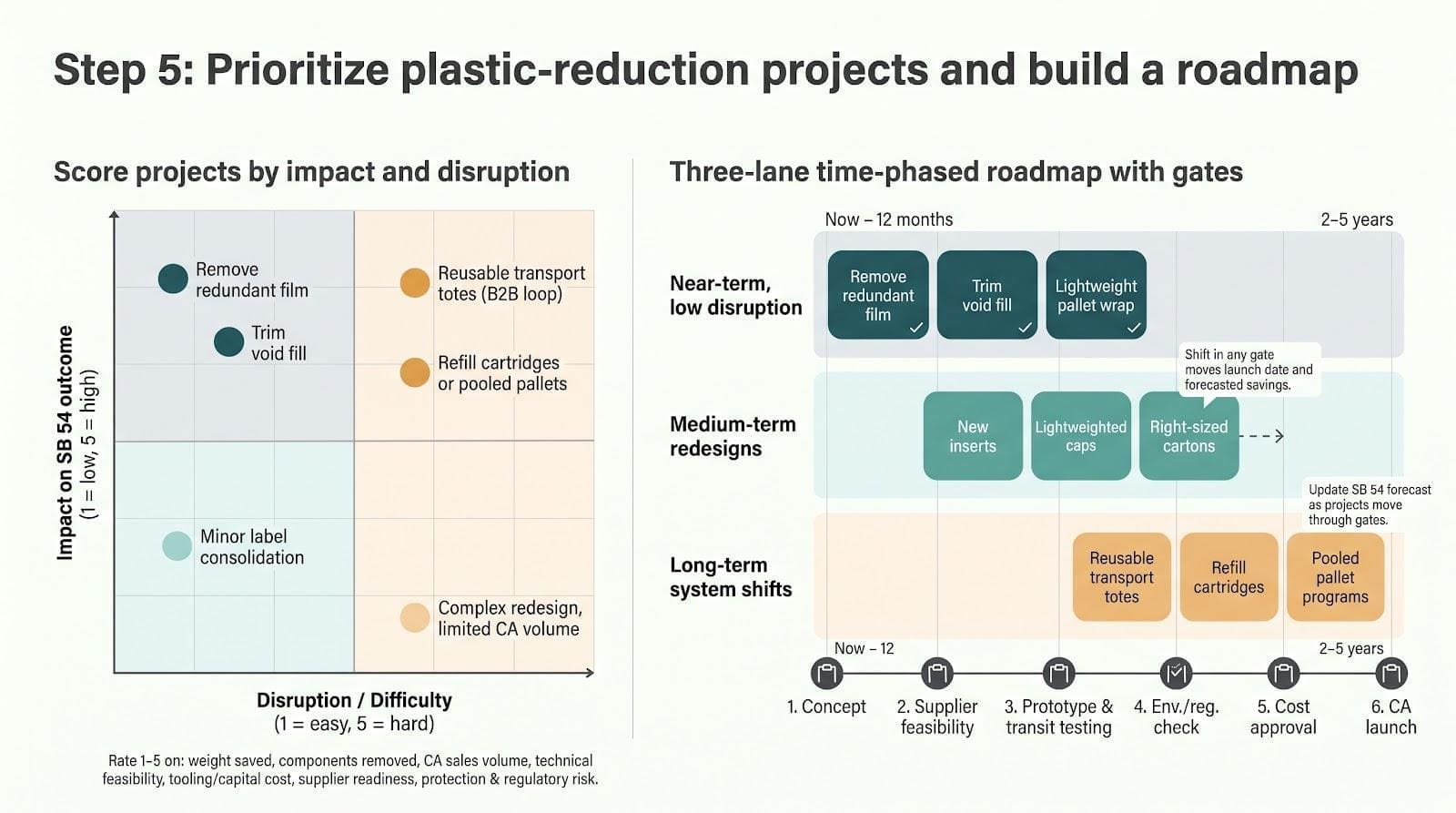
A good roadmap turns ideas into action by ranking each project against a common yardstick, then timing the work so resources do not collide.
1. Score Every Idea
Create a simple matrix and rate each opportunity 1 (easy) to 5 (hard) on:
- Plastic weight saved
- Components removed
- California sales volume affected
- Technical feasibility
- Tooling or capital cost
- Supplier readiness
- Product-protection and regulatory risk
Weight the first three factors most heavily and deduct points for high risk. The resulting score lets you sort the list in seconds.
2. Place Projects in 3 Lanes
Near-term, low disruption – minor spec tweaks that fit existing lines (for example, remove redundant film, trim void fill).
Medium-term redesigns – new inserts, lightweighted caps, right-sized cartons that require tooling or supplier qualification.
Long-term system shifts – reusable transport totes, refill cartridges or pooled pallet programs that touch IT, logistics and customer behaviour.
3. Add gate reviews
Each project moves through the same gates:
- Concept approval
- Supplier feasibility
- Prototype and transit testing
- Environmental or regulatory check
- Cost approval
- Production qualification and controlled California launch
A slip at any gate automatically shifts the launch date and the forecasted savings.
4. Build Contingencies
Assign an alternate supplier or material, model a delayed-implementation case and script a reversion plan if damage spikes. Contingencies turn bold plans into managed experiments, not gambles.
Step 6: Assign Ownership and Make the Forecast Reporting-ready
1. Resolve the “Hot Potato”
Extended producer responsibility touches every corner of the company, so name one executive owner with the authority to pull data, align budgets and break tie votes.
Create a simple RACI:
Packaging engineering – specifications and test plans
Sustainability – targets and aggregate tracking
Legal – producer status, trademarks, exclusions, and confidentiality flags
Procurement – compliant materials and suppliers
Sales analytics – California unit counts
IT / master data – system integrity
Finance – fees, savings, and capital timing
Weekly 15-minute huddles surface blockers; monthly reviews confirm committed projects stay on schedule.
2. Establish a Single Source of Truth
- Assign every component a permanent ID.
- Link SKUs to those IDs in a relational table.
- Pull California sales nightly from the ERP.
- Build unit-conversion rules into code, not manual formulas.
- Store drawings, test reports, PCR certificates and de minimis evidence as attachments.
Automated alerts flag any weight or spec change for approval before it hits the live forecast.
3. Protect Trade Secrets the Right Way
Flag only the cells that contain producer-specific financial, production or sales data or other trade secrets, and identify them the way 14 CCR section 18980.14 requires. CalRecycle says confidentiality depends on meeting those requirements, so check them before you submit.
4. Make Annual Reporting a Click, not a Crisis
Because your system already reconciles forecast versus actual weight, component count and pathway contributions, annual reporting means exporting what the PRO asks for and attaching the evidence collected all year. No last-minute spreadsheet scramble.
Three Hypothetical Scenarios

The companies, weights, costs and test results below are invented to show how a forecast reads. They are not data from real producers.
Scenario 1: Canadian Home-appliance Maker Selling Direct into California
A Quebec manufacturer ships countertop mixers from Montréal straight to U.S. consumers, including in California, via its own webstore. With no California factory or distributor, it falls into Tier 3, the first party to sell or distribute the product in the state.
Component inventory
- Corrugated retail box
- Two EPS end-caps
- Polybag
- Cable ties, tape, labels
- E-commerce overbox with air pillows
- Pallet film and straps
Forecasted moves
| # | Change | Pathway | Confidence |
| 1 | Replace EPS with moulded-fiber end-caps | Substitution | Feasible |
| 2 | Remove polybag after moisture test | Elimination | Committed |
| 3 | Right-size retail box (-2 air pillows) | Right-sizing | Committed |
| 4 | Cut pallet film to one wrap of 15 µm | Lightweighting | Committed |
| 5 | Pilot reusable corner protectors on closed loop | Reuse | Stretch |
Together, the committed and feasible items cut plastic weight 38 percent and trim five components per unit. If the reuse pilot scales and achieves a return rate of at least 90 percent, total weight savings could exceed 50 percent.
Key assumptions
- Fibre tooling lead time: 14 weeks
- Environmental range: 30 to 80 percent RH
- Pallet wrap test: one wrap pass
By stating these anchors up front, the forecast moves from wish-list to roadmap the PRO can trust.
Scenario 2: Beverage-appliance Packaging Redesign
A British Columbia brand sells a countertop seltzer maker through U.S. retailers. Customer surveys disliked the polystyrene foam, so engineering replaced the two foam blocks with a custom moulded-fibre insert.
Although it feels like elimination, a protective insert still exists, so the move is logged as material substitution. The swap removes 120 grams of plastic and one component per unit.
Lingering plastic
- PET window on retail carton
- Two PP caps on CO₂ cylinders
- LDPE film around spare bottle
Validation
- Drop test: 1.2 m, pass
- Vibration: 60 min, initial shift; add small fibre spacer (+8 g fibre, 0 g plastic), then pass
The mould costs CAD $55,000 with an eight-week lead time; finance amortizes this over three years.
Outcome
Committed launch Q3 2027. Net plastic reduction 14 percent for the SKU, and a ready case study for retailer line reviews.
Scenario 3: Paint, Toolbox and Pallet Boundary Check
A Saskatchewan coatings company ships one-gallon architectural paint pails to California home-improvement stores. Packaging for paint products as defined in the state paint-stewardship law is excluded from SB 54, including its secondary and tertiary packaging, so the forecast flags it as “excluded” and cites the statute.
The same company also ships metal toolboxes, protected by foam corner guards, on everyday pallets wrapped in stretch film. The durable toolbox may qualify for the long-term-storage exclusion, but the disposable guards, cartons, tape and film are covered. Two quick wins enter the roadmap:
- Remove corner guards once drop tests confirm the powder-coat finish survives.
- Cut pallet film from two wraps to one.
Reusable pallets sound attractive, yet the exclusion applies only to pallets that meet the reuse criteria, including design for multiple uses and recovery through a systematic program. The current pool is one-way softwood, so the film stays in scope. Operations is piloting a reusable HDPE pallet on the Saskatoon-to-Fresno lane; if recovery tops 90 percent after six months, a 2028 scale-up moves to the feasible column.
Key takeaway for leadership: exclusions apply component by component. One company can ship excluded paint packaging, covered stretch film and a possibly excluded toolbox inside a covered carton. A detailed inventory makes those boundaries clear and shows the PRO exactly which grams of plastic remain on the hook.
Common Planning Errors to Avoid
Even experienced teams trip on the same wires. Spot them early and you save weeks of rework.
- Treating the 10, 20, and 25 percent collective targets as personal quotas
- Assuming the non-binding forecast is optional; filing is mandatory
- Writing “CalRecycle approval pending” on a cover sheet (CalRecycle never reviews individual plans)
- Forgetting that the August 1, 2026 filing date has passed; late filers should contact CAA now
- Omitting tape, labels, inks or adhesives from the component list
- Calling every small part de minimis without checking CalRecycle’s criteria
- Logging PCR as source reduction; allowed only under the PRO’s yet-to-be-approved PCR formula
- Believing an out-of-state address avoids producer status
- Excluding transport packaging that lacks a proven reuse loop
- Promising “simple annual plan revisions” before CAA finishes its update process
What Your Forecast Should Track from 2027 to 2032 (Status Checked November 4, 2026)
- Permanent rules took effect May 1, 2026; CAA’s revised plan, filed October 13, 2026, is under CalRecycle review.
- The first collective target (10 percent weight and components) still points to January 1, 2027; CAA’s plan says it is seeking a “unique challenges” exemption from the 2027 target, with no decision reported yet.
- CalRecycle’s November 2, 2026 baseline update, built on data from 2,127 producers (about half of participants), put the baseline at 1.03 million tons and 222 billion plastic components; the next update is due November 2027.
- CAA’s 2027 fee rates, bonuses, and maluses are proposals in a plan still under review; treat them as directional.
- Several lawsuits are pending, including a multistate federal challenge and an October 2026 state-court petition, but SB 54 remains in effect while they proceed.
Plan for compliance and keep flexibility for baseline shifts and fee tweaks.
Frequently Asked Questions
Does my company have to cut its own plastic by 25 percent?
No. The 25 percent target applies to the PRO’s aggregate packaging, not to every producer.
Is the individual plan optional because it is non-binding?
No. Filing is mandatory, even though the outcomes you forecast are not enforceable promises.
Will CalRecycle review or approve my plan?
No. You upload the plan to Circular Action Alliance. CalRecycle reviews the collective plan and annual progress, not individual forecasts.
What if I missed the August 2026 deadline?
Contact CAA Producer Support right away and check your status in the Producer Portal. CAA’s plan lists failure to submit an individual plan as a delinquency it reports to CalRecycle.
Do labels, tape and adhesives count?
Yes, unless the de minimis exclusion or another exclusion applies. Plastic sub-parts add weight and count as components.
Does adding PCR qualify as source reduction?
Only under the PRO’s alternative compliance formula (still awaiting CalRecycle approval) and only for up to 8 percent of the source reduction requirement.
What penalties apply if I sell without filing?
CalRecycle may assess up to $50,000 per day per violation ($25,000 per day for qualifying small producers). Penalties start to accrue 30 calendar days after notice of the violation.
Is transport packaging inside scope?
Yes. Stretch film, pallet straps and other tertiary materials count unless the item itself meets the reuse criteria or another exclusion.
Practical Action Checklist and Resources
- Confirm producer status – Run every product through the Tier 1-2-3 screen, and document the answer.
- Register or update CAA records – Late filers should upload data and request support before penalties grow.
- Separate covered, excluded and uncertain packaging – Flag gray areas for legal review; do not guess.
- Reconcile 2023 California sales – Accurate unit counts anchor every forecast equation.
- Build the component-level bill of materials – One row per plastic part; weight measured, supplier named.
- Request missing supplier data – Specs, PCR certificates, adhesive details and test reports.
- Classify each proposed change by pathway – Elimination, right-sizing, substitution, reuse or PCR overlay.
- Model committed, feasible and stretch cases – Attach confidence scores and launch dates.
- Validate protection, safety and life cycle trade-offs – No point saving plastic if damage or carbon spikes.
- Assign owners, budgets and gate reviews – A one-page RACI keeps work moving.
- Close actual versus forecast each month – Do not wait for year-end to spot gaps.
- Archive assumptions and proof – Audits are simple when evidence is already filed.
Conclusion
An SB 54 plan is a forecast, not a quota. The targets bind the PRO, while your job is to join, report and file credible numbers. Build those numbers on real component data, test each change before you commit to it and update the model as the rules and the baseline settle.
Status checked November 4, 2026. This article provides general information only and is not legal advice.
Images from Depositphotos