
The South-Facing Windows Problem: Heat, Glare and Privacy – And How to Fix All Three
A Comprehensive Comparison of 10 Window Covering and Glazing Options

A south-facing home in Saskatchewan receives up to 8 hours of direct sunlight on its windows during a summer day. On a clear July afternoon, that glass can transmit enough solar energy to raise an unshaded room’s temperature by 8–10°C within a couple of hours. For Prairie homeowners who spent all winter chasing warmth, summer becomes a paradox: the orientation that made the house feel bright and comfortable in January turns it into an oven by Canada Day.
South-facing homes are prized in Canada for good reason. They align with passive solar design principles, reduce heating loads in winter and flood living spaces with natural light. But without the right window treatments, that same orientation creates a trio of problems that make summer living genuinely uncomfortable: excessive heat gain, blinding glare and a fishbowl effect that forces homeowners to choose between privacy and natural light.
Understanding the Problem of South-Facing Windows
In summer, the sun tracks high across the southern sky, peaking at roughly 63° above the horizon at solar noon in Regina, Saskatchewan. South-facing windows receive direct sunlight for much of the day during summer, exposing interior spaces to significant solar heat gain even when roof overhangs help limit how deeply sunlight penetrates into the room. Unlike east or west windows that catch the sun for a few hours at low angles, south windows are in the firing line all day long.

In winter, the sun’s arc in Regina drops to just 18° above the horizon at noon – shallow enough that the light angles under any reasonable roof overhang and penetrates deep into the space. This is exactly what passive solar design wants in January. The trouble is that most Canadian homes lack a properly calculated roof overhang that would naturally block summer sun while admitting winter sun. Without that architectural element, the work falls entirely to window treatments and glazing solutions. Refer to the diagram and you’ll see how much of an effect the overhang projection has on the amount of sunlight entering the home.

Get the Green Building Project Checklist
Use this handy checklist on your next project to keep track of all the ways you can make your home more energy-efficient and sustainable.
During peak summer sunshine, a typical 1.5 m × 1.2 m double-pane window can admit solar heat comparable to running a small electric space heater inside the room. Several unshaded south-facing windows collectively add a substantial cooling burden to the home.
The privacy problem compounds this. South-facing rooms are typically living areas like a living room or kitchen. During the day, anyone outside can see in clearly, yet closing solid blinds to solve that problem immediately kills the light and makes the room feel like a cave.
So for homes that do not have sufficient overhang projection to block the summer sun, what to do? Below we’ll explore a number of solutions that have different strengths and weaknesses, each helping to solve the problem of solar gain in the summer, privacy and glare.
10 Solar Control Options to Consider

Solutions fall into two broad categories: glazing treatments that modify the glass itself and window coverings that manage light from inside or outside. They’re not mutually exclusive. The best results for serious south-facing heat gain often come from combining both.
A Comparison of Solar Control Options
Glazing treatments
| Option | Heat reduction | Privacy (day) | Natural light | Glare control | Winter value | Relative cost | Best use |
|---|---|---|---|---|---|---|---|
| Exterior solar screen mesh | Very high | Good | Good (mesh view) | Very good | Remove in winter | Medium | Maximum heat reduction |
| Solar film (reflective) | High | Good (daytime only) | Moderate | Very good | Minimal | Low–medium | Heat + glare priority |
| Low-e glass (factory) | Moderate–high | None | Excellent | Moderate | Very high | High | New window installation |
| Solar film (spectrally selective) | Moderate | Low | Very good | Good | Low–medium | Medium | Light-preserving retrofit |
| Low-e film (retrofit) | Moderate | Low | Good | Moderate | High | Medium | Year-round efficiency |
Window coverings
| Option | Heat reduction | Privacy (day) | Natural light | Glare control | Winter value | Relative cost | Best use |
|---|---|---|---|---|---|---|---|
| Exterior awning (retractable) | Very high | Good | Adjustable | Very good | Retract in winter | High | Serious heat gain |
| Cellular shades (blackout) | High | Excellent | None when closed | Excellent | High | Medium–high | Bedrooms, offices |
| Roller blind (blackout) | High | Excellent | None when closed | Excellent | Low | Low–medium | Bedrooms |
| Cellular shades (light-filtering) | Moderate | Good | Good (diffused) | Good | Medium | Medium–high | Any room |
| Zebra blinds | Moderate | Good | Excellent (adjustable) | Good | Low | Medium | Living rooms, main areas |
| Roman shades / lined drapes | Moderate | Good | Moderate | Moderate | Low–moderate | Medium–high | Aesthetic priority rooms |
| Solar shades (3–5%) | Low–moderate | Partial | Good | Very good | Low | Medium | Views, glare control |
| Faux-wood Venetians | Low | Moderate | Good (adjustable) | Moderate | Low | Medium | Secondary rooms |
Window Coverings
Solar Shades (Screen Shades)
Made from open-weave mesh fabric, solar shades filter UV and reduce glare while maintaining an outward view. The openness factor (typically 1, 3, 5 or 10 percent) determines how much light and visibility passes through. A 3 percent shade blocks the majority of UV and significantly reduces glare while still letting you see the yard. The main limitation is that they do not provide privacy at night when interior lights are on, which matters for street-facing living rooms.
Pros
- Maintains outward view while reducing glare and UV
- Good daytime light quality
- Unobtrusive appearance
- Reduces eye strain from direct sun on screens and work surfaces
Cons
- No privacy at night when interior lights are on
- Moderate heat reduction only
- No insulating value
- Direct sun can still create warm spots in the room on peak summer days
Cellular (Honeycomb) Shades
Cellular shades trap air in honeycomb-shaped cells, creating an insulating barrier at the window. For year-round comfort, cellular shades with low-E properties are hard to beat. They can reduce heat loss by 30 to 50 percent in winter while blocking 40 to 60 percent of solar heat gain in summer. For a Prairie climate dealing with both extreme summer heat gain and winter cold, this dual-season performance is genuinely valuable. Blackout cellular shades deliver maximum thermal performance; light-filtering options allow diffused light while still insulating meaningfully.
Pros
- Good balance of insulation, diffused light, and privacy
- Year-round performer
- Softer light quality than open blinds
- Available in wide range of opacities
- Better heat reduction than fabric blinds
Cons
- Less aggressive heat blocking than blackout version
- Moderate rather than high heat reduction
- More expensive than basic roller blinds
- Limited adjustability compared to zebra blinds
Exterior Awnings (Retractable)
A retractable fabric awning blocks solar radiation before it reaches the glass — addressing the problem at source rather than managing the consequences. The effectiveness advantage over interior treatments is substantial. The limitations are cost, the need to retract in Prairie wind events and the fact that a fixed awning may block winter sun you actually want. Retractable motorized versions solve the seasonal issue but add cost and maintenance.
Pros
- Most effective heat intervention available without modifying the glass
- Blocks solar radiation before it reaches the window
- Retractable versions allow full winter solar gain
- Keeps room cooler without sacrificing light on overcast days
- Adds curb appeal

Cons
- Highest cost of all options
- Must be retracted during Prairie wind events and winter
- Motorized versions add mechanical complexity and maintenance
- Requires professional installation
- Fixed versions block winter sun you want
Zebra Blinds (Dual-Layer Roller Shades)
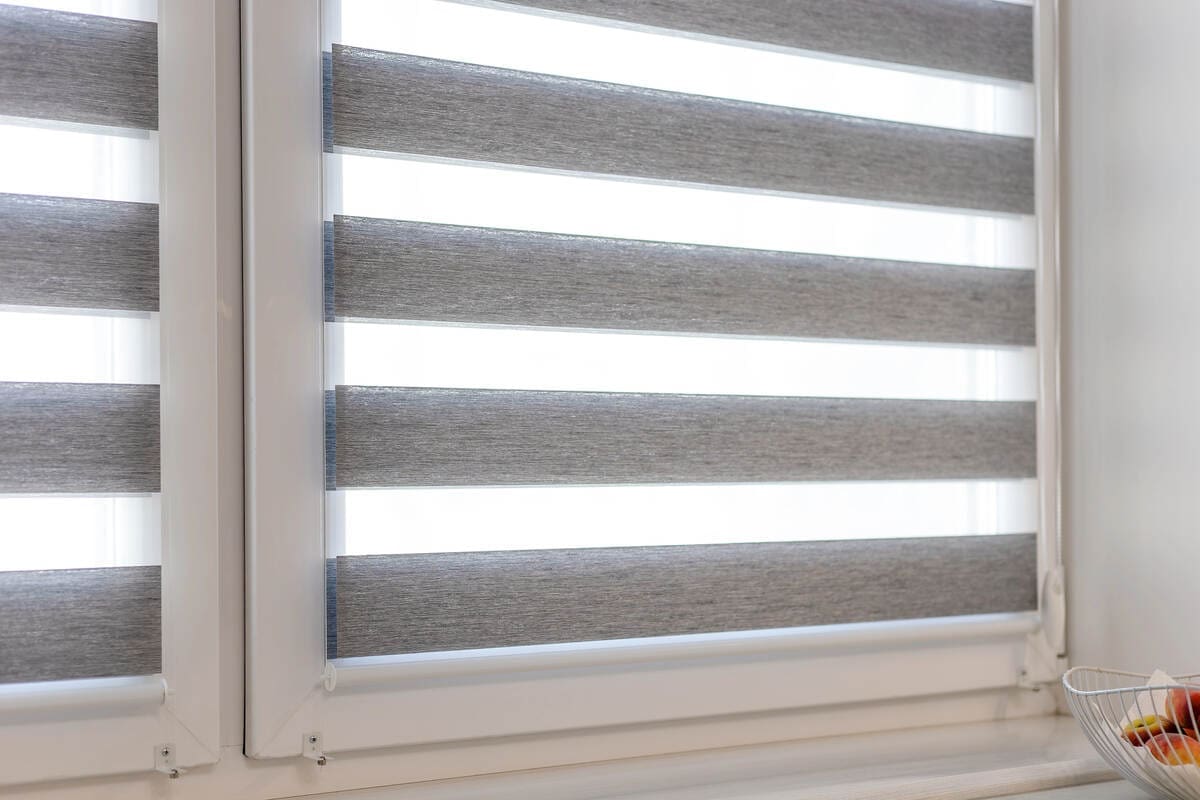
Zebra blinds consist of alternating opaque and sheer horizontal bands on two fabric layers that shift relative to each other. When the opaque bands align, you get solid coverage with good privacy and moderate heat blocking. When offset, the sheer sections align and diffuse light enters freely. This adjustability makes zebra blinds uniquely suited to the south-facing scenario: diffused light with privacy in the morning, full closure at peak afternoon heat, reopened in the evening. The zebra configuration also means the shade stays at a consistent height while the open/closed function is controlled by band alignment with no bunching or cords collecting at the bottom.
Pros
- Adjustable bands allow continuous tuning between full light and full privacy
- No binary open/closed limitation
- Modern, clean appearance
- Good privacy without blocking light entirely
- Easy to operate daily
Cons
- Moderate heat blocking only — inadequate as a standalone solution on a heavily sun-exposed window
- No insulating value in winter
- Does not block UV when in open position
- Fabric can fade over time under intense direct sun
Roller Blinds (Blackout or Room-Darkening)
Standard roller blinds in blackout or room-darkening fabric are the simplest and most affordable window covering option. They handle heat gain and privacy well when closed but the binary open/closed function means constantly trading light for comfort. Well-suited for bedrooms; less ideal for main living areas where people want light without heat through the day.
Pros
- Simplest and most affordable option
- Completely blocks heat and light when closed
- Very effective for bedrooms
- Easy to install
- Wide range of colours and materials
Cons
- Binary open/closed only — no middle ground
- No insulating value
- Not practical as a daily solution in a south-facing living room
- Fabric quality varies widely at lower price points
Faux-Wood Venetian Blinds
Slatted blinds allow fine angle control — tilt to block direct sun while still allowing some diffused light. The limitation is that partial positions still admit direct light through gaps, so glare reduction is incomplete. Faux-wood is generally preferred over real wood in Prairie climates because of the extreme humidity swings between very dry winters and more humid summers, which cause real wood to warp and split.
Pros
- Slat angle control allows some light direction fine-tuning
- Classic appearance suits many interiors
- Moisture-resistant
- Affordable
- Handles Prairie humidity swings better than real wood
Cons
- Lowest heat reduction of any option
- Gaps between slats allow direct sun through in any partial position
- Dust accumulates in slat gaps requiring regular cleaning
- Privacy is incomplete at most angles
Roman Shades and Drapery
Fabric-based options including Roman shades and lined drapery can provide good light diffusion and a softer aesthetic. Lined or blackout-backed versions offer reasonable heat blocking when closed. The limitation is that, like roller blinds, they tend to be binary (open or closed) and heavy drapes that block heat effectively also tend to make a room feel heavy and dark. Maintenance is another issue. The significant amount of material used in drapes holds onto a lot of dust and requires greater upkeep.
Pros
- Soft, warm aesthetic
- Lined or blackout-backed versions offer reasonable heat blocking when closed
- Can be layered with sheer under-curtains for light control
- Wide range of fabrics and styles
Cons
- Primarily binary open/closed
- Heavy drapes that block heat well make a room feel dark and closed
- Fabric fades in intense south-facing direct sun
- Performs best as a complement to glazing treatment, not as a standalone solution
Glazing Treatments
Solar Film (Window Tint)
Solar film is an adhesive polyester film applied directly to the interior glass surface. It works by reflecting and absorbing infrared radiation before it converts to heat inside the room. High-performance films can lower solar heat gain by up to 70 percent, translating into 15–30 percent reductions in cooling expenses depending on home orientation and system efficiency. Most residential films block up to 99 percent of UVA and UVB radiation, and professional-grade films typically last 20–25 years when installed correctly.
There are several types. Reflective or mirrored films provide strong heat rejection and daytime privacy but give windows a tinted appearance. Clear or spectrally selective films reject 40–60 percent of solar heat while allowing 60–80 percent of natural light to pass through, making them ideal for south-facing living rooms where brightness matters. Low-E films use microscopic metallic layers to reflect indoor heat back into rooms during winter while still providing summer cooling benefits, effectively upgrading the window’s insulation value without glass replacement.
One important caveat: certain films are not compatible with all glass types. Film applied to sealed double-pane units can cause thermal stress and void the window warranty – always verify compatibility before installation.
Pros
- One-time installation, no daily operation needed
- Strong heat and glare reduction
- Provides daytime privacy
- Lasts 15–20 years with professional installation
- Lower cost than window replacement
Cons
- Gives windows a tinted or mirrored appearance
- No privacy at night when interior lights are on
- Reduces winter solar gain on south-facing windows
- May void window warranty on newer sealed units
- Not compatible with all glass types

Low-E Glass (Factory Coating)
Low-emissivity coatings are metallic layers applied at the factory during glass manufacturing. They are not a retrofit product – they are built into new windows. A south-facing home with older single-pane or uncoated double-pane windows experiences significantly more heat gain than one with modern low-E glazing. If window replacement is already under consideration for other reasons, specifying a low-E coating on south windows is a permanent, maintenance-free improvement with no visual impact.
If you’re more concerned about keeping your home cool in the summer and don’t mind your windows being somewhat darker and your room being darker, opt for solar control low-E coatings. If you’re more concerned about allowing sunlight into your home in the winter to provide warmth, opt for high solar gain low-E. If, on the other hand, you want to allow the sun’s warmth into your home to add heat in the winter, opt for high-solar gain low-E coatings. And if you’d like to your windows to be as clear as possible and your room as bright as possible while still reducing the amount of the sun’s heat from entering your home, opt for a spectrally selective low-E coating.
Pros
- Permanent, maintenance-free, and completely invisible
- Lasts the lifetime of the window
- Best overall thermal performance of any glazing option
- Works passively in both summer and winter with no user action
- No impact on appearance or view
Cons
- Only available on new windows — not a retrofit option
- Requires full window replacement
- Significant upfront investment
- Specification must be chosen carefully — high vs low solar gain coatings serve different purposes
Exterior Solar Screen Mesh
A physical mesh screen installed on the exterior of the window frame – similar to an insect screen but made from tightly woven solar-blocking fabric. It stops solar radiation before it hits the glass, which is fundamentally more effective than any interior treatment. Heat reduction window films and screens can reduce heat entering via a window by as much as 91 percent when installed on the exterior. The tradeoff is that exterior screens slightly reduce the view and must be removed or stored in winter in Prairie climates to allow passive solar gain.
Pros
- Stops solar radiation before it hits the glass — more effective than any interior treatment
- Works passively with no daily operation required
- Significantly reduces glare
- Compatible with any existing interior window treatment
- No effect on interior decor or room aesthetics
Cons
- Slightly darkens the view through the window
- Must be removed in Prairie winters to allow passive solar gain
- Requires exterior installation and proper framing
- Difficult to install on upper floors without professional help
Combining Solutions for Better Results
The most effective approach is almost never a single product. Each solution addresses a different part of the problem, and layering two or three targeted options produces dramatically better results than any one product alone.
1. Spectrally selective film + zebra blinds
The baseline combination for most south-facing living rooms. The film handles the passive heat load permanently (working even when the blinds are fully open) while the zebra blinds manage privacy and light quality through the day. On a 30°C July afternoon, the film alone reduces solar heat gain by 40–55 percent, and the closed opaque bands on the zebra blind reduce it further. The room stays usable with natural light rather than requiring a blackout response to summer sun. Cost is moderate and installation is straightforward.
2. Exterior solar screen + cellular light-filtering shades
Best for serious overheating situations, such as a large south-facing window in a home in Saskatchewan where the afternoon temperature becomes genuinely uncomfortable. The exterior screen eliminates 60–80 percent of solar radiation before it hits the glass, and the cellular shade behind it adds insulating value in winter plus light diffusion year-round. This combination also handles the privacy requirement cleanly. Higher cost and installation effort, but the most thermally effective interior-plus-exterior pairing short of replacing the windows.
3. Low-E glass (on new windows) + zebra blinds or solar shades
The ideal long-term solution for a full window replacement project. The factory low-E coating handles the baseline passively and permanently, while the zebra blind or solar shade on top provides the daily light and privacy management the homeowner actually wants. This combination performs well in all four seasons: the low-E glass retains heat in winter, reduces it in summer, and the blind supplements both functions. The investment is front-loaded into the window replacement, but no ongoing maintenance or film degradation to manage.
4. Retrofit low-E film + exterior awning (retractable)
The premium retrofit combination for a homeowner who wants the best performance on existing windows without full replacement. The low-E film improves year-round thermal performance of the existing glass, and the motorized retractable awning intercepts summer solar radiation before it reaches the glass at all. In winter the awning is retracted and the low-E film’s heat-retention benefit comes into play. Highest cost of the retrofit options but approaches new-window performance at a fraction of replacement cost.
Choosing the Right Solution for Your Home

The right combination depends on your specific situation: your budget, how severe the problem is, whether you’re renting or own and how much disruption you’re willing to accept. Here are the most common scenarios.
You have a hot south-facing living room and want to fix it without spending much
Start with a light spectrally selective solar film on the worst-offending window – typically the largest south-facing pane in the main living area. A 3M or Llumar SS film professionally installed on one or two windows runs $400–800 and will make a noticeable difference without changing the room’s appearance or requiring daily action. Add zebra blinds if privacy or glare is also a problem. This combination costs under $1,500 for most rooms and solves the core issues.
You’re renovating or replacing windows
Specify factory low-E glass as a non-negotiable on all south-facing windows. The cost premium over standard double-pane is modest in the context of a full window replacement project, and you will never have to deal with a retrofit. Pair with zebra blinds or solar shades for daily light and privacy management. If budget allows, add a retractable awning on the main south window. This is the moment to do it since the wall and trim are already being touched.
You want maximum heat reduction and budget is not the primary concern
The exterior solar screen or retractable awning plus low-E film or low-E glass is your combination. Add cellular blackout shades in any south-facing bedroom and cellular light-filtering in the main living areas. This multi-layer approach of exterior barrier, improved glazing and insulating interior shade produces the lowest possible solar heat gain and the best year-round thermal performance. Also the strongest case for reducing air conditioning runtime and energy bills.
You rent and can’t modify the windows or install exterior hardware
You are limited to interior window coverings only. The best option is cellular light-filtering shades, which provide the most insulating and heat-blocking value of any covering without requiring any physical modification to the window or wall. Zebra blinds are the next best choice for living areas where you want light flexibility. Both are easily removable when you move. Avoid roller blinds as your only solution in a heavily sun-exposed south room as the binary open/closed limitation will frustrate you quickly.
Your main concern is privacy during the day, not heat
Solar shades at 3–5 percent openness are the most targeted solution. They reduce glare and UV, maintain the view out, and make it difficult for passers-by to see in during daylight hours without making the room feel enclosed. Note that they provide no privacy at night when lights are on. If evening privacy is also needed, layer with a sheer roller blind or light-filtering cellular shade on a second rod behind the solar shade.
You have a south-facing bedroom that becomes unbearable in summer
Cellular blackout shades are the clear recommendation. The bedroom use case is the one place where the binary open/closed limitation of blackout shades is an advantage rather than a drawback. You want full darkness for sleeping and full light when you’re not in the room. The insulating honeycomb structure also helps retain warmth in winter, which matters in many climates within Canada where you get cold winters and hot summers. If budget allows, add a spectrally selective film on the glass itself so the room doesn’t pre-heat during the day while you’re out.
You’re building new or doing a major renovation
This is the moment to solve the problem architecturally rather than with products. A properly calculated roof overhang on south-facing windows (eg. 45–60cm for Prairie latitudes) will naturally shade the windows in summer when the sun is high while allowing full winter sun penetration when the sun is low. Combined with factory low-E glass and interior zebra blinds or solar shades, an overhang eliminates the need for exterior screens or awnings entirely. No moving parts, no maintenance, no seasonal adjustment. Get this right in the design stage and the product decisions downstream become much simpler.
Images from Depositphotos


