What Makes a Roof Access Hatch Suitable for Sustainable Building Design?

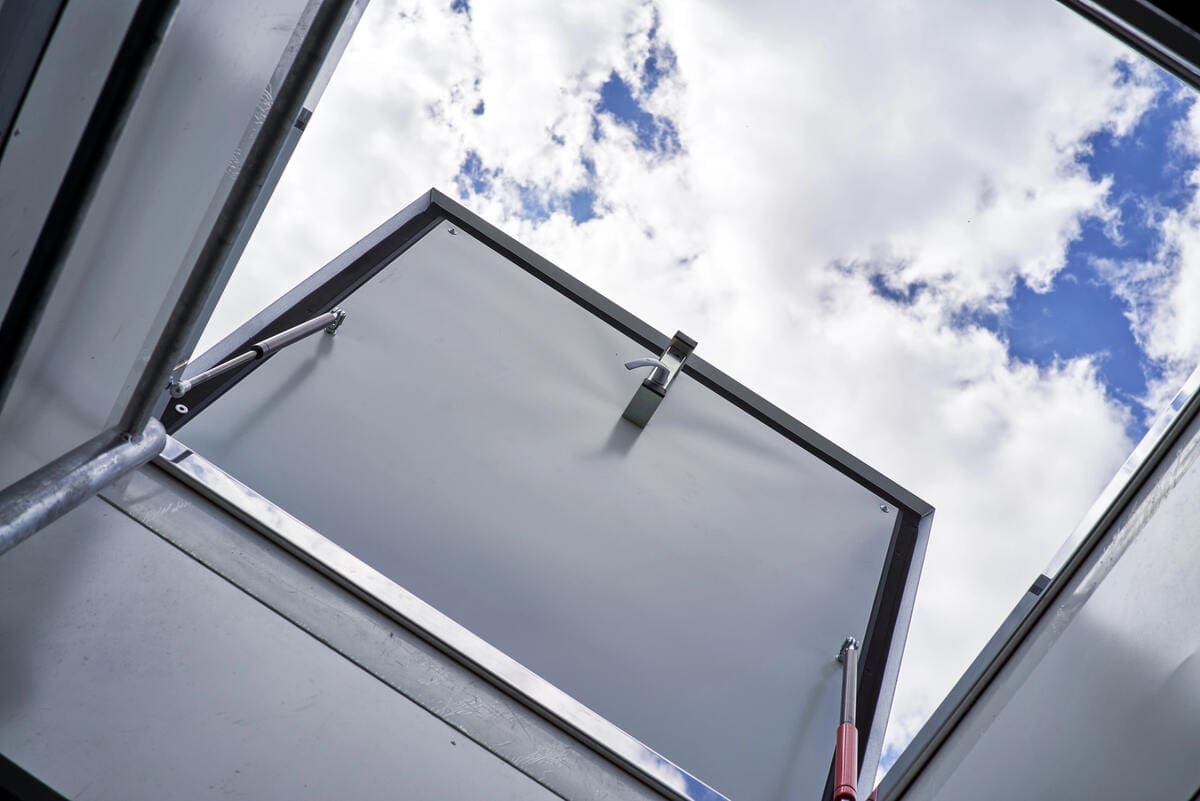
Solar panels and green roofs enhance building performance, but their effectiveness depends on safe, reliable access for ongoing maintenance.
A roof access hatch might seem like a minor hardware specification, but in the context of a high-performance building, it can be critical. In Canada’s harsh climate – where a single season can swing from +30°C to -30°C – the choice of hatch impacts energy retention, moisture control and the longevity of the very systems it is meant to serve.
The Role of Roof Access in Building Performance and Lifecycle Costs
The relationship between access and sustainability is direct: a system that is difficult or dangerous to reach is more likely to have delayed maintenance. In the commercial sector, deferred maintenance is the primary driver of premature equipment failure and inflated lifecycle costs.
In a high-performance building, an inefficient roof access hatch can become a critical weak point. Poor insulation and air leakage increase heat loss and may introduce thermal bridging, forcing HVAC systems to work harder and undermining the performance gains of high-efficiency windows and wall assemblies.
In Canada, the stakes are higher due to extreme freeze-thaw cycles. Snow accumulation and ice damming can stress rooftop flashings and seals. Without a reliable roof access hatch, routine winter inspections to clear drainage paths or check for membrane stress become neglected.

Get the Green Building Project Checklist
Use this handy checklist on your next project to keep track of all the ways you can make your home more energy-efficient and sustainable.
Reliable access ensures that routine inspections are not ignored. This avoids total roof failure and ensures solar panels continue to perform their best by allowing quick removal of debris and snow.
Key Features That Make a Roof Access Hatch Sustainable

When choosing an eco-friendly roof access solution for a green project, architects must look beyond simple dimensions. To be considered a sustainable option, a hatch must meet certain performance requirements:
Thermal Insulation and U-Value
Standard hatches often act as energy chimneys, allowing heat to escape. A thermal insulated roof hatch features high-performance insulation – often polyisocyanurate – within the cover and the curb.
For example, a hatch with insulation and a special frame can reduce heat loss. This helps keep the building’s interior temperature stable and prevents spots.
Airtight Seals and Weatherproofing
Air infiltration is the silent killer of energy efficiency. Sustainable hatches use unique EPDM or silicone gaskets that supply a continuous seal when the cover is latched. This is important for preventing moisture from entering the building during Canadian winters.
Material Durability and Corrosion Resistance
Sustainability is synonymous with longevity. Using corrosion-resistant materials, such as high-gauge galvanized steel or aluminum, ensures that the hatch survives decades of exposure to salt, humidity, UV radiation and the heavy snow loads typical throughout Canada
Safety and Serviceability
A hatch is only sustainable if it is safe. There are essential features, such as gas-spring operators for effortless one-handed opening, integrated safety railings and hold-open arms.
These features allow technicians to carry tools safely, facilitating the frequent service required by high-tech green roofs and HVAC systems.
Types of Roof Access Hatches and When to Specify Them
The type of hatch you choose depends on the roof’s primary function and the building’s occupancy:
Curb-mounted hatches – The standard for most commercial roofs. These are elevated above the roof membrane to prevent water access during heavy rain or snowmelt.
Flush/walk-on hatches – Ideal for accessible roof terraces or “blue roofs” (water management systems). These allow for a seamless aesthetic but require specialized drainage and high-load glass or metal covers.
Thermally insulated hatches – These are a must for any conditioned building envelope. Non-insulated options should be strictly restricted to unheated structures, such as cold storage sheds or mechanical penthouses, that are outside the thermal boundary.
In Canada, designers must ensure hatches comply with building code requirements for vent and structural load-bearing capacity, particularly regarding localized snow drifting around the curb.
Design Considerations Specific to Green Roofs and Solar Installations
Green roofs and rooftops with solar panels can be tricky to work with. A roof access hatch must be strategically placed to care for the investment in vegetation and technology.
Solar Array Access
When installing solar PV, the hatch should be located so technicians can reach the panels and walkways without stepping on live panels. The hatch cover should open fully without blocking the sun.
Green Access for Green Roofs
For extensive green roofs, hatch placement is fundamental to prevent social paths – areas where maintenance crews trampling across the sedum kill the plants. Specifying a sustainable building access hatch with a built-in safe zone, or connecting it directly to a permanent walkway, prevents root compaction and damage to the drainage system.
Moreover, hatches near green roofs must have superior debris seals to prevent soil, mulch or organic matter from clogging the hatch’s gaskets or drainage channels.
Energy and Cost Savings: Real-World Impacts
Choosing high-quality, energy-saving building components makes financial sense when you consider how much it improves the building’s overall thermal performance.
A standard, non-broken metal hatch can let out as much heat as a small open window. Ultimately, building owners can see a measurable reduction in annual heating and cooling loads by upgrading to a thermally efficient model.
Consider a commercial warehouse in Calgary. A standard hatch might have collected condensation on the underside during a cold snap, leading to moisture dripping onto the floor or into the ceiling insulation. This moisture reduces the R-value of the surrounding materials and can lead to mould.
A sustainable hatch prevents this moisture cycle, protecting the building’s structural integrity and interior air quality while keeping energy bills predictable.
Installation Best Practices and Coordination with Trades

A high-performance hatch is only as good as its installation. Coordination is required between the roofing contractor and the carpenter or mason:
Thermal continuity – The insulation around the hatch should meet the roof insulation without gaps.
Flashing – The roof membrane should be sealed properly around the hatch to prevent leaks.
Commissioning – During building handover, the hatch should be tested for ease of operation and seal integrity. A smoke test or infrared thermography can confirm that there is no air or heat leakage around the perimeter.
Maintenance Checklist for Facility Managers
To maintain the green status of your roof access, follow this seasonal schedule:
Pre-winter – Inspect gaskets for cracks; lubricate hinges and gas springs; ensure the latch pulls the cover tight against the seal.
Post-winter – Clear debris and salt from the frame; check for any membrane lifting around the curb caused by ice expansion.
Bi-annually – Check that safety railings are secure and that the hold-open arm functions correctly.
Documentation – Log all access events to track maintenance frequency of rooftop solar or HVAC units.
Choosing a Supplier: What Commercial Specifiers Should Ask
When sourcing components, ask potential suppliers for tested R-values (Is the insulation value for the entire unit or just the centre of the panel?); air leakage tates (Does the hatch meet ASTM E283 standards?) and snow load ratings (Can the hatch support the weight of a heavy snowfall while remaining operational?)
Images from Depositphotos