

Two weeks ago we published Composting Toilets: Taking Responsibility for Our Own Waste. Composting your crap is one way to handle things. Septic systems are another, and that’s what we’ll be discussing today.
Installing a septic system can be a DIY job and to make things easier you can get kits online that come with what you need. But it is one of those jobs you only want to do once since it involves a fair amount of digging, and if you get your levels wrong…. well, let’s ensure you don’t.
Water has two rules: it runs downhill and when it accumulates it stays level. By keeping those two qualities in mind, your planning will ensure a trouble-free septic tank system that will last decades.
Before starting, it’s essential to check with your local authority to get the correct permit to install a septic tank. Regulations vary from region to region, and you certainly don’t want to go through the whole process only to find that your system doesn’t comply with local rules (if you’re in Ontario, here’s a link that explains the Ontario Building Code for septic systems).
Here, we will go through the project from start to finish with a couple of handy tips to avoid any messy repair activities.
Where to Position Your Septic Tank
When positioning your septic tank, there are a couple of things to consider. First, you want to be sure the tank is easily accessible while keeping the piping to a reasonable depth to allow for the slope of the pipe. Second, you don’t want to have your tank in a depression in your garden. Try to keep the tank on higher ground so the natural seepage of rainwater into the ground will not flood the area around the tank.
You will also need to consider the tank’s runoff to the drain field. Keeping the septic tank on higher ground and making use of any handy slope to the ground level will help you avoid some pretty hefty digging.

Get the Green Building Project Checklist
Use this handy checklist on your next project to keep track of all the ways you can make your home more energy-efficient and sustainable.
Diagram of a Septic System
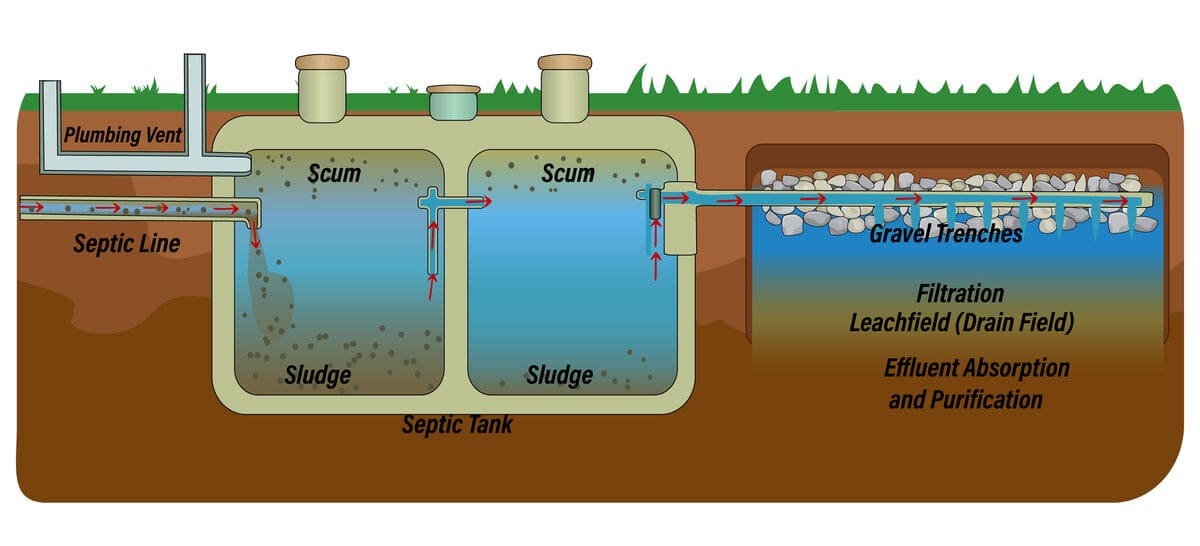
The piping from the house has to slope at the rate of at least a quarter inch per foot or more easily measured as one inch per four feet. So, if you’re going to place your septic tank at the minimum distance from the house (20 feet if your house does not have a basement and double that if it does), you can work out that the end of the pipe will need to be at least one and a quarter inches below the house connection.
That doesn’t sound like much, but here are a few additional little measurements to add to your calculations:
- You have to use the pipe level at the house as your starting point, and it will already be below the surface.
- The entry hole of the septic tank is not quite at the top of the tank, so you have to keep that additional distance from the bottom of the access hole to the top of the tank in mind when measuring up for the base of the septic tank.
- Remember to add enough depth to the base of the septic tank to accommodate the slope of the pipe.
Correctly Sizing Your Septic Tank System
You’ll have to check that the size of your septic system matches the size of the house. This is calculated by the number of bedrooms, not, as one would assume, bathrooms. This is your ‘Q’ value or the ‘Daily Flow Rate’; depending on the house’s living area.
Your local authority will be able to advise you on local regulations, but the general rule of thumb is that the septic tank’s capacity must be twice the Daily Flow Rate.
Here’s a rough guide to the ratio of bedrooms and the required volume of the septic tank:
| One Bedroom | 750 L |
| Two Bedrooms | 1100 L |
| Three Bedrooms | 1600 L |
| Four Bedrooms | 2000 L |
| Five Bedrooms | 2500 L |
You will also need to get a value for the time it takes for the wastewater to be absorbed by the soil. This is referred to as the ‘T’ factor – you can measure this yourself by timing how long it takes for the level in a water-filled hole to drop by a centimetre.
You can also send a soil sample away for analysis, but I would only do that if your time elapsed for the required drop in level is greater than thirty minutes. A quicker and possibly more efficient way to obtain your ‘T’ score is to have a professional company do a percolation test on-site.
Types of Septic Tank Kits
Some kits have square access hatches, while others have round ones. Both are fine if they are light enough to be easily lifted, so make sure there are lifting lugs on the lids. Remember, it will hopefully be a couple of years before you need to open the tank and by then dirt will have lodged itself between the lid and the tank’s body, so lifting it will not be that simple.
The other issue to consider is that the opening should be large enough to provide access to all tank areas, but it’s a compromise; the larger the lid, the heavier it is.
I always grassed over my septic tanks, but it’s not essential and leaving the top of the tank visible does have the benefit of finding it easily. It sounds silly, but in a large garden, the position of the septic tank can wander off in your memory, so make sure you can identify the tank’s position accurately. Planting a tree near the tank is possibly the worst thing to do, as the tree’s roots will creep towards the tank, and that’s something you don’t want. Keeping trees away from the tank is a good rule to follow.
Prefabricated kits come in various sizes and designs; make sure the kit you want to purchase conforms to local building regulations in terms of construction material and design.
General Arrangement of Septic Tank and Drainfield
How to Calculate the Size of your Drainfield

We went through the basic requirements to establish the septic tank size for your house, but the drain field size is equally important; this is calculated in terms of trench length. To get to the required trench length, you’ll need to multiply the ‘Q’ value we mentioned earlier when assessing the size of the septic tank and the ‘T’ value for the percolation time.
Once you have this figure, divide it by 200, giving you the total trench length required.
Calculation:
(Q x T) / 200 = Total trench length
Example:
(2000 litres x 20 minutes) / 200 = 200 metres total trench length
Perforated plastic piping is one of the most common materials to create a drain field. The piping is laid on a layer of gravel. A more compact design is the chamber drain field, a system of interconnecting chambers forming a piping network.
Both of these systems function effectively in soils that drain well, but if your area has a high water table or the soil conditions are poor for drainage, you may need to install a mound drain field system, which is effective for these areas. You’ll have a good idea of the soil condition from the percolation tests done at the start of the project.
A couple of hours spent setting out the position of the septic tank and the accompanying drain field will ensure that the project proceeds smoothly.
A wide range of kit sizes is available, and I always advise taking one size up, even if you have no plans to enlarge your house. The additional cost of a larger kit is going to be insignificant compared to the trouble and upheaval of having to replace the existing septic tank system should you decide to extend your home.
DIY Septic System Installation Video:
Want to learn how to maintain your septic system? Read our guide to septic system maintenance.


