

There is a high correlation between income and sanitation; in other words, your income is dependent on how efficient your government is at dealing with your waste. The right to sanitation is commonly regarded as a basic human right, but according to the World Health Organization, more than four billion people in the world have no efficient means of dealing with human waste.
Thoughts of what happens after we flush the loo seem to languish in the realm of items we’d rather not deal with, but the reality is that on average, each of us produces a pound of poo per day. So how do we deal with this in a sustainable and practical way?
Septic tanks have existed for centuries, and the ones I built for my own use more than 25 years ago still function perfectly. They use no energy and are remarkably efficient, but they do require a reliable water supply. However, many off-grid toilet options require no water, and here, we’ll investigate the many composting toilet options for the perfect poo solution.
What Is a Composting Toilet?
A composting toilet is a natural sewage treatment process that converts solid human waste into compost. By regulating the waste’s temperature, moisture content and oxygen level, composting toilets also provide the ideal environment for creating valuable organic compost in addition to being a vehicle for disposing of human waste.
An efficient composting toilet will foster a process that removes excess water by separating urine from solid waste and reducing the moisture content through evaporation. Separating liquid from solid waste and introducing bulking material will accelerate the breakdown of the solids and reduce the presence of odours.
The composting toilet must also provide an efficient and harmless way of disposing of the compost when the storage compartment has reached its full capacity.
How Does a Composting Toilet Work?

Get the Green Building Project Checklist
Use this handy checklist on your next project to keep track of all the ways you can make your home more energy-efficient and sustainable.

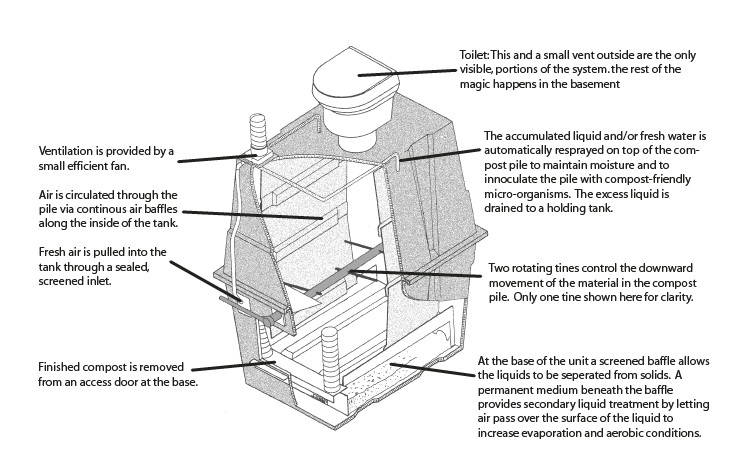
A composting toilet relies on aerobic bacteria to convert solid waste into compost. The process is dependent on specific moisture and temperature levels, as well as a compatible nitrogen-carbon balance.
While human waste is 90 percent water, composting toilets operate efficiently under moist—not wet—conditions. That means you’ll need to reduce the amount of liquid in the system by separating urine from solid waste or having an efficient evaporation system.
So do composting toilets stink? This is one of the most common questions asked about them. Fortunately, a well-managed composting toilet system will be odourless, thanks to the introduction of bulking material that promotes aeration and accelerates the decomposition of waste material. Typical bulking materials include wood chips, sawdust or peat mix.
The Design of a Composting Toilet
To ensure you can efficiently use a composting toilet off the grid, you’ll need a method of removing the treated waste and disposing of it so it becomes a safe and useful addition to your garden. Modern composting toilets have systems with two or three chambers that make the process as comfortable as possible with no smell or trace of human waste getting in the way.
A mixing feature is incorporated into the design to further accelerate the composting process and introduce additional oxygen into the chamber to feed the bacteria. The composting mixture is turned over with the turn of a handle, much like we’d turn over a compost heap from time to time.
The design of a composting toilet also incorporates a finishing or settling chamber where the dry compost is stored and ready for removal.
How Composting Toilets Operate
6 Alternatives to Standard Composting Toilets
Incinerating Toilet (Off the Grid)
Incinerating toilets burn solid waste into ash and evaporate the liquid. They come in two versions: an electrical version and one that’s powered by gas. For off-grid, the gas-powered version would typically be the first choice, unless a generous supply of electricity were available. In my experience, though, you never seem to have a surplus of electricity while living off the grid, so the gas option is preferable.
On a positive note, the gas consumption is miserly and makes for an economical selection. A 20-pound gas tank would normally be sufficient to power about 120 burns, while the ash produced by the system would need to be emptied out after about 80 burns.
One of the unusual elements of an incinerating system is that a bowl liner has to be fitted to the toilet before it’s used, regardless of the power source.
Another point to consider is that as per the Canadian Gas Code Specifications, a ventilation system has to be installed with the incinerating system.
For an in-depth comparison of composting and incinerating toilets, read Smart Sanitation: Composting Toilets vs Incinerating Toilets.
DIY Composting Toilet
If you’re handy with woodworking tools, building your own DIY composting toilet system is fairly simple. Many plans are available to guide you through the process, and your imagination will be the only limit to the degree of sophistication. There are also many ready-to-install kits available to make your project even easier.
As mentioned, human waste consists of almost 90 percent water; however, oxygen is required for the aerobic process to function effectively, so a urine diverter is a great feature to incorporate into your DIY composting toilet’s design. Not only does the separation of urine accelerate the composting rate, but it also plays a significant role in reducing odours.
Building a DIY off-grid toilet isn’t rocket science. After all, toilet systems have been around for about as long as we’ve found the smell of sewage somewhat off-putting. However, you must focus on some essential design features if you want your system to achieve unanimous approval. People have varying degrees of hygiene standards, but it’s important to realize that your family’s health will be reliant on an effective sewage disposal system.
A small tip here is to include the ladies of the family in your discussions about the design features. Not doing so may result in some serious remodelling!
Bucket Composting Toilet
This is one of the most straightforward toilet systems that can also serve as a portable composting toilet. It consists of a bucket that’s filled with about three inches of suitable organic material (such as wood chips, sawdust or coco coir matting) before it’s used.
The base of organic absorbent material absorbs urine and reduces the amount of moisture in the bucket. After every use, an inch or so of absorbent material is used to cover the poo and prevent odours.
Once the bucket is full, the contents should be disposed of in an outdoor composting bin to allow for further decomposition. The load should be covered with additional dry material, like lawn cuttings or leaves, to minimize the presence of flies and smells.
Compact Composting Toilet
A suitable composting toilet for an RV or a cabin, where space is limited, can be found in the many stand-alone units that incorporate a holding tank. These portable composting toilets are designed to separate liquid from solid waste, which helps prevent unpleasant odours.
There’s a wide range of options in this category. Some models feature electrically powered exhaust fans and agitators that circulate the compost material with the solid waste. Manual agitating models that offer a totally off-grid function are also available. Regardless of which model you choose, agitating the compost in the tank introduces additional oxygen and accelerates the composting process.
Perhaps the biggest advantage of this type of composting toilet is that it makes no demand on the RV or cabin’s water supply.
For people living in off-grid cabins, cottages or tiny homes, space isn’t the only concern. A lot of them are also looking for low maintenance options. Two of the most common they go for are incineration toilets and composting toilets. Incineration toilets reduce maintenance by burning waste down to small amounts of sterile ash that’s emptied periodically – and composting toilets that instead rely on ventilation and periodic emptying of a solids container.
For those in cabins, cottages and tiny homes, limited space is only part of the equation – ease of upkeep matters just as much. Many people exploring off grid living solutions prioritize systems that reduce water use, infrastructure needs and day-to-day maintenance. Two of the most common options are incineration toilets and composting toilets. Incineration models minimize handling by reducing waste to small amounts of sterile ash that only need to be emptied occasionally. Composting toilets, on the other hand, use ventilation and natural decomposition, requiring periodic removal of solids while avoiding the need for plumbing or septic connections.
Dry Flush Toilet
Dry flush toilets occupy less space than composting toilets, but they do require a power source. They dispose of liquid and solid waste by using a Mylar bag that’s fitted in the bowl. Once the toilet is used, the flushing mechanism twists and closes a section of the bag, making it airtight. Once a complete bag has been utilized, it may be disposed of at a landfill, much like a baby’s diapers.
Off-grid Flush Toilet With Septic Tank
One of the most common off-grid flush toilet systems is the septic tank. They use regular toilets and plumbing. The difference from municipal plumbing is that most of the sewage treatment happens on your property in a natural way. They require a constant water supply – the toilet’s contents are flushed with water that travels into a tank, which is usually built underground and consists of two chambers.
Bacteria in the first chamber break down some of the solid waste with the remaining sludge accumulating at the bottom of the tank. The liquid waste flows into the second chamber and then out to a drain field where it gets naturally filtered by the soil. A third layer of scum (composed of fat, oils and grease) rises to the top of the first chamber. In time—and we’re talking a few years here—the tank will need to pumped of the sludge and scum.
The Advantages of Composting Toilets
As an off-grid item, the composting toilet excels as an environmentally friendly feature. It uses no water and (in many instances) no electricity, and creates no harmful waste. The typical odours one associates with public toilets are absent from composting toilets.
Composting toilets are an important part of a comprehensive recycling and environmental responsibility program. They allow you to take charge of your own waste and its disposal in a responsible manner without adding to the load at the local waste treatment plant.
Another advantage of this type of system is that a composting toilet and toilet paper are a good match, as toilet paper will compost itself along with all the other materials. On the other hand, you should be careful about using wet wipes in a composting toilet, as the chemicals contained in wet wipes could negatively affect the composting process.
In a system like an off-grid composting toilet, no septic tank is required, as no water is needed to process the waste material. As alluded to above, this sort of system thrives in a moist environment that allows it to separate urine from solid waste.
The best composting toilets incorporate design features that allow for efficient aerobic action. They speedily break down waste into compost that’s easily removable in a safe and odourless fashion.
How Much Does a Composting Toilet Cost?
In Canada, composting toilets are available with a wide range of features and at many different levels of sophistication. Consequently, the cost of each unit can vary from a few hundred dollars to $2,000. Here, we’ve selected units that are regarded as the best in their class with price tags that offer excellent value.
The best-rated composting toilet in Canada is the Nature’s Head unit, which costs just over $1,000. This unit has an electric ventilation fan that requires a power source. Liquids and solids are separated, but all users must be seated during use.
The SunMar Excel composting toilet is a more expensive option that goes for $2,000. This toilet can be used in a way that’s similar to conventional toilets, and liquid and solid waste aren’t separated. A power source is required to operate the fan and the heater. If you add composting materials like wood chips, peat moss or coconut fibre, the composting rate increases with the use of the heater.
The TRELINO Evo composting toilet is the best composting toilet for off-grid use, and it’s also very easy on the pocket. Three models in this line of products cost between $350 and $550 each. These units are designed for small groups of people, and the composting doesn’t take place directly in the toilet. The toilet is suitable for a wide range of applications, including use in boats, vans and cabins.
FAQ About Composting Toilets
1. Do composting toilets smell?
The short and somewhat surprising answer is: No, a well-maintained composting toilet doesn’t smell. The emphasis is, however, on the maintenance part. The efficient separation of liquid from solid waste is essential to maintaining an odour-free system.
2. What’s a good composting toilet for a motorhome?
The composting toilet known as Separett Tiny has been designed to operate efficiently in motorhomes and RVs, as it’s self-contained and will fit into small areas. An exhaust fan, together with the separation of liquid and solid waste, ensures an odourless function. The unit sells for around $1,000.
3. Are there any items that shouldn’t be discarded in composting toilets?
Apart from toilet paper, nothing else should be deposited in a composting toilet unless you’ve eaten or drank it.
Valuing Our Environment

Dealing with our own waste is a significant part of treating our environment with value. Too easily, raw sewage is viewed as someone else’s problem and is neatly handed over to a civic body to handle on our behalf. The reality is that waterborne sewage, while being convenient, is also hugely wasteful.
The worst part of it is that it’s wasting a resource that becomes more scarce every year. Luckily, composting toilets can serve as an alternative to wasteful waterborne sewage while positively influencing the environment and contributing to the conservation of our water supply.
Images from Depositphotos; Diagram from EMSWCD


We are planning to build an additional dwelling unit in Moont hope Ontario on my daughter’s property. Would a composting toilet be allowed in that situation? Would you know who we would contact to find more about that? Thank you
If you’re handling this yourself you could speak with your municipal government to see if any planning permission is required. It varies from one municipality to another. Otherwise, contact a local plumber who specializes in these systems and they should know. You can try having a look at our directory to find someone.