
If you’re in the market for windows, you’re likely to encounter window energy performance stickers, especially on windows that have been ENERGY STAR certified.
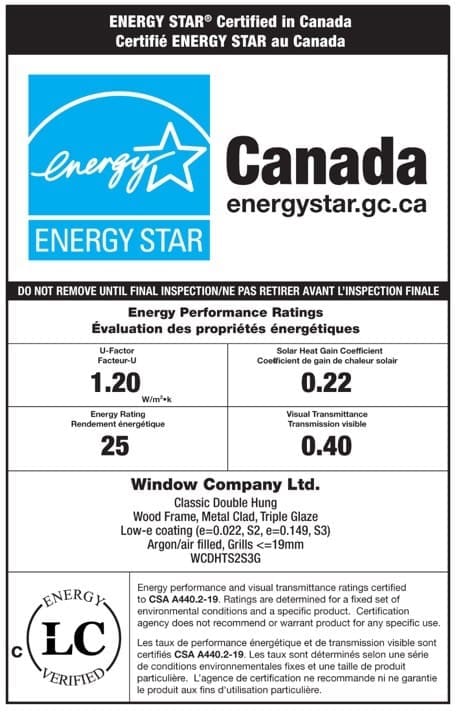
ENERGY STAR windows are actually required to display specific details regarding the window itself, its performance ratings and the certification it received. These stickers feature a lot of information that can seem a bit cryptic if you don’t know what any of the numbers or acronyms mean.
Good news, though—we’re here to help. Let’s decode some window energy performance stickers together.
What Do the Energy Performance Ratings Mean?
With energy performance ratings, there will be four (possibly five) numbers to worry about. Let’s go through each in turn.
U-Factor
U-Factor, or U-Value, is a measure of how much heat is gained or lost through the glass when the air temperature outside differs from the indoor air temperature. Essentially, this number measures how much heated or cooled air will, if you’ll excuse the pun, go out the window.

Get the Green Building Project Checklist
Use this handy checklist on your next project to keep track of all the ways you can make your home more energy-efficient and sustainable.
This is measured as a number between 0.2 and 1.2. With this metric, lower is better. A lower number means that the window is better insulated and less heat will be lost.
Solar Heat Gain Coefficient
Unlike the U-Factor, which measures how much heat passes through the glass, Solar Heat Gain Coefficient (SHGC) measures how much heat is absorbed by the glass and then released into the home. It’s represented by a number between 0 and 1.
In general, lower is considered better when it comes to SHGC. Lower numbers mean a window will transmit less heat to your home. That said, solar heat gain is less an issue in the winter than it is in the summer, when effective blocking of the sun’s heat will make life easier for your air conditioner and/or your electric fan and/or yourself.
If you live in an area with extremely cold winters and south facing windows, a higher SHGC could be a bonus, as it will passively add some warmth to your home.
Visual Transmittance
Visual Transmittance (VT) tells you how much visible light passes through a window. In general, the more panes of glass light has to travel through (3 vs. 2, for instance), the less natural light will make its way into your home and the lower the VT will be.
VT is expressed as a number from 0-1. Whether it’s better for your home to have a higher or lower number depends on a few factors. A higher VT rating means the window will be more effective at daylighting. You might find you have to sacrifice some efficiency to get that higher rating, however, as the most efficient windows often come with lower VT.
If you have south or west-facing windows and work from home, you might easily be able to take a hit on window efficiency (in terms of energy consumption) and make up that hit with lower lighting costs. This is one area where you’ll need to think about the specifics of your home to find the right balance.
Energy Rating
The Energy Rating (ER) is a metric of a window’s overall performance. This rating is based on a calculation that takes U-Factor, SHGC and air leakage into consideration. You can think of it as a kind of shorthand that can make it simpler to compare and contrast different windows.
ER is represented as a number between 0 and 50. With this number, higher is better. A higher number indicates a more efficient window.
Air Leakage
The possible fifth number on a label is Air Leakage. Air Leakage, as you might expect, is a measure of how much air can pass through the window.
This is optional data to give consumers, and not every label will include it. Those that do will tell you how many cubic feet of air can pass through a square foot of the window’s area (cfm/sq. ft. It’s also likely to be given in metric, too).
The lower the number, the better here. A low rating means that the window, as a product, is more air tight. How airtight the window actually is when it’s set into your wall will depend on it being installed properly. This number assumes that it will be.
What Can You Tell from the Manufacturing Information?
The label will include information about the window’s manufacturer and details about the product. This will help you if the previous owners installed the windows and you otherwise wouldn’t know who made them.
This is valuable information to have if any issues arise with the window. It’s also good to know if you’re renovating and want to install a matching window or if you need a replacement part.
The product description is likewise valuable to have. If you’re not an expert, it can be difficult to look at a window and discern technical information about it.
The product description will tell you what your window frame is made of and what the cavities between the panes have been filled with (air, argon or krypton, for example).
It will also say whether the window is double or triple glazed, as well as whether it’s had any coatings, such as a low-e coating, applied.
What Does the Certification Information Mean?
In Canada, there are 6 accredited bodies that certify windows. Those bodies are: CSA International (CSA), Intertek Testing Services (ITS), Labtest Certifications, Quality Auditing Institute Ltd. (QAI), The National Fenestration Rating Council (NFRC) and Keystone Certifications, Inc. Depending on which one certified your windows, your label will look different.
NFRC labels will include Air Leakage but not an Energy Rating, for example. Some certifying bodies include a map to indicate which climate zones a window is certified in.
For most of us, understanding who certified the window will be getting into the weeds a bit. It is helpful, however, to know that even though the stickers might look different, as long as a window is certified through one of those bodies, it’s legit.
We hope this has helped demystify window energy performance stickers. After all, the more you know about the technical capabilities of your windows, the better purchasing and maintenance decisions you can make.
Feature image: Mark Fletcher-Brown; Image 1: Waldemar Brandt


Hello,
I appreciate to be on your mailing list for learning about tech issues related to green building.But I would appreciate more to being informed about training opportunities and certification program mastered by green building Canada.Do you have please an event section that showcase this kind of information .
Regards.
Hi Ronald,
We don’t have training opportunities or certification programs ourselves, but you can check out our post on certification programs in Canada for more information on the organizations that do: https://greenbuildingcanada.ca/green-building-guide/green-building-certifications-rating-systems-canada/
Thanks for your request!
Green Building Canada